QUESTION IMAGE
Question
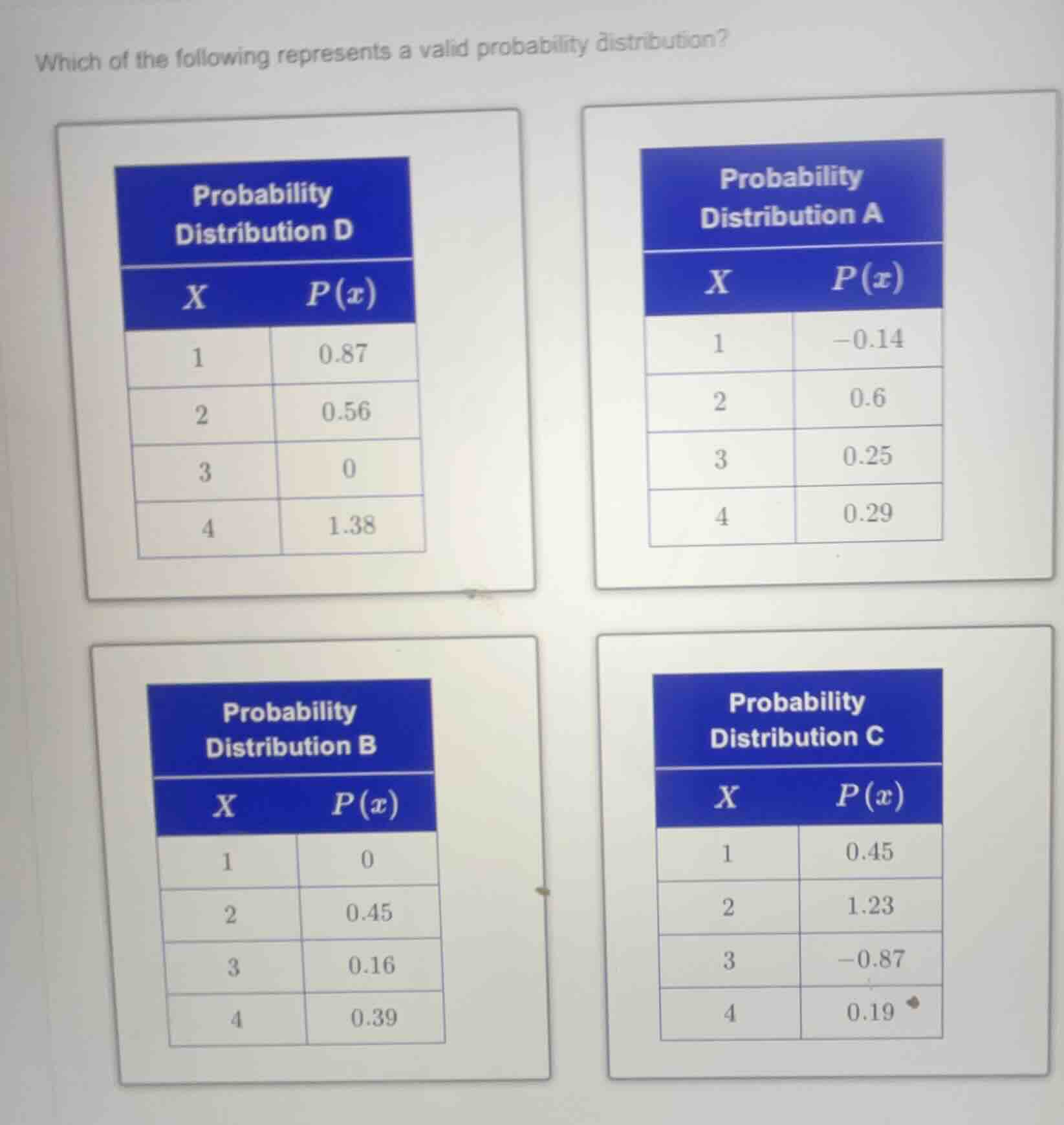
which of the following represents a valid probability distribution?
probability distribution d:
| x | p(x) |
|---|---|
| 2 | 0.56 |
| 3 | 0 |
| 4 | 1.38 |
probability distribution a:
| x | p(x) |
|---|---|
| 2 | 0.6 |
| 3 | 0.25 |
| 4 | 0.29 |
probability distribution b:
| x | p(x) |
|---|---|
| 2 | 0.45 |
| 3 | 0.16 |
| 4 | 0.39 |
probability distribution c:
| x | p(x) |
|---|---|
| 2 | 1.23 |
| 3 | -0.87 |
| 4 | 0.19 |
To determine a valid probability distribution, we use two rules:
- Each probability \( P(x) \) must satisfy \( 0 \leq P(x) \leq 1 \).
- The sum of all probabilities must equal \( 1 \).
Step 1: Check Probability Distribution A
- For \( x = 1 \), \( P(1) = -0.14 \), which is less than \( 0 \). So, it violates the first rule.
Step 2: Check Probability Distribution B
- For \( x = 1 \), \( P(1) = 0 \); \( x = 2 \), \( P(2) = 0.45 \); \( x = 3 \), \( P(3) = 0.16 \); \( x = 4 \), \( P(4) = 0.39 \).
- Check individual probabilities: All \( P(x) \) values are between \( 0 \) and \( 1 \).
- Sum the probabilities: \( 0 + 0.45 + 0.16 + 0.39 = 1 \). It satisfies both rules.
Step 3: Check Probability Distribution C
- For \( x = 2 \), \( P(2) = 1.23 \) (greater than \( 1 \)) and \( x = 3 \), \( P(3) = -0.87 \) (less than \( 0 \)). Violates the first rule.
Step 4: Check Probability Distribution D
- Sum the probabilities: \( 0.87 + 0.56 + 0 + 1.38 = 2.81 \), which is not equal to \( 1 \). Also, \( P(4) = 1.38 > 1 \). Violates both rules.

Snap & solve any problem in the app
Get step-by-step solutions on Sovi AI
Photo-based solutions with guided steps
Explore more problems and detailed explanations
Probability Distribution B (where \( X \) has \( P(x) \) values \( 0 \) (for \( x = 1 \)), \( 0.45 \) (for \( x = 2 \)), \( 0.16 \) (for \( x = 3 \)), and \( 0.39 \) (for \( x = 4 \))) is the valid probability distribution.