QUESTION IMAGE
Question
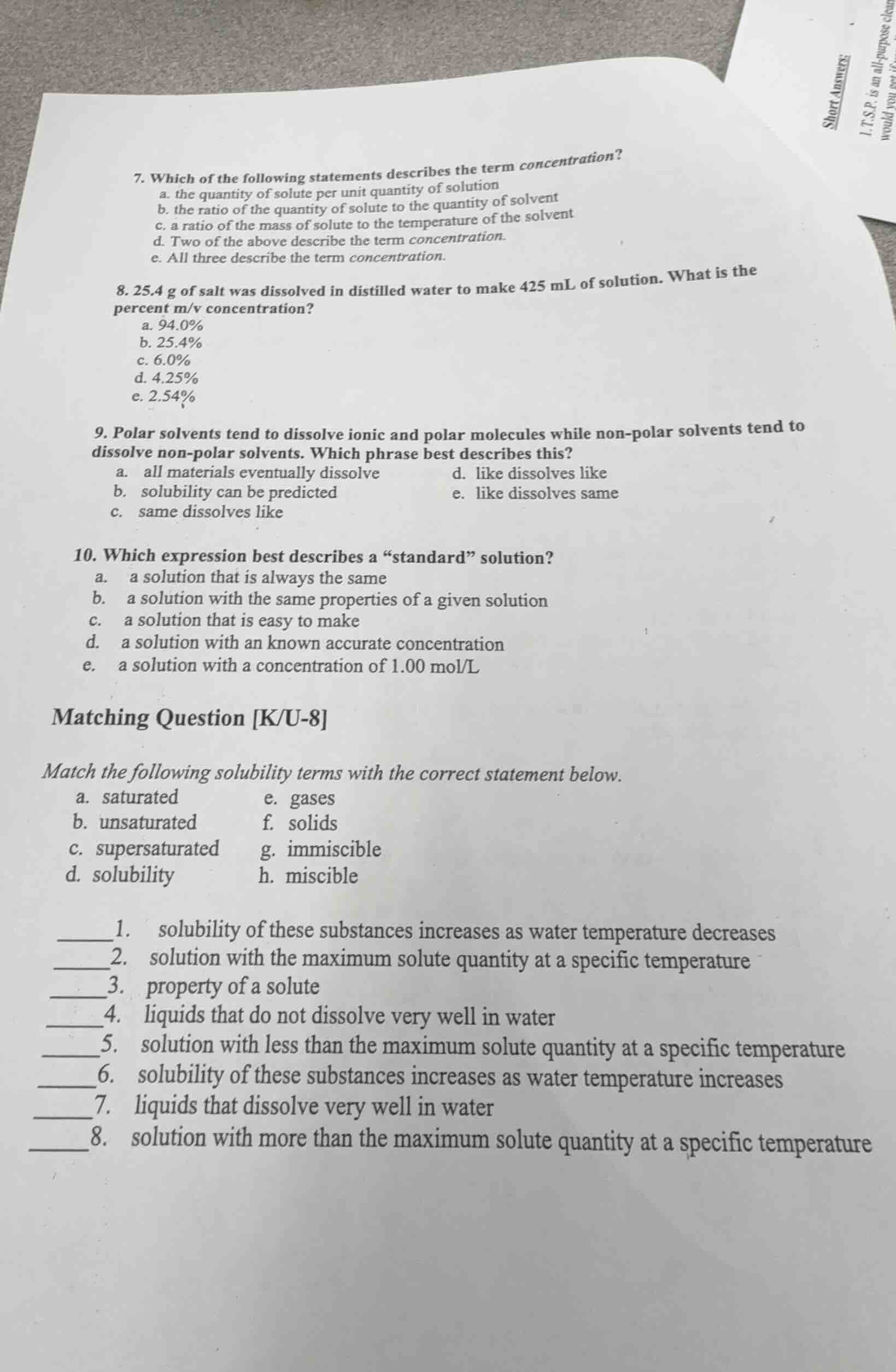
- which of the following statements describes the term concentration?
a. the quantity of solute per unit quantity of solution
b. the ratio of the quantity of solute to the quantity of solvent
c. a ratio of the mass of solute to the temperature of the solvent
d. two of the above describe the term concentration.
e. all three describe the term concentration.
- 25.4 g of salt was dissolved in distilled water to make 425 ml of solution. what is the percent m/v concentration?
a. 94.0%
b. 25.4%
c. 6.0%
d. 4.25%
e. 2.54%
- polar solvents tend to dissolve ionic and polar molecules while non - polar solvents tend to dissolve non - polar solvents. which phrase best describes this?
a. all materials eventually dissolve
d. like dissolves like
b. solubility can be predicted
e. like dissolves same
c. same dissolves like
- which expression best describes a “standard” solution?
a. a solution that is always the same
b. a solution with the same properties of a given solution
c. a solution that is easy to make
d. a solution with an known accurate concentration
e. a solution with a concentration of 1.00 mol/l
matching question k/u - 8
match the following solubility terms with the correct statement below.
a. saturated
e. gases
b. unsaturated
f. solids
c. supersaturated
g. immiscible
d. solubility
h. miscible
______1. solubility of these substances increases as water temperature decreases
______2. solution with the maximum solute quantity at a specific temperature
______3. property of a solute
______4. liquids that do not dissolve very well in water
______5. solution with less than the maximum solute quantity at a specific temperature
______6. solubility of these substances increases as water temperature increases
______7. liquids that dissolve very well in water
______8. solution with more than the maximum solute quantity at a specific temperature
Question 7
- Option a: Concentration can be defined as the quantity of solute per unit quantity of solution (e.g., molarity, mass/volume percent).
- Option b: The ratio of solute to solvent quantity (e.g., molality, mass/mass percent) is also a measure of concentration.
- Option c: Temperature is not part of concentration definitions, so c is incorrect.
- Since a and b are correct, "Two of the above" (d) is the answer.
Step1: Recall the formula for percent m/v concentration.
The formula for percent mass/volume ($\% \text{m/v}$) is $\% \text{m/v} = \frac{\text{mass of solute (g)}}{\text{volume of solution (mL)}} \times 100\%$.
Step2: Substitute the given values.
Given mass of solute = $25.4\ \text{g}$, volume of solution = $425\ \text{mL}$.
Substitute into the formula: $\% \text{m/v} = \frac{25.4}{425} \times 100\%$.
Step3: Calculate the value.
First, calculate $\frac{25.4}{425} \approx 0.06$, then multiply by 100%: $0.06 \times 100\% = 6.0\%$.
The principle that polar solvents dissolve polar/ionic solutes and non - polar solvents dissolve non - polar solutes is known as "like dissolves like". Option a is incorrect as not all materials dissolve. Option b is too vague. Options c and e have incorrect phrasing. So the correct phrase is "like dissolves like" (d).

Snap & solve any problem in the app
Get step-by-step solutions on Sovi AI
Photo-based solutions with guided steps
Explore more problems and detailed explanations
d. Two of the above describe the term concentration.