QUESTION IMAGE
Question
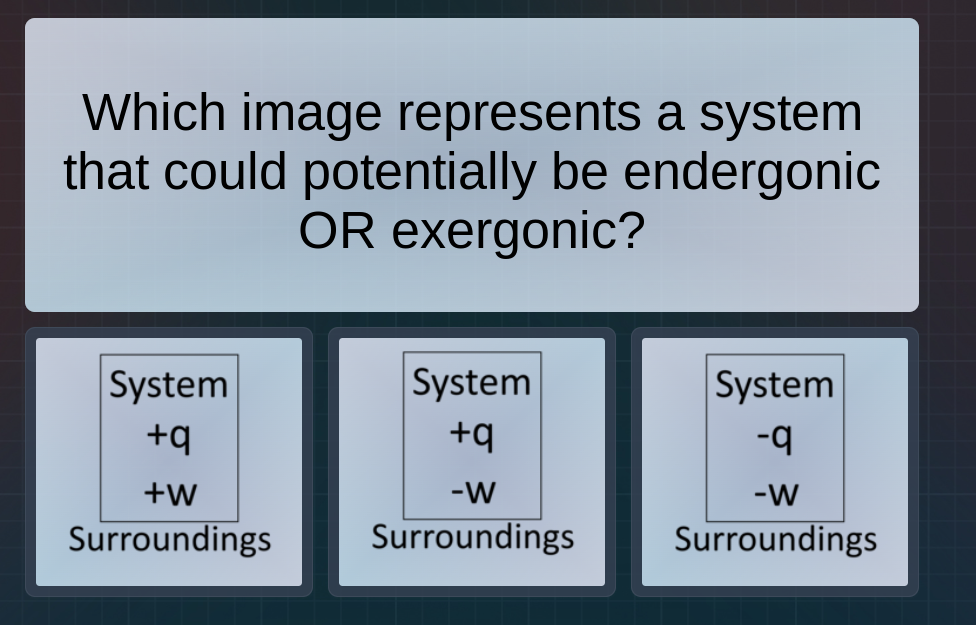
which image represents a system that could potentially be endergonic or exergonic? system +q +w surroundings system +q -w surroundings system -q -w surroundings
To determine if a system is endergonic (ΔG > 0, non - spontaneous, energy - absorbing) or exergonic (ΔG < 0, spontaneous, energy - releasing), we can use the first law of thermodynamics ΔU=q + w (where ΔU is the change in internal energy, q is heat, and w is work). But for the possibility of being either endergonic or exergonic, we need to consider the net energy change.
Step 1: Analyze the first image (System: +q, +w)
If the system gains heat (\(+q\)) and gains work (\(+w\)), the internal energy change \(\Delta U=q + w\) will be positive. This system is more likely to be endergonic as it is taking in energy, and it is less likely to be exergonic.
Step 2: Analyze the second image (System: +q, -w)
Here, the system gains heat (\(+q\)) but loses work (\(-w\)). The net energy change \(\Delta U = q+(-w)=q - w\). The value of \(q\) and \(w\) can vary. If \(q>w\), the system can be endergonic (if the overall energy change for a reaction (related to Gibbs free energy) is positive) or if \(q < w\), it can be exergonic (if the overall energy change for a reaction is negative). So this system has the potential to be either endergonic or exergonic.
Step 3: Analyze the third image (System: -q, -w)
The system loses heat (\(-q\)) and loses work (\(-w\)). The internal energy change \(\Delta U=-q - w\) which is negative. This system is more likely to be exergonic as it is releasing energy, and it is less likely to be endergonic.

Snap & solve any problem in the app
Get step-by-step solutions on Sovi AI
Photo-based solutions with guided steps
Explore more problems and detailed explanations
The second image (System: +q, -w) represents a system that could potentially be endergonic or exergonic.