QUESTION IMAGE
Question
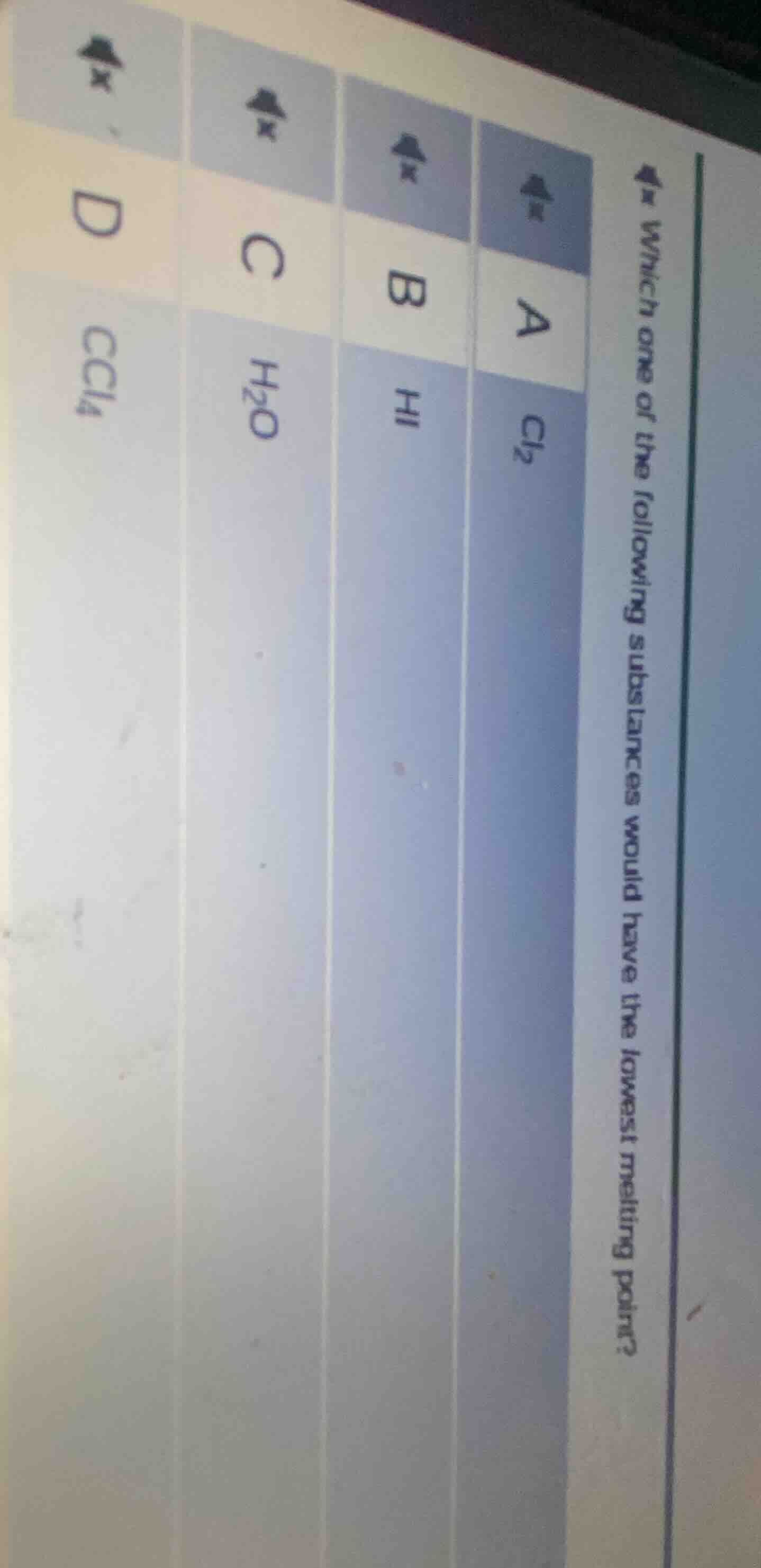
which one of the following substances would have the lowest melting point? a \ce{cl2} b \ce{hi} c \ce{h2o} d \ce{ccl4}
Step1: Analyze the types of substances
- \( \text{Cl}_2 \) (A) is a non - polar diatomic molecule with only London dispersion forces.
- \( \text{HI} \) (B) is a polar molecule (due to the electronegativity difference between H and I), so it has dipole - dipole interactions and London dispersion forces.
- \( \text{H}_2\text{O} \) (C) is a polar molecule and can form hydrogen bonds (in addition to dipole - dipole and London dispersion forces). Hydrogen bonds are relatively strong intermolecular forces.
- \( \text{CCl}_4 \) (D) is a non - polar molecule (tetrahedral symmetry) with London dispersion forces.
Step2: Relate intermolecular forces to melting point
The strength of intermolecular forces is related to the melting point. The stronger the intermolecular forces, the higher the melting point.
- London dispersion forces depend on the molar mass (for similar types of molecules). The molar mass of \( \text{Cl}_2 \) is \( M(\text{Cl}_2)=2\times35.5 = 71\space g/mol \), the molar mass of \( \text{CCl}_4 \) is \( M(\text{CCl}_4)=12 + 4\times35.5=154\space g/mol \). Since \( \text{Cl}_2 \) has a smaller molar mass than \( \text{CCl}_4 \), the London dispersion forces in \( \text{Cl}_2 \) are weaker than in \( \text{CCl}_4 \).
- Dipole - dipole interactions (in HI) and hydrogen bonds (in \( \text{H}_2\text{O} \)) are stronger than the London dispersion forces in \( \text{Cl}_2 \) (because dipole - dipole and hydrogen bonds involve more significant electrostatic attractions than the instantaneous dipole - induced dipole interactions in non - polar molecules with small molar masses).
So, \( \text{Cl}_2 \) has the weakest intermolecular forces among the given substances, and thus the lowest melting point.

Snap & solve any problem in the app
Get step-by-step solutions on Sovi AI
Photo-based solutions with guided steps
Explore more problems and detailed explanations
A. \( \text{Cl}_2 \)