QUESTION IMAGE
Question
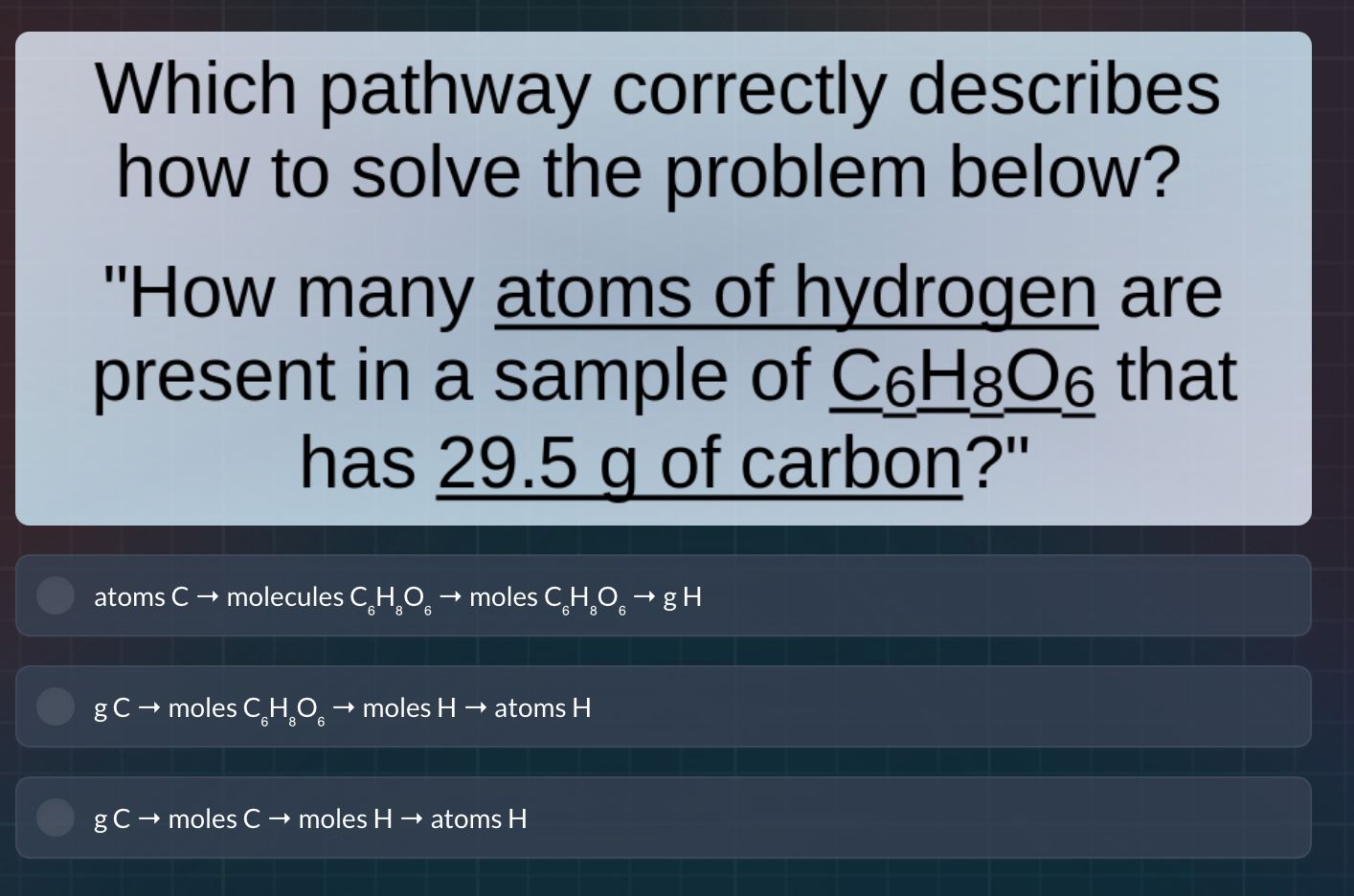
which pathway correctly describes how to solve the problem below? \how many atoms of hydrogen are present in a sample of c₆h₈o₆ that has 29.5 g of carbon?\ atoms c → molecules c₆h₈o₆ → moles c₆h₈o₆ → g h g c → moles c₆h₈o₆ → moles h → atoms h g c → moles c → moles h → atoms h
Brief Explanations
- First, we start with the mass of carbon (g C). We need to convert grams of carbon to moles of carbon using the molar mass of carbon. Then, using the mole ratio from the formula \( C_6H_8O_6 \) (6 moles of C per 1 mole of \( C_6H_8O_6 \)), we find moles of \( C_6H_8O_6 \). Next, using the mole ratio of H to \( C_6H_8O_6 \) (8 moles of H per 1 mole of \( C_6H_8O_6 \)), we find moles of H. Finally, we convert moles of H to atoms of H using Avogadro's number.
- Analyzing the options:
- The first option has incorrect steps (starts with atoms C, ends with g H which is not what we need).
- The second option: "g C → moles \( C_6H_8O_6 \) → moles H → atoms H" is incorrect because we first need to find moles of C from g C, then relate to moles of \( C_6H_8O_6 \). Wait, no, actually, the correct approach is: g C → moles C (using molar mass of C) → moles \( C_6H_8O_6 \) (using 6 moles C per 1 mole \( C_6H_8O_6 \)) → moles H (using 8 moles H per 1 mole \( C_6H_8O_6 \)) → atoms H. But looking at the options, the third option is "g C → moles C → moles H → atoms H". Wait, let's re - evaluate.
- The formula is \( C_6H_8O_6 \), so 6 moles of C are in 1 mole of \( C_6H_8O_6 \), and 8 moles of H are in 1 mole of \( C_6H_8O_6 \). So from g C, we calculate moles of C (\( n = \frac{m}{M} \), where \( m \) is mass of C, \( M \) is molar mass of C). Then, moles of \( C_6H_8O_6=\frac{\text{moles of C}}{6} \). Then moles of H = moles of \( C_6H_8O_6\times8 \). Then atoms of H = moles of H × Avogadro's number. But the third option is "g C → moles C → moles H → atoms H". Wait, maybe there is a simpler way to think about the mole ratios. Since in \( C_6H_8O_6 \), the ratio of C to H is 6:8 or 3:4. So moles of H=\( \frac{8}{6}\times \) moles of C. So starting with g C, convert to moles C, then use the mole ratio to get moles H, then convert to atoms H. So the third option "g C → moles C → moles H → atoms H" is correct. The second option incorrectly skips the step of converting g C to moles C and directly goes to moles of the compound.

Snap & solve any problem in the app
Get step-by-step solutions on Sovi AI
Photo-based solutions with guided steps
Explore more problems and detailed explanations
C. g C → moles C → moles H → atoms H