QUESTION IMAGE
Question
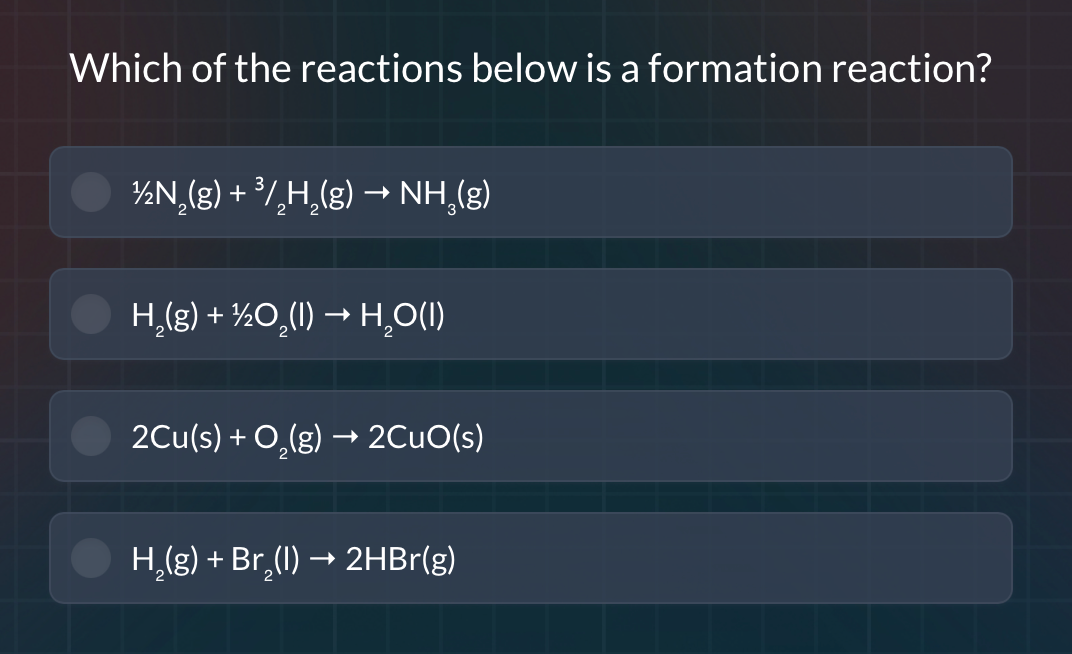
which of the reactions below is a formation reaction?
½n₂(g) + ³⁄₂h₂(g) → nh₃(g)
h₂(g) + ½o₂(l) → h₂o(l)
2cu(s) + o₂(g) → 2cuo(s)
h₂(g) + br₂(l) → 2hbr(g)
A formation reaction is defined as a reaction where 1 mole of a compound is formed from its constituent elements in their standard states.
- For the first reaction: $\frac{1}{2}\text{N}_2(\text{g}) + \frac{3}{2}\text{H}_2(\text{g})
ightarrow \text{NH}_3(\text{g})$. Nitrogen ($\text{N}_2$) and hydrogen ($\text{H}_2$) are in their standard states (gaseous diatomic molecules), and 1 mole of $\text{NH}_3$ is formed.
- Second reaction: $\text{O}_2$ is a gas in standard state, not liquid, so this is incorrect.
- Third reaction: It forms 2 moles of $\text{CuO}$, but formation reaction should form 1 mole of the compound, so incorrect.
- Fourth reaction: It forms 2 moles of $\text{HBr}$, but formation reaction should form 1 mole of the compound, so incorrect.
So the correct reaction is the first one.

Snap & solve any problem in the app
Get step-by-step solutions on Sovi AI
Photo-based solutions with guided steps
Explore more problems and detailed explanations
$\boldsymbol{\frac{1}{2}\text{N}_2(\text{g}) + \frac{3}{2}\text{H}_2(\text{g})
ightarrow \text{NH}_3(\text{g})}$ (the first option)