QUESTION IMAGE
Question
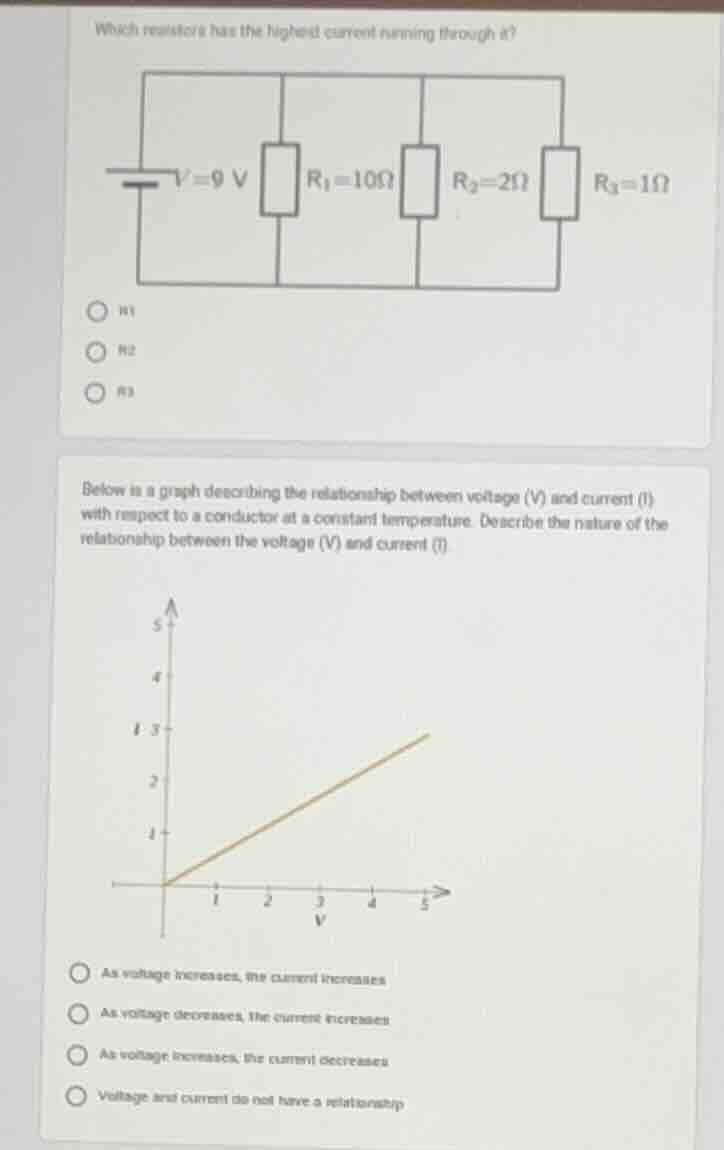
which resistors has the highest current running through it?
$v=9\\ \text{v}$
$r_1=10\omega$
$r_2=2\omega$
$r_3=1\omega$
$r_1$
$r_2$
$r_3$
below is a graph describing the relationship between voltage (v) and current (i) with respect to a conductor at a constant temperature. describe the nature of the relationship between the voltage (v) and current (i)
as voltage increases, the current increases
as voltage decreases, the current increases
as voltage increases, the current decreases
voltage and current do not have a relationship
---
First Question
Step1: Recall Ohm's Law for current
For a resistor in parallel, voltage $V$ is equal across all resistors. The current through a resistor is given by $I=\frac{V}{R}$.
Step2: Calculate current for $R_1$
Substitute $V=9\ \text{V}$, $R_1=10\ \Omega$
$I_1=\frac{9}{10}=0.9\ \text{A}$
Step3: Calculate current for $R_2$
Substitute $V=9\ \text{V}$, $R_2=2\ \Omega$
$I_2=\frac{9}{2}=4.5\ \text{A}$
Step4: Calculate current for $R_3$
Substitute $V=9\ \text{V}$, $R_3=1\ \Omega$
$I_3=\frac{9}{1}=9\ \text{A}$
Step5: Compare the three currents
$I_3 > I_2 > I_1$
The graph shows a straight, positive-sloped line passing through the origin, meaning current (I) rises proportionally as voltage (V) increases, which aligns with Ohm's Law for an ohmic conductor at constant temperature.

Snap & solve any problem in the app
Get step-by-step solutions on Sovi AI
Photo-based solutions with guided steps
Explore more problems and detailed explanations
R3
---