QUESTION IMAGE
Question
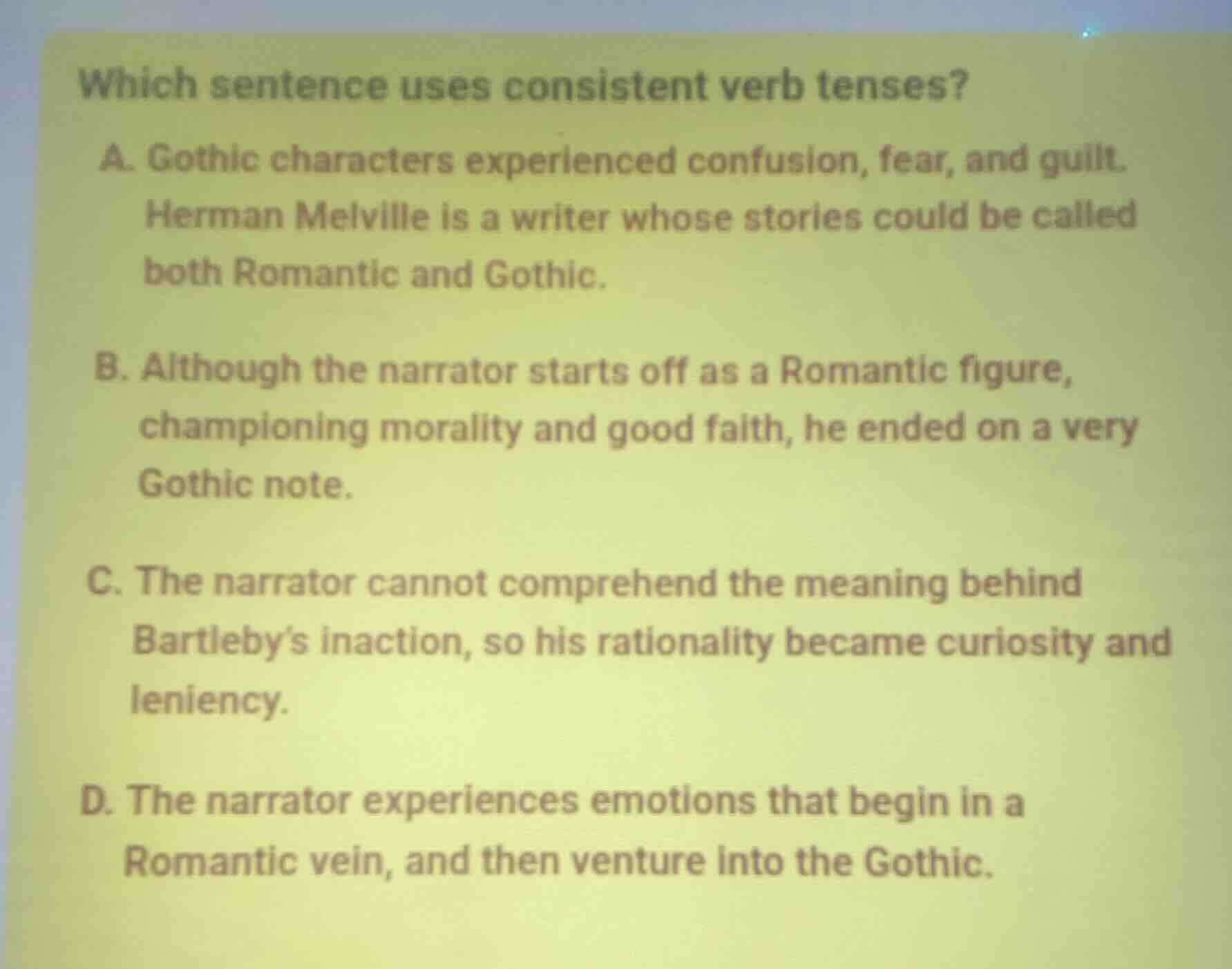
which sentence uses consistent verb tenses?
a. gothic characters experienced confusion, fear, and guilt. herman melville is a writer whose stories could be called both romantic and gothic.
b. although the narrator starts off as a romantic figure, championing morality and good faith, he ended on a very gothic note.
c. the narrator cannot comprehend the meaning behind bartleby’s inaction, so his rationality became curiosity and leniency.
d. the narrator experiences emotions that begin in a romantic vein, and then venture into the gothic.
To determine which sentence has consistent verb tenses, we analyze each option:
- Option A: "experienced" (past) and "is" (present), "could be called" (modal, timeless context). The present tense for Herman Melville's status and modal for his stories' classification, along with past for characters' experience, has mixed tenses but the present for a fact (Melville's identity) and modal (timeless) are acceptable? Wait, no—wait, let's recheck. Wait, no, actually, in A: "Gothic characters experienced..." (past), "Herman Melville is..." (present), "could be called" (modal, which is timeless). But the main verbs: "experienced" (past) and "is" (present) and "could be" (modal). Wait, maybe I made a mistake. Let's check D: "experiences" (present), "begin" (present), "venture" (present). All present tense.
- Option B: "starts" (present) and "ended" (past) – inconsistent.
- Option C: "cannot comprehend" (present) and "became" (past) – inconsistent.
- Option D: "experiences" (present), "begin" (present), "venture" (present) – all present tense, consistent. Wait, wait, earlier analysis of A was wrong. Wait, A: "Gothic characters experienced..." (past), "Herman Melville is..." (present), "could be called" (modal). The tenses here: past for characters' experience, present for Melville's identity (a fact, so present is okay), and modal (timeless). But D: all present. Wait, let's re - examine each option:
Option A:
- First sentence: "experienced" (past simple).
- Second sentence: "is" (present simple, stating a fact about Herman Melville, which is valid), "could be called" (modal verb + past participle, used to express possibility in a timeless or general sense). The past simple in the first sentence and present simple in the second are different tenses, so there is a shift.
Option B:
- "starts" (present simple) and "ended" (past simple) – clear tense shift.
Option C:
- "cannot comprehend" (present simple) and "became" (past simple) – tense shift.
Option D:
- "experiences" (present simple), "begin" (present simple), "venture" (present simple) – all verbs are in the present simple tense, so the verb tenses are consistent.

Snap & solve any problem in the app
Get step-by-step solutions on Sovi AI
Photo-based solutions with guided steps
Explore more problems and detailed explanations
D. The narrator experiences emotions that begin in a Romantic vein, and then venture into the Gothic.