QUESTION IMAGE
Question
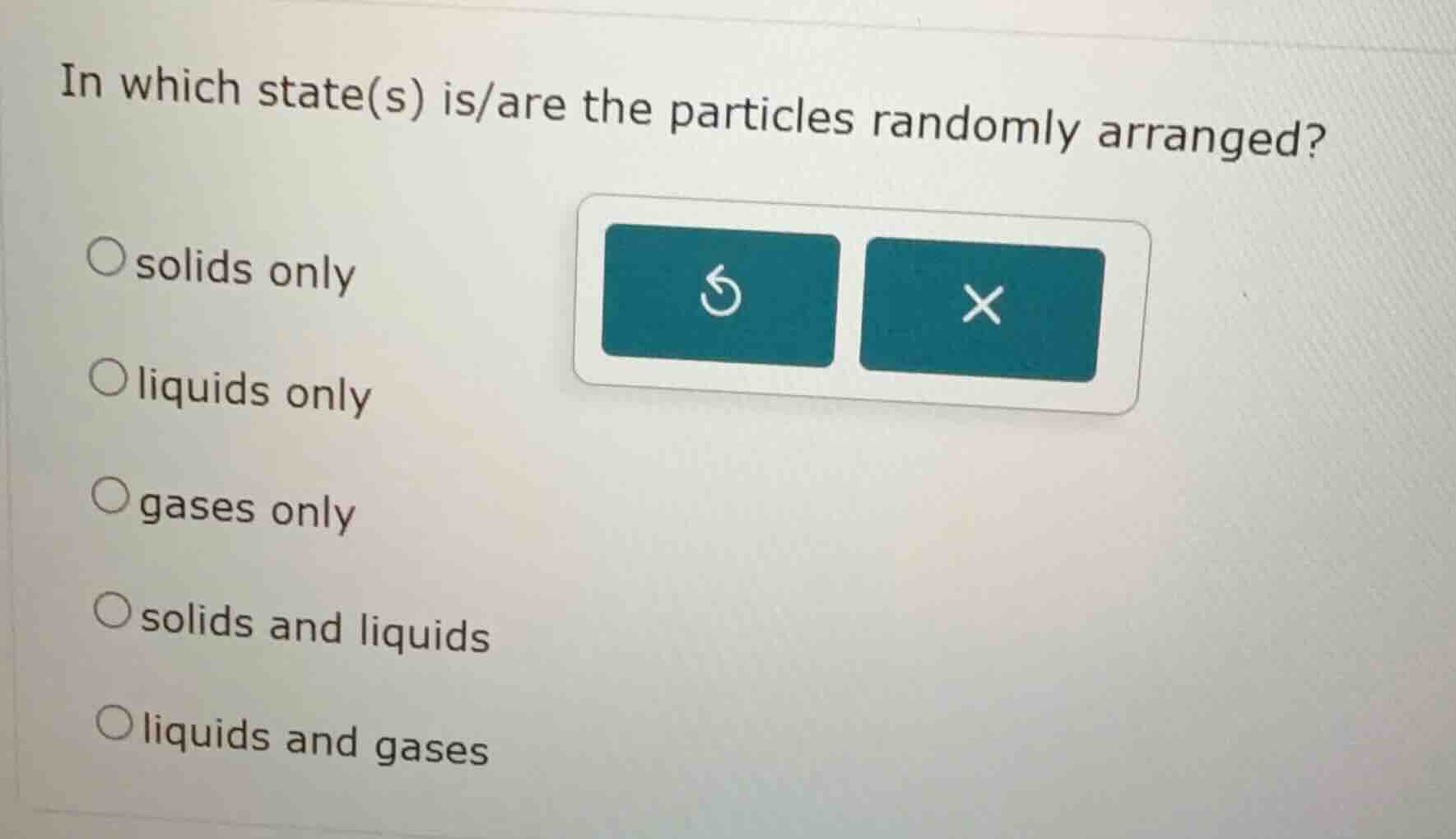
in which state(s) is/are the particles randomly arranged?
solids only
liquids only
gases only
solids and liquids
liquids and gases
Brief Explanations
To determine the state with randomly arranged particles, we analyze each state:
- Solids: Particles are closely packed in a regular, ordered lattice structure.
- Liquids: Particles are close together but can move past each other, with a random arrangement (no fixed lattice like solids).
- Gases: Particles are far apart and move freely in random directions, with a random arrangement. Wait, no—wait, liquids and gases: Wait, no, let's correct. Wait, solids have ordered arrangement. Liquids: particles are not in a fixed lattice, so random arrangement (but close). Gases: particles are far apart, random. But wait, the options: "liquids and gases"? Wait no, the options are: solids only (no, ordered), liquids only (no, gases also), gases only (no, liquids too?), wait no—wait, the correct answer is liquids and gases? Wait no, wait: Solids have a regular, ordered arrangement. Liquids: particles are in a random arrangement (not fixed like solids). Gases: particles are randomly arranged (far apart, moving freely). Wait, but the option "liquids and gases" is there? Wait no, the options are: solids only, liquids only, gases only, solids and liquids, liquids and gases. Wait, let's recall: In solids, particles are arranged in a regular, repeating pattern (crystalline or amorphous, but amorphous still has some order, but generally, solids have ordered arrangement). Liquids: particles are close together but can move, and their arrangement is random (no fixed lattice). Gases: particles are far apart, move freely, and are randomly arranged. So both liquids and gases have randomly arranged particles? Wait, but maybe the question considers that solids have ordered, liquids and gases have random. Wait, but let's check the options. The option "liquids and gases" is present. Wait, but maybe I made a mistake. Wait, no—wait, in liquids, the particles are not in a fixed, ordered structure (unlike solids), so they are randomly arranged (but close). In gases, particles are far apart, randomly arranged. Solids: ordered. So the correct answer is liquids and gases? Wait, but let's check the options. The options are:
- solids only: No, solids are ordered.
- liquids only: No, gases also.
- gases only: No, liquids too.
- solids and liquids: No, solids are ordered.
- liquids and gases: Yes, because both liquids (particles not in fixed order) and gases (particles far apart, random) have random arrangements. Wait, but maybe the question's intended answer is liquids and gases? Wait, no—wait, maybe I confused. Wait, let's check again. The key is: Solids have a definite shape and volume because particles are closely packed in an ordered arrangement. Liquids have definite volume but indefinite shape, with particles in a random arrangement (not fixed like solids). Gases have indefinite volume and shape, with particles randomly arranged (far apart). So both liquids and gases have randomly arranged particles. So the correct option is "liquids and gases". Wait, but let's confirm. So the answer is the option "liquids and gases".
Wait, but maybe the question's intended answer is liquids and gases? Let's check the options. So the correct answer is the option "liquids and gases" (the last option: "liquids and gases").

Snap & solve any problem in the app
Get step-by-step solutions on Sovi AI
Photo-based solutions with guided steps
Explore more problems and detailed explanations
E. liquids and gases