QUESTION IMAGE
Question
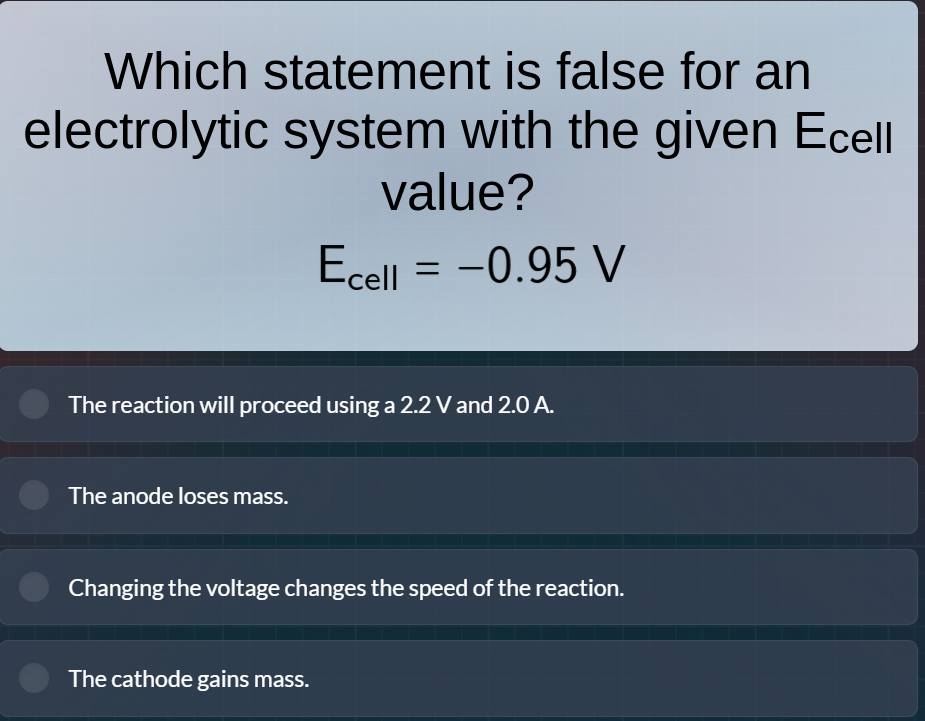
which statement is false for an electrolytic system with the given $e_{cell}$ value?
$e_{cell} = -0.95$ v
the reaction will proceed using a 2.2 v and 2.0 a.
the anode loses mass.
changing the voltage changes the speed of the reaction.
the cathode gains mass.
- For an electrolytic cell with \( E_{\text{cell}} = - 0.95\space V\):
- An electrolytic cell requires an external voltage (overpotential) greater than the magnitude of \(|E_{\text{cell}}|\) to drive the non - spontaneous reaction. A 2.2 V external voltage (greater than 0.95 V) can provide the necessary energy for the reaction to proceed, and current (2.0 A) is related to the rate of charge transfer, so the reaction can proceed with 2.2 V and 2.0 A.
- In an electrolytic cell, oxidation occurs at the anode. If the anode is an active electrode (e.g., a metal being oxidized), the anode will lose mass as the metal atoms are oxidized to ions and go into solution.
- The speed of an electrolytic reaction (rate of electron transfer, which is related to the amount of product formed per unit time) is related to the current, and current is related to voltage (by Ohm's law \(I=\frac{V}{R}\), for a given resistance, changing voltage changes current). So changing the voltage (which changes the current) changes the speed of the reaction.
- In an electrolytic cell, the cathode is where reduction occurs. If the species being reduced is a metal ion (e.g., \(Cu^{2 + }\) being reduced to \(Cu\)), the cathode will gain mass as metal is deposited. However, if the electrolyte does not contain metal ions that can be reduced to form a solid (e.g., reduction of water or other non - metallic species), the cathode may not gain mass. But in a typical electrolytic cell with metal electrodes and metal - ion electrolytes, the cathode gains mass. But let's re - evaluate: Wait, no, in an electrolytic cell with \(E_{\text{cell}}<0\), the reaction is non - spontaneous. But the key here is that the statement "The cathode gains mass" is not always true. Wait, no, let's correct. Wait, no, in an electrolytic cell, the cathode is the site of reduction. If the substance being reduced is a metal ion, then the cathode gains mass. But if the reduction is of a non - metal species (like \(H_2O\) being reduced to \(H_2\) or \(O_2\) being reduced, or \(Cl^-\) being oxidized at anode and \(H_2O\) being reduced at cathode), the cathode may not gain mass. But the other statements:
- The first statement: Since \(|E_{\text{cell}}| = 0.95\space V\), an external voltage of 2.2 V (greater than 0.95 V) can drive the reaction, and current (2.0 A) is about the rate of charge flow, so the reaction can proceed.
- The second statement: Anode is the site of oxidation. If the anode is a metal (active electrode), it will lose mass (e.g., \(Cu\) anode: \(Cu
ightarrow Cu^{2 + }+2e^-\)).
- The third statement: Voltage (related to current) affects the rate of reaction (more voltage, more current, more rate of electron transfer, hence faster reaction).
- The fourth statement: "The cathode gains mass" is not always true. But wait, no, in the context of a typical electrolytic cell with metal deposition, but if the electrolyte is, say, \(HCl\) and we are electrolyzing it, at the cathode \(2H^++2e^-
ightarrow H_2\) (gas, no mass gain), at the anode \(2Cl^-
ightarrow Cl_2 + 2e^-\). But in the case of the other statements, the only statement that is false is "The cathode gains mass" is incorrect? Wait, no, let's re - analyze. Wait, no, the false statement is "The cathode gains mass" is not always true, but among the options, the statement "The cathode gains mass" is false. Wait, no, let's check again. Wait, in an electrolytic cell, the reaction is forced. The anode is oxidation (loss of electrons), cathode is reduction (gain of electrons). If the cathode reaction is reduct…

Snap & solve any problem in the app
Get step-by-step solutions on Sovi AI
Photo-based solutions with guided steps
Explore more problems and detailed explanations
The false statement is: The cathode gains mass.