QUESTION IMAGE
Question
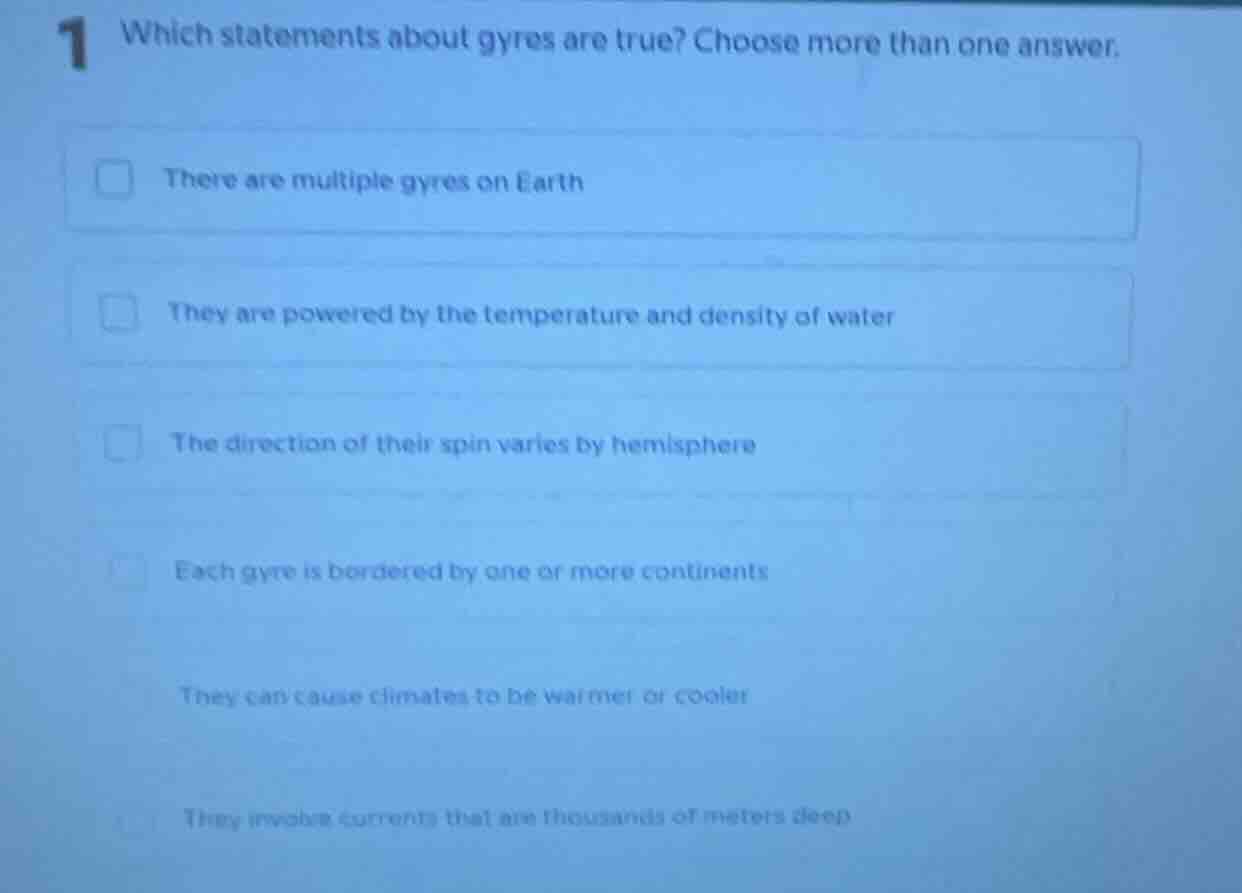
1 which statements about gyres are true? choose more than one answer. there are multiple gyres on earth they are powered by the temperature and density of water the direction of their spin varies by hemisphere each gyre is bordered by one or more continents they can cause climates to be warmer or cooler they involve currents that are thousands of meters deep
Brief Explanations
- "There are multiple gyres on Earth": Earth has several major ocean gyres (e.g., North Pacific, South Pacific, North Atlantic, South Atlantic, Indian Ocean gyres), so this is true.
- "They are powered by the temperature and density of water": Gyres are mainly driven by wind (Coriolis effect, prevailing winds) rather than water temperature/density (which drive thermohaline circulation). So this is false.
- "The direction of their spin varies by hemisphere": Due to the Coriolis effect, gyres in the Northern Hemisphere spin clockwise, and in the Southern Hemisphere counterclockwise. So this is true.
- "Each gyre is bordered by one or more continents": Ocean gyres are typically bounded by continental landmasses and oceanic features. For example, the North Atlantic Gyre is bordered by North America, Europe, and Africa. So this is true.
- "They can cause climates to be warmer or cooler": Ocean gyres transport heat; warm gyres (e.g., Gulf Stream - part of North Atlantic Gyre) warm coastal climates, cold gyres cool them. So this is true.
- "They involve currents that are thousands of meters deep": Ocean gyres include surface currents (top ~400m) and some deeper currents, but major gyre circulation is mainly in the upper ocean, not thousands of meters deep (the deep ocean is more for thermohaline circulation). So this is false.

Snap & solve any problem in the app
Get step-by-step solutions on Sovi AI
Photo-based solutions with guided steps
Explore more problems and detailed explanations
A. There are multiple gyres on Earth
C. The direction of their spin varies by hemisphere
D. Each gyre is bordered by one or more continents
E. They can cause climates to be warmer or cooler