QUESTION IMAGE
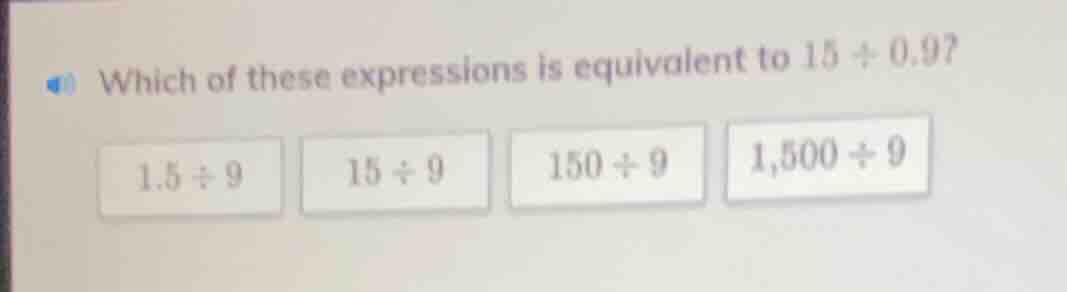
Question
which of these expressions is equivalent to 15 ÷ 0.9? 1.5 ÷ 9, 15 ÷ 9, 150 ÷ 9, 1,500 ÷ 9
Step1: Recall the rule of equivalent division
When we multiply or divide both the dividend and the divisor by the same non - zero number, the quotient remains the same. The formula for this property is \(\frac{a}{b}=\frac{a\times k}{b\times k}\) (\(k
eq0\)) and \(\frac{a}{b}=\frac{a\div k}{b\div k}\) (\(k
eq0\)).
Step2: Analyze the given division \(15\div0.9\)
We want to make the divisor \(0.9\) into \(9\). To do this, we multiply \(0.9\) by \(10\) (since \(0.9\times10 = 9\)). According to the rule of equivalent division, we also need to multiply the dividend \(15\) by \(10\).
So, when we multiply \(15\) by \(10\), we get \(15\times10=150\), and when we multiply \(0.9\) by \(10\), we get \(0.9\times10 = 9\). So the equivalent expression of \(15\div0.9\) is \(150\div9\).
Let's check the other options:
- For \(1.5\div9\): If we compare with \(15\div0.9\), the dividend \(15\) is divided by \(10\) to get \(1.5\) and the divisor \(0.9\) is multiplied by \(10\) to get \(9\). This does not follow the rule of equivalent division.
- For \(15\div9\): The dividend \(15\) remains the same and the divisor \(0.9\) is multiplied by \(10\) to get \(9\). This does not follow the rule of equivalent division.
- For \(1500\div9\): The dividend \(15\) is multiplied by \(100\) and the divisor \(0.9\) is multiplied by \(10\). Since the multipliers are different, this is not an equivalent expression.

Snap & solve any problem in the app
Get step-by-step solutions on Sovi AI
Photo-based solutions with guided steps
Explore more problems and detailed explanations
\(150\div9\)