QUESTION IMAGE
Question
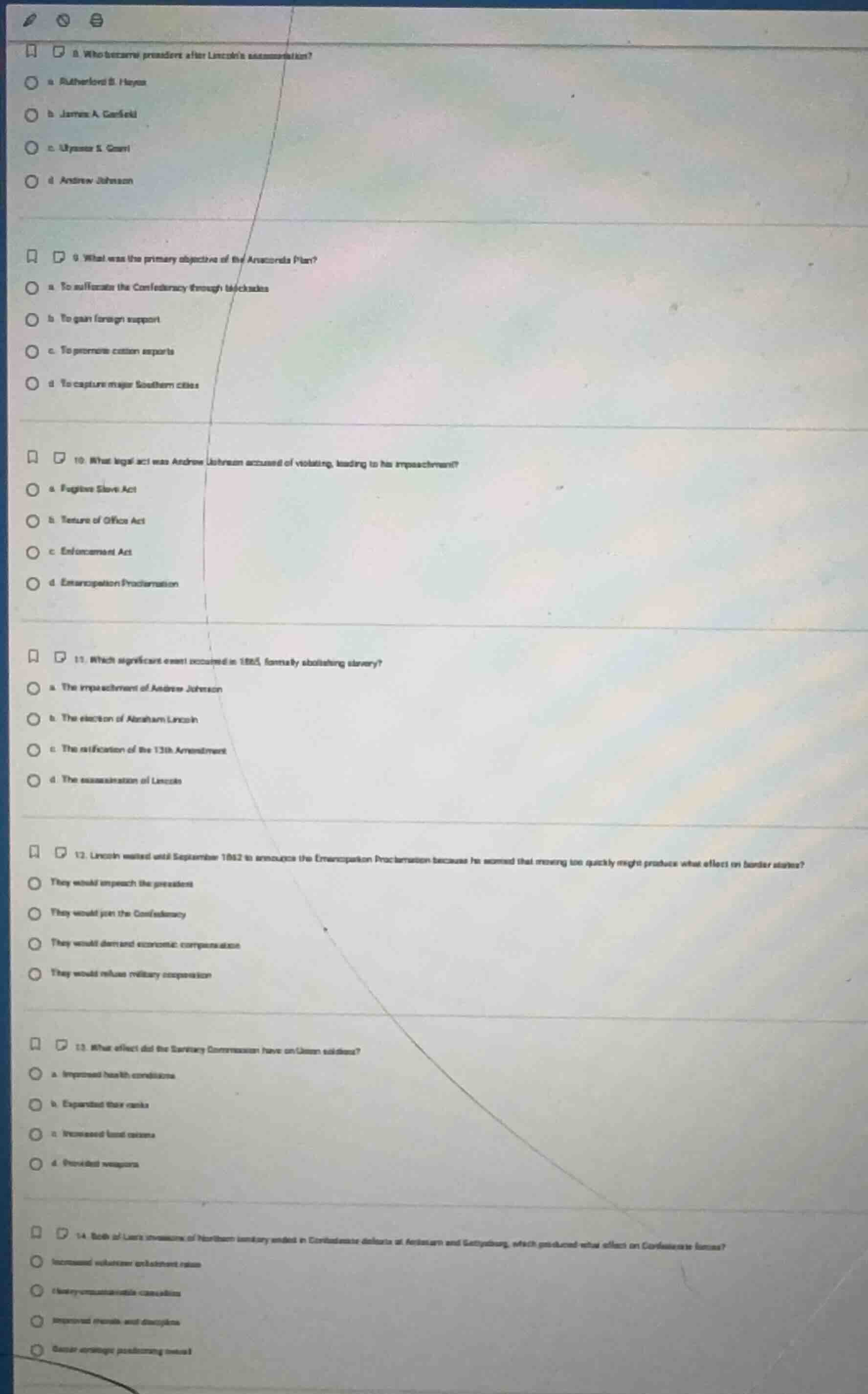
- who became president after lincolns assassination?
a. rutherford b. hayes
b. james a. garfield
c. ulysses s. grant
d. andrew johnson
- what was the primary objective of the anaconda plan?
a. to suffocate the confederacy through blockades
b. to gain foreign support
c. to promote cotton exports
d. to capture major southern cities
- what legal act was andrew johnson accused of violating, leading to his impeachment?
a. fugitive slave act
b. tenure of office act
c. enforcement act
d. emancipation proclamation
- which significant event occurred in 1865, formally abolishing slavery?
a. the impeachment of andrew johnson
b. the election of abraham lincoln
c. the ratification of the 13th amendment
d. the assassination of lincoln
- lincoln waited until september 1862 to announce the emancipation proclamation because he worried that moving too quickly might produce what effect on border states?
they would impeach the president
they would join the confederacy
they would demand economic compensation
they would refuse military cooperation
- what effect did the sanitary commission have on union soldiers?
a. improved health conditions
b. expanded their ranks
c. increased local taxes
d. provided weapons
- both of lees invasions of northern territory ended in confederate defeats at antietam and gettysburg, which produced what effect on confederate forces?
increased volunteer enlistment rates
heavy-unavoidable casualties
improved morale and discipline
better strategic positioning overall
- After Abraham Lincoln's assassination in 1865, his vice president, Andrew Johnson, assumed the presidency.
- The Anaconda Plan was a Union military strategy focused on blockading Confederate ports and controlling the Mississippi River to cut off supplies and "suffocate" the Confederacy.
- Andrew Johnson was impeached in 1868 for violating the Tenure of Office Act, which restricted presidential removal of certain officials without Senate approval.
- The 13th Amendment to the U.S. Constitution was ratified in 1865, formally abolishing slavery across the United States.
- Lincoln delayed the Emancipation Proclamation until after the Union victory at Antietam in 1862, fearing early announcement would push border states (slave states that remained in the Union) to join the Confederacy.
- The Sanitary Commission was a Union organization that worked to improve hygiene, medical care, and health conditions for Union soldiers during the Civil War.
- The Confederate defeats at Antietam and Gettysburg were major turning points; they ended Lee's invasions of the North, dented Southern morale, and made it nearly impossible for the Confederacy to gain foreign recognition or support, leading to irreversible casualties they could not replace.

Snap & solve any problem in the app
Get step-by-step solutions on Sovi AI
Photo-based solutions with guided steps
Explore more problems and detailed explanations
- d. Andrew Johnson
- a. To suffocate the Confederacy through blockades
- b. Tenure of Office Act
- c. The ratification of the 13th Amendment
- They would join the Confederacy
- a. Improved health conditions
- Irreversible casualties