QUESTION IMAGE
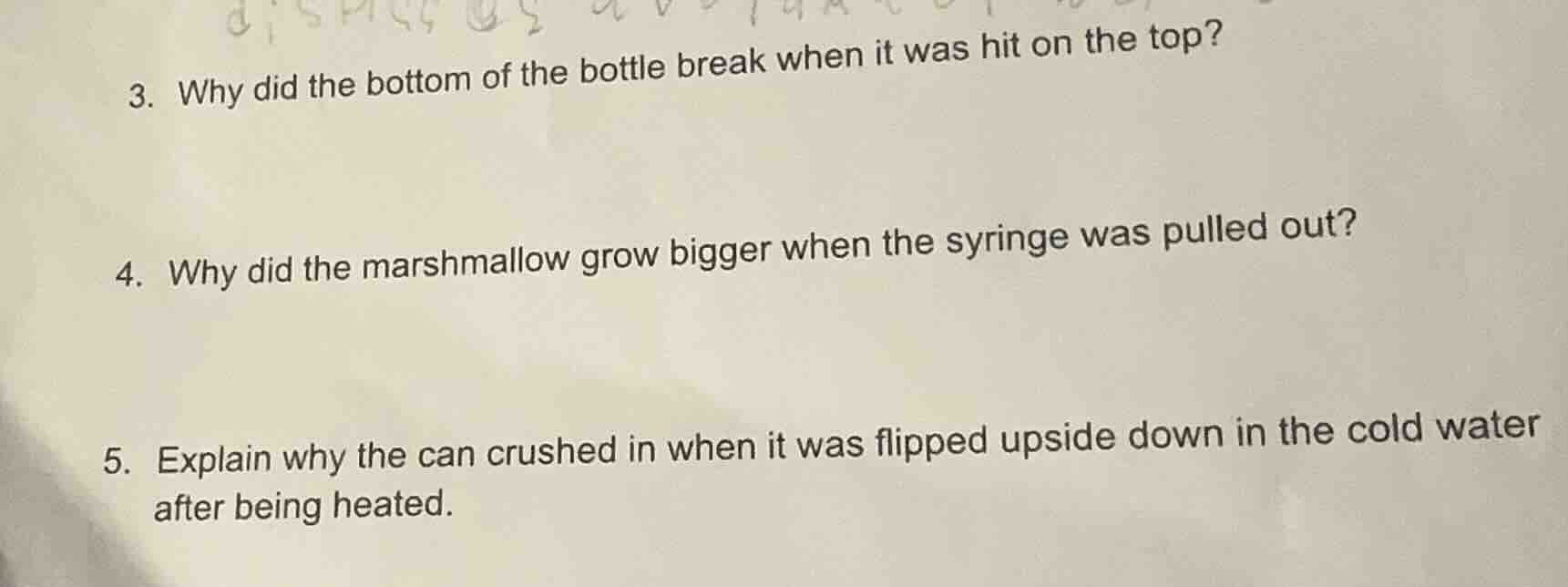
Question
- why did the bottom of the bottle break when it was hit on the top?
- why did the marshmallow grow bigger when the syringe was pulled out?
- explain why the can crushed in when it was flipped upside down in the cold water after being heated.
Question 3
When the top of the bottle is hit, a shock wave is transmitted through the liquid inside. The liquid, being nearly incompressible, transfers the force to the bottom. If the force exceeds the structural strength of the bottom (due to stress concentration or material limits), the bottom breaks. Also, if the bottle was filled (or partially filled) and the impact creates a pressure surge in the liquid, the bottom, which might have less support or be a weaker part, fails under the pressure.
A marshmallow has air bubbles inside. When the syringe is pulled out, the external pressure decreases (lowering the pressure around the marshmallow). According to Boyle's Law ($P_1V_1 = P_2V_2$ for a gas at constant temperature), as the external pressure ($P_2$) drops, the volume ($V_2$) of the gas (air) inside the marshmallow’s bubbles increases. This causes the marshmallow to expand (grow bigger) as the trapped air expands against the now lower external pressure.
- Heating Step: Heating the can (with some water inside, likely) turns the water to steam, which displaces the air inside, so most of the can’s interior is filled with steam (low - density gas).
- Flipping into Cold Water: When flipped into cold water, the steam rapidly condenses back to liquid water. This creates a very low - pressure (partial vacuum) inside the can because the steam (gas) is now a small - volume liquid.
- Pressure Difference: The external atmospheric pressure (around 1 atm) is much higher than the internal pressure (near vacuum). The force due to atmospheric pressure ($F = P\times A$, where $P$ is atmospheric pressure and $A$ is the can’s surface area) acting on the outside of the can is much greater than the internal force. This large pressure difference causes the can to be crushed inward by the external atmospheric pressure.

Snap & solve any problem in the app
Get step-by-step solutions on Sovi AI
Photo-based solutions with guided steps
Explore more problems and detailed explanations
The impact on the top creates a force/pressure wave in the liquid (if present) or transfers impact force. The bottom, with structural limits, breaks when the force/pressure exceeds its strength (e.g., stress concentration, pressure surge from liquid transfer of force).