QUESTION IMAGE
Question
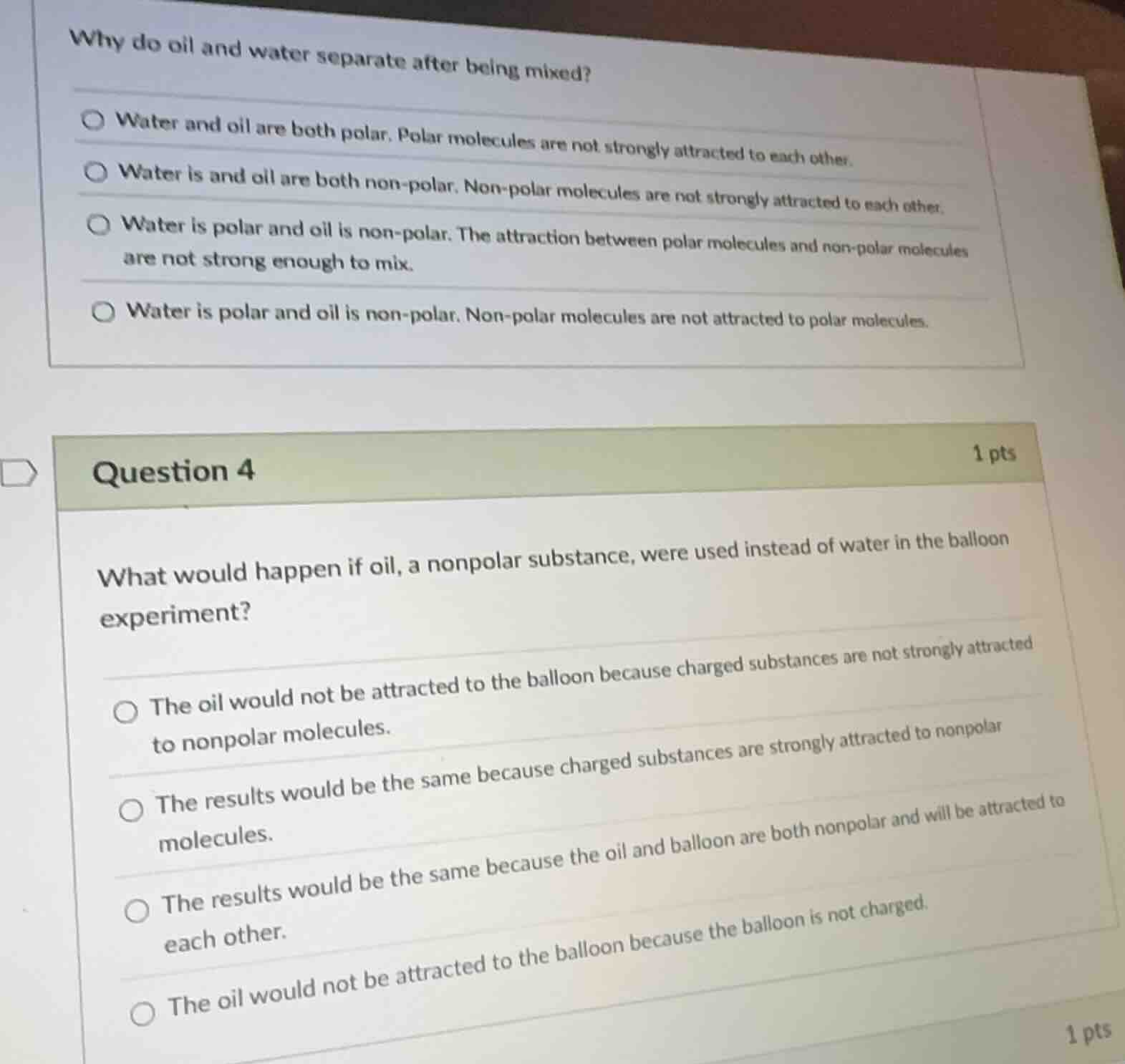
why do oil and water separate after being mixed?
- water and oil are both polar. polar molecules are not strongly attracted to each other.
- water is and oil are both non - polar. non - polar molecules are not strongly attracted to each other.
- water is polar and oil is non - polar. the attraction between polar molecules and non - polar molecules are not strong enough to mix.
- water is polar and oil is non - polar. non - polar molecules are not attracted to polar molecules.
question 4
1 pts
what would happen if oil, a nonpolar substance, were used instead of water in the balloon experiment?
- the oil would not be attracted to the balloon because charged substances are not strongly attracted to nonpolar molecules.
- the results would be the same because charged substances are strongly attracted to nonpolar molecules.
- the results would be the same because the oil and balloon are both nonpolar and will be attracted to each other.
- the oil would not be attracted to the balloon because the balloon is not charged.
Response
First Question (Why do oil and water separate...):
Brief Explanations
To determine why oil and water separate, we analyze the polarity of their molecules:
- Water is a polar molecule (due to its bent shape and electronegativity difference in O - H bonds).
- Oil is a non - polar molecule (most oils are hydrocarbons with symmetric electron distributions).
- The principle of "like dissolves like" states that polar substances interact well with other polar substances, and non - polar substances interact well with other non - polar substances. The attraction between polar (water) and non - polar (oil) molecules is not strong enough to overcome the intermolecular forces within each substance, so they do not mix and separate.
- Let's analyze the options:
- Option 1: Water is polar, oil is non - polar. So this option is wrong.
- Option 2: Water is polar, oil is non - polar. So this option is wrong.
- Option 3: This option correctly states the polarity of water (polar) and oil (non - polar) and that the attraction between them is not strong enough to mix.
- Option 4: The statement "Non - polar molecules are not attracted to polar molecules" is too absolute. There is a weak attraction, but it is not strong enough for mixing. So this option is wrong.
Brief Explanations
In a typical balloon experiment (e.g., a charged balloon attracting water, which is polar), we consider the polarity of oil and the nature of intermolecular attractions:
- Oil is non - polar. A charged balloon has regions of charge separation (polarized or charged). Charged substances (or polarizable substances) interact with polar molecules strongly due to dipole - dipole or ion - dipole interactions. However, the interaction between charged substances and non - polar molecules (oil) is weak because non - polar molecules do not have a permanent dipole and their induced dipole interactions with charged substances are not strong enough to cause a significant attraction like in the case of polar water.
- Let's analyze the options:
- Option 1: This option correctly states that the oil (non - polar) would not be attracted to the balloon (charged, which interacts strongly with polar molecules) because charged substances are not strongly attracted to non - polar molecules.
- Option 2: Charged substances are not strongly attracted to non - polar molecules, so the results would not be the same. This option is wrong.
- Option 3: The balloon in such experiments is usually charged (e.g., by rubbing), and oil and balloon (if the balloon is made of a non - polar material, but the key is the charge on the balloon) do not have a strong attraction. Also, the statement about the reason is wrong. So this option is wrong.
- Option 4: The balloon in these experiments is typically charged (e.g., by static electricity), so this option's reason is wrong.

Snap & solve any problem in the app
Get step-by-step solutions on Sovi AI
Photo-based solutions with guided steps
Explore more problems and detailed explanations
C. Water is polar and oil is non - polar. The attraction between polar molecules and non - polar molecules are not strong enough to mix.