QUESTION IMAGE
Question
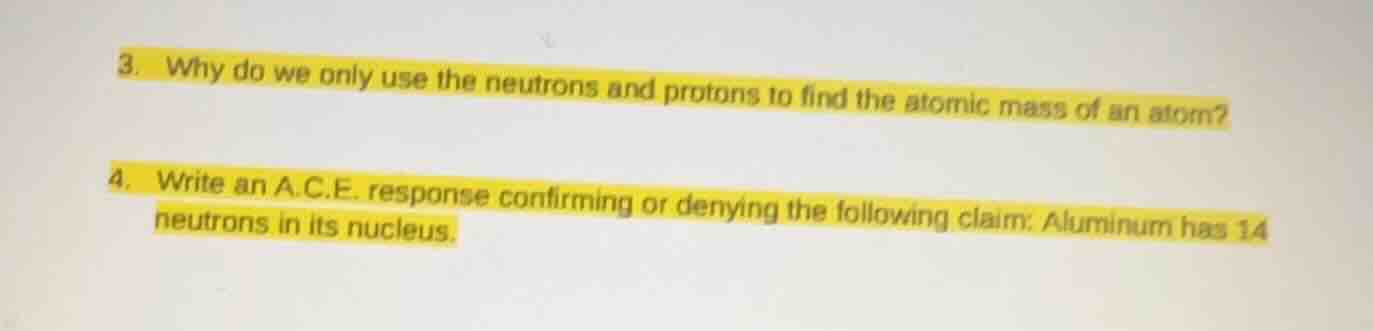
- why do we only use the neutrons and protons to find the atomic mass of an atom?
- write an a.c.e. response confirming or denying the following claim: aluminum has 14 neutrons in its nucleus.
For question 3: Electrons have an extremely small mass (about $\frac{1}{1836}$ the mass of a proton) that is negligible when calculating the overall atomic mass, so only protons and neutrons (the massive particles in the nucleus) are used.
For question 4: A.C.E. stands for Answer, Cite, Explain. First, confirm the claim is correct. Cite that aluminum has an atomic number of 13 (13 protons) and a standard atomic mass of ~27. Calculate neutrons as atomic mass minus atomic number: $27 - 13 = 14$. Explain this formula gives the number of neutrons for the most common isotope of aluminum.

Snap & solve any problem in the app
Get step-by-step solutions on Sovi AI
Photo-based solutions with guided steps
Explore more problems and detailed explanations
- Electrons have negligible mass, so only the much more massive protons and neutrons (located in the atom's nucleus) contribute to the measurable atomic mass.
- Answer: The claim that aluminum has 14 neutrons in its nucleus is correct.
Cite: Aluminum has an atomic number of 13 and a standard atomic mass of approximately 27.
Explain: The number of neutrons in an atom is calculated as $\text{Atomic Mass} - \text{Atomic Number}$. For aluminum, this is $27 - 13 = 14$, which is the neutron count for its most abundant isotope.