QUESTION IMAGE
Question
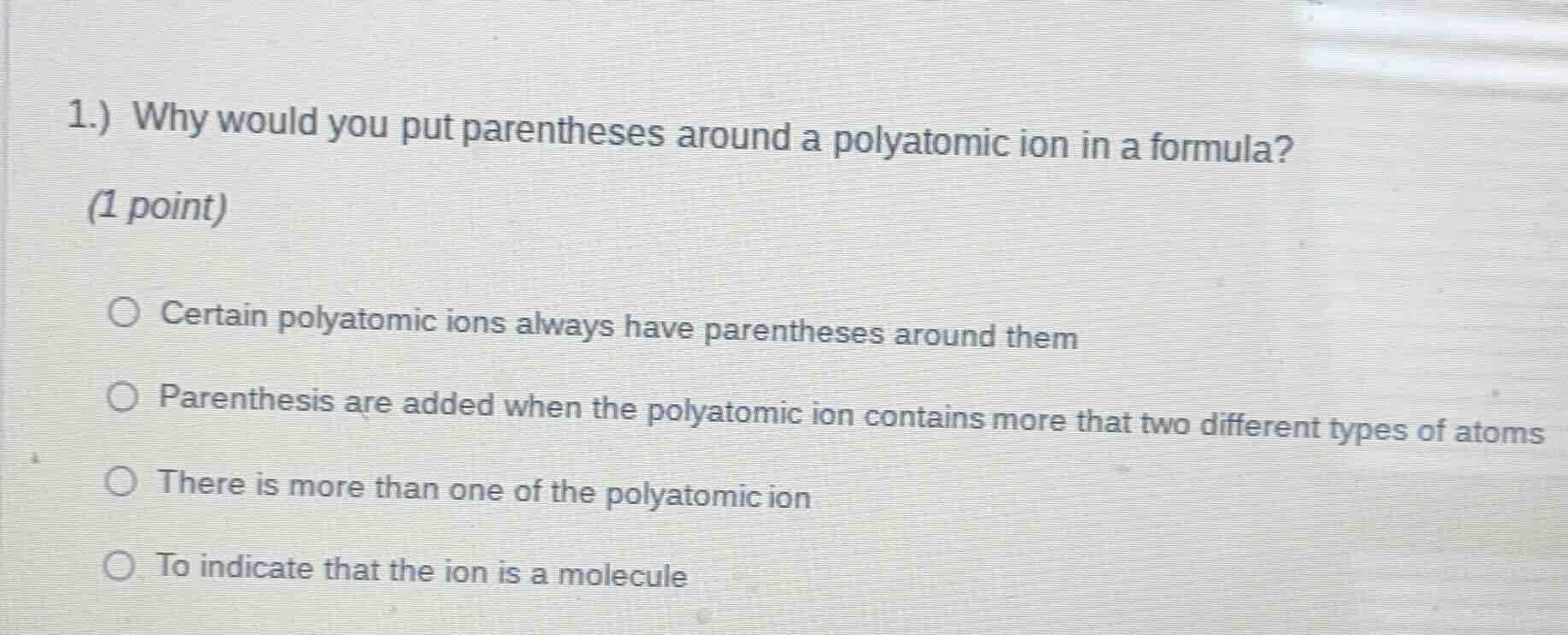
1.) why would you put parentheses around a polyatomic ion in a formula? (1 point) certain polyatomic ions always have parentheses around them parenthesis are added when the polyatomic ion contains more that two different types of atoms there is more than one of the polyatomic ion to indicate that the ion is a molecule
Brief Explanations
To determine the correct answer, we analyze each option:
- Option 1: Polyatomic ions don't always have parentheses; it depends on the formula's context, so this is incorrect.
- Option 2: The number of different atom types in a polyatomic ion doesn't determine the use of parentheses. For example, \( \text{OH}^- \) (two atom types) doesn't need parentheses unless there are multiple, while \( \text{SO}_4^{2-} \) (three atom types) also follows the "multiple ions" rule. So this is wrong.
- Option 3: When there is more than one polyatomic ion in a formula, parentheses are used around the ion, and a subscript is added outside to indicate the number of those ions. For example, in \( \text{Ca(OH)}_2 \), parentheses around \( \text{OH}^- \) show there are 2 hydroxide ions. This matches the rule for using parentheses with polyatomic ions.
- Option 4: Polyatomic ions are ions, not molecules, and parentheses don't indicate they are molecules. So this is incorrect.

Snap & solve any problem in the app
Get step-by-step solutions on Sovi AI
Photo-based solutions with guided steps
Explore more problems and detailed explanations
C. There is more than one of the polyatomic ion