QUESTION IMAGE
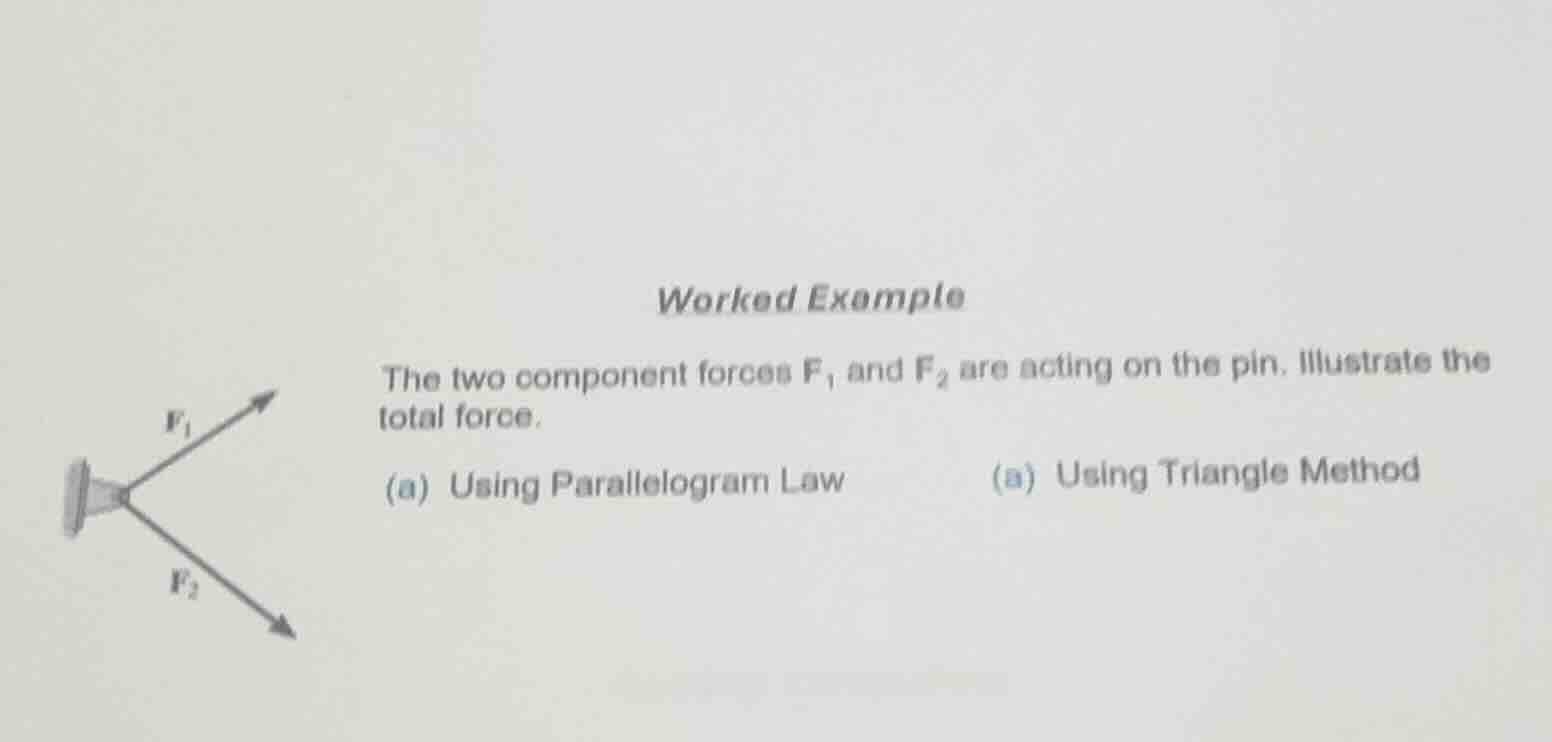
Question
worked example
the two component forces $f_1$ and $f_2$ are acting on the pin. illustrate the
total force.
(a) using parallelogram law
(b) using triangle method
Brief Explanations
For Parallelogram Law:
- Draw a line parallel to $\boldsymbol{F_1}$ starting from the tip of $\boldsymbol{F_2}$.
- Draw a line parallel to $\boldsymbol{F_2}$ starting from the tip of $\boldsymbol{F_1}$.
- The two parallel lines intersect to form a parallelogram.
- Draw a vector from the pin (common origin of $\boldsymbol{F_1}$ and $\boldsymbol{F_2}$) to the intersection point of the parallel lines; this vector is the total (resultant) force $\boldsymbol{F_R}$.
For Triangle Method:
- Redraw $\boldsymbol{F_1}$ with its starting point at the pin.
- Redraw $\boldsymbol{F_2}$ such that its starting point is at the tip of $\boldsymbol{F_1}$.
- Draw a vector from the pin (origin of $\boldsymbol{F_1}$) to the tip of the relocated $\boldsymbol{F_2}$; this vector is the total (resultant) force $\boldsymbol{F_R}$.

Snap & solve any problem in the app
Get step-by-step solutions on Sovi AI
Photo-based solutions with guided steps
Explore more problems and detailed explanations
(a) Parallelogram Law Illustration:
        /F₁
       /   \
Pin -------*  <-- Intersection of parallel lines
       \   /
        \F₂
         (Resultant F_R is from Pin to *)
(b) Triangle Method Illustration:
Pin --> F₁ --> F₂
        \       /
         \     /
          \F_R/  <-- F_R connects Pin to tip of F₂
The resultant force $\boldsymbol{F_R}$ represents the total force acting on the pin for both methods.