QUESTION IMAGE
Question
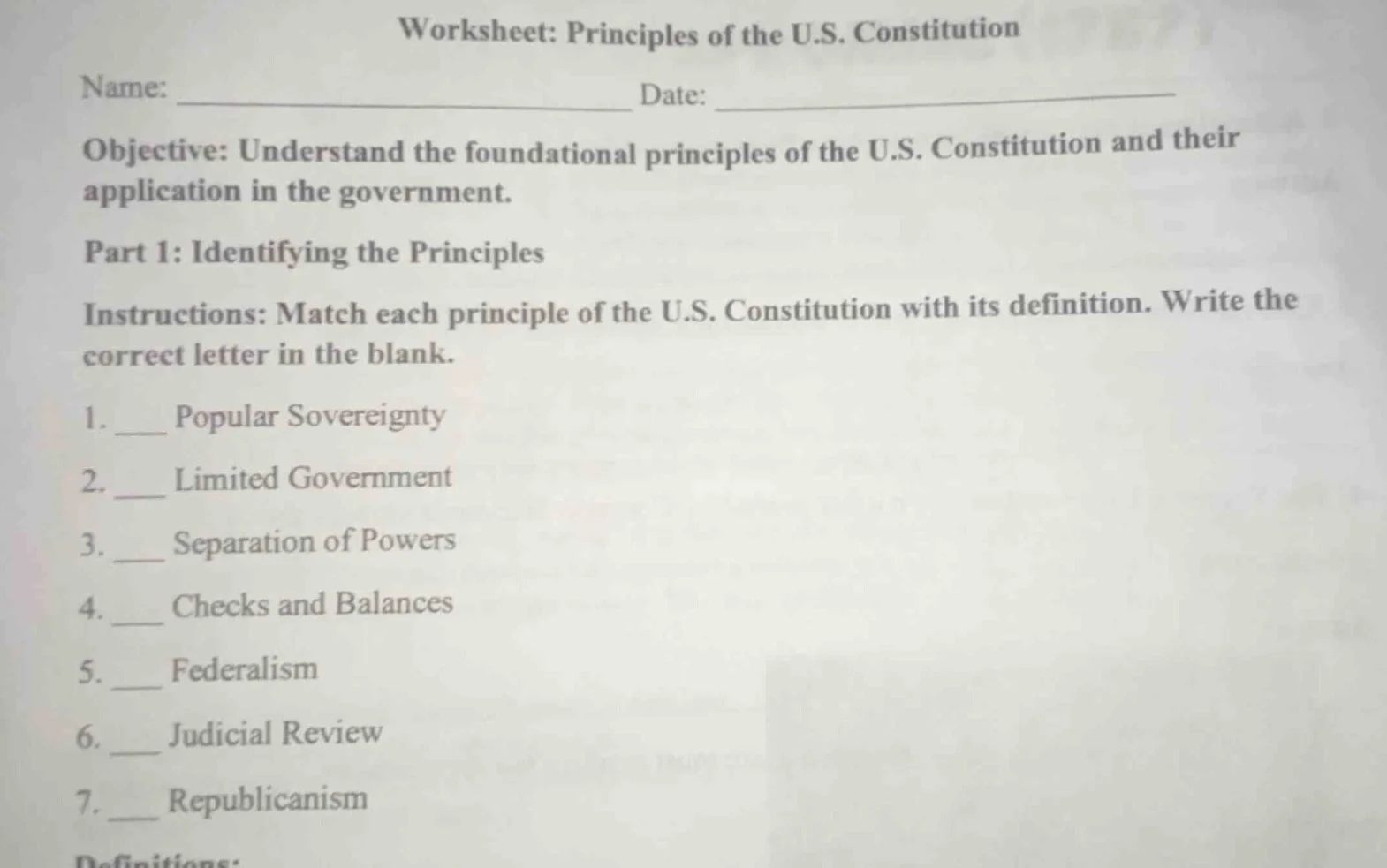
worksheet: principles of the u.s. constitution
name: _________________________ date: _________________________
objective: understand the foundational principles of the u.s. constitution and their
application in the government.
part 1: identifying the principles
instructions: match each principle of the u.s. constitution with its definition. write the
correct letter in the blank.
- ___ popular sovereignty
- ___ limited government
- ___ separation of powers
- ___ checks and balances
- ___ federalism
- ___ judicial review
- ___ republicanism
definitions:
To solve this matching problem about the principles of the U.S. Constitution, we first need to recall the definitions of each principle:
- Popular Sovereignty: The government’s power comes from the people (e.g., through voting).
- Limited Government: The government can only do what the people allow (via the Constitution), and everyone, including leaders, is subject to the law.
- Separation of Powers: The government is divided into three branches (legislative, executive, judicial) to prevent one group from having too much power.
- Checks and Balances: Each branch can limit the power of the other branches (e.g., the president can veto laws, Congress can override vetoes, courts can declare laws unconstitutional).
- Federalism: Power is shared between the national (federal) government and state governments.
- Judicial Review: Courts can determine if laws or actions are constitutional (established by Marbury v. Madison).
- Republicanism: The people elect representatives to make decisions on their behalf.
Assuming the definitions (not fully shown in the image) follow these standard explanations, the matching would be:
- Popular Sovereignty → (Definition about government power from the people)
- Limited Government → (Definition about government power restricted by the Constitution/law)
- Separation of Powers → (Definition about three branches of government)
- Checks and Balances → (Definition about branches limiting each other)
- Federalism → (Definition about shared power between federal and state governments)
- Judicial Review → (Definition about courts reviewing constitutionality)
- Republicanism → (Definition about elected representatives)
Since the exact definitions are not provided in the image, we use the standard constitutional principles to guide the matching. For example, if the definitions include:
- A: Power is divided between national and state governments (matches Federalism, 5).
- B: Government power comes from the people (matches Popular Sovereignty, 1).
- C: Government is divided into three branches (matches Separation of Powers, 3).
- D: Branches limit each other’s power (matches Checks and Balances, 4).
- E: Government power is limited by the Constitution (matches Limited Government, 2).
- F: Courts can declare laws unconstitutional (matches Judicial Review, 6).
- G: People elect representatives (matches Republicanism, 7).
Final Matching (Example with Standard Definitions):
- Popular Sovereignty → B
- Limited Government → E
- Separation of Powers → C
- Checks and Balances → D
- Federalism → A
- Judicial Review → F
- Republicanism → G
(Note: Adjust based on the actual definitions provided in the worksheet. The key is to align each principle with its core concept.)

Snap & solve any problem in the app
Get step-by-step solutions on Sovi AI
Photo-based solutions with guided steps
Explore more problems and detailed explanations
To solve this matching problem about the principles of the U.S. Constitution, we first need to recall the definitions of each principle:
- Popular Sovereignty: The government’s power comes from the people (e.g., through voting).
- Limited Government: The government can only do what the people allow (via the Constitution), and everyone, including leaders, is subject to the law.
- Separation of Powers: The government is divided into three branches (legislative, executive, judicial) to prevent one group from having too much power.
- Checks and Balances: Each branch can limit the power of the other branches (e.g., the president can veto laws, Congress can override vetoes, courts can declare laws unconstitutional).
- Federalism: Power is shared between the national (federal) government and state governments.
- Judicial Review: Courts can determine if laws or actions are constitutional (established by Marbury v. Madison).
- Republicanism: The people elect representatives to make decisions on their behalf.
Assuming the definitions (not fully shown in the image) follow these standard explanations, the matching would be:
- Popular Sovereignty → (Definition about government power from the people)
- Limited Government → (Definition about government power restricted by the Constitution/law)
- Separation of Powers → (Definition about three branches of government)
- Checks and Balances → (Definition about branches limiting each other)
- Federalism → (Definition about shared power between federal and state governments)
- Judicial Review → (Definition about courts reviewing constitutionality)
- Republicanism → (Definition about elected representatives)
Since the exact definitions are not provided in the image, we use the standard constitutional principles to guide the matching. For example, if the definitions include:
- A: Power is divided between national and state governments (matches Federalism, 5).
- B: Government power comes from the people (matches Popular Sovereignty, 1).
- C: Government is divided into three branches (matches Separation of Powers, 3).
- D: Branches limit each other’s power (matches Checks and Balances, 4).
- E: Government power is limited by the Constitution (matches Limited Government, 2).
- F: Courts can declare laws unconstitutional (matches Judicial Review, 6).
- G: People elect representatives (matches Republicanism, 7).
Final Matching (Example with Standard Definitions):
- Popular Sovereignty → B
- Limited Government → E
- Separation of Powers → C
- Checks and Balances → D
- Federalism → A
- Judicial Review → F
- Republicanism → G
(Note: Adjust based on the actual definitions provided in the worksheet. The key is to align each principle with its core concept.)