QUESTION IMAGE
Question
worksheet
worksheet
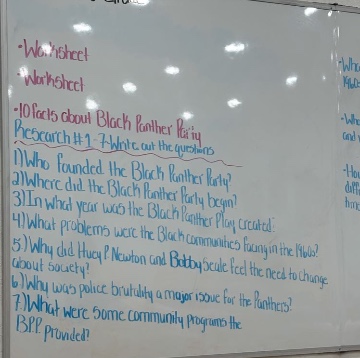
10 facts about black panther party
research #1 - write out the questions
- who founded the black panther party?
- where did the black panther party begin?
- in what year was the black panther party created?
- what problems were the black communities facing in the 60s?
- why did huey newton and bobby seale feel the need to change about society?
- why was police brutality a major issue for the panthers?
- what were some community programs the bpp provided?
Brief Explanations
These are research questions about the Black Panther Party, a 20th-century African American revolutionary organization. Answers are based on historical records of the party's origins, leadership, community context, and activities.
- The Black Panther Party was founded by Huey P. Newton and Bobby Seale.
- It began in Oakland, California, United States.
- It was created in October 1966.
- Black communities in the 1960s faced systemic racism, police brutality, poverty, lack of access to quality education, healthcare, and housing, as well as disenfranchisement.
- Huey Newton and Bobby Seale saw the need to challenge systemic racism, police violence, and the neglect of Black communities by the government, and to advocate for Black self-determination.
- Police brutality was a major issue because Black people were regularly targeted, harassed, and violently attacked by law enforcement, with little to no accountability, which was a core injustice the party sought to confront.
- Some community programs the Black Panther Party provided included free breakfast programs for children, free health clinics, free clothing drives, educational programs to teach Black history and political education, and free transportation for elderly residents to medical appointments.

Snap & solve any problem in the app
Get step-by-step solutions on Sovi AI
Photo-based solutions with guided steps
Explore more problems and detailed explanations
- Huey P. Newton and Bobby Seale
- Oakland, California, U.S.
- October 1966
- Systemic racism, police brutality, poverty, inadequate education/healthcare/housing, disenfranchisement
- To challenge racial injustice and fight for Black self-determination
- Routine violent targeting of Black people by police with no accountability
- Free breakfast for kids, free health clinics, free clothing drives, Black history education, senior medical transport