QUESTION IMAGE
Question
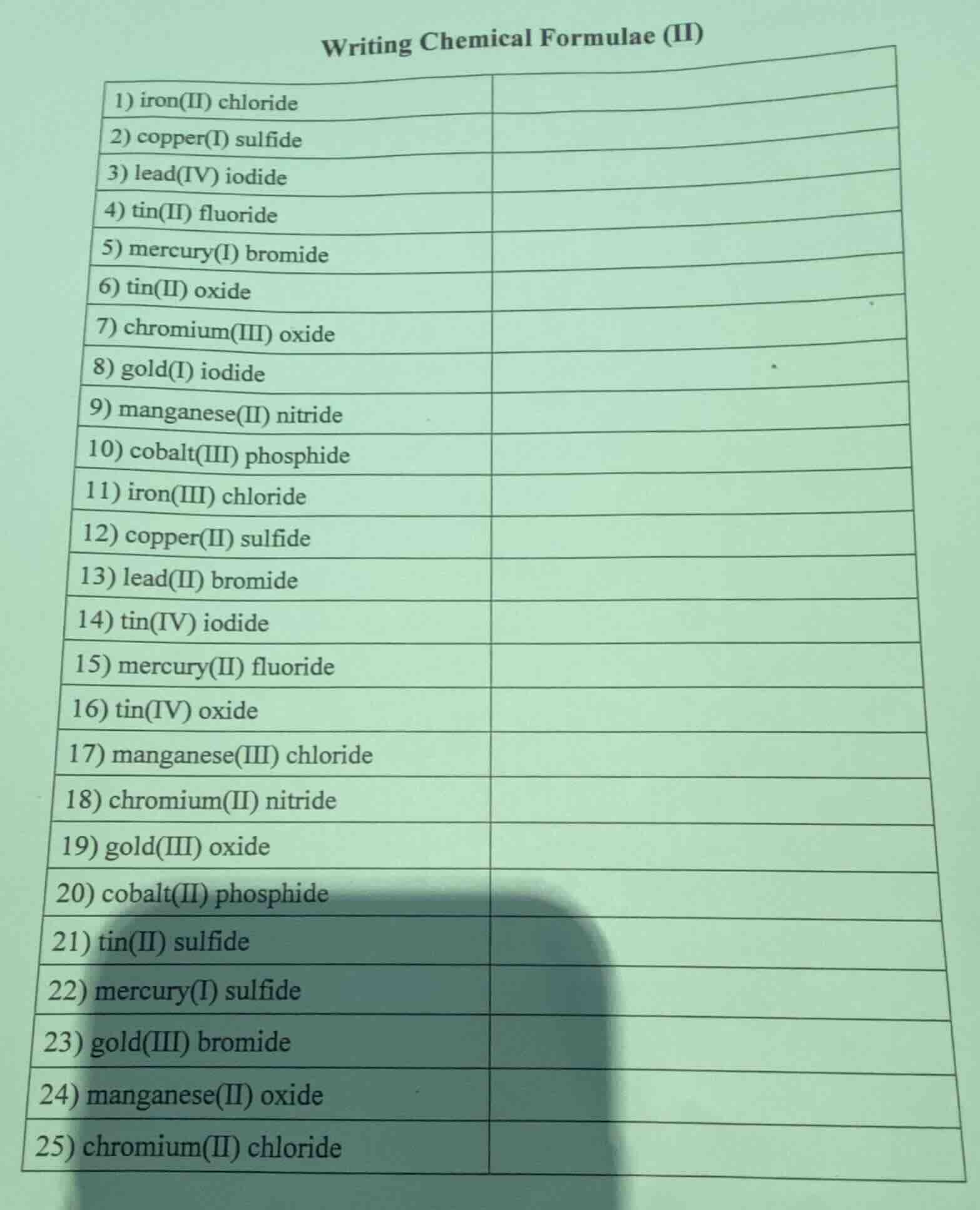
writing chemical formulae (ii)
- iron(ii) chloride
- copper(i) sulfide
- lead(iv) iodide
- tin(ii) fluoride
- mercury(i) bromide
- tin(ii) oxide
- chromium(iii) oxide
- gold(i) iodide
- manganese(ii) nitride
- cobalt(iii) phosphide
- iron(iii) chloride
- copper(ii) sulfide
- lead(ii) bromide
- tin(iv) iodide
- mercury(ii) fluoride
- tin(iv) oxide
- manganese(iii) chloride
- chromium(ii) nitride
- gold(iii) oxide
- cobalt(ii) phosphide
- tin(ii) sulfide
- mercury(i) sulfide
- gold(iii) bromide
- manganese(ii) oxide
- chromium(ii) chloride
Step1: Identify ion charges
Use Roman numerals for cation charge; recall common anion charges:
- Halides (Cl⁻, Br⁻, I⁻, F⁻): $1^-$
- Oxide ($O^{2-}$): $2^-$
- Sulfide ($S^{2-}$): $2^-$
- Nitride ($N^{3-}$): $3^-$
- Phosphide ($P^{3-}$): $3^-$
- Mercury(I) is $Hg_2^{2+}$ (special case)
Step2: Balance charge for neutrality
Cation total charge = Anion total charge; use subscripts to balance.
Step3: Write final formula
Simplify subscripts to smallest whole numbers (except $Hg_2^{2+}$).
---

Snap & solve any problem in the app
Get step-by-step solutions on Sovi AI
Photo-based solutions with guided steps
Explore more problems and detailed explanations
- $\text{FeCl}_2$
- $\text{Cu}_2\text{S}$
- $\text{PbI}_4$
- $\text{SnF}_2$
- $\text{Hg}_2\text{Br}_2$
- $\text{SnO}$
- $\text{Cr}_2\text{O}_3$
- $\text{AuI}$
- $\text{Mn}_3\text{N}_2$
- $\text{CoP}$
- $\text{FeCl}_3$
- $\text{CuS}$
- $\text{PbBr}_2$
- $\text{SnI}_4$
- $\text{HgF}_2$
- $\text{SnO}_2$
- $\text{MnCl}_3$
- $\text{Cr}_3\text{N}_2$
- $\text{Au}_2\text{O}_3$
- $\text{Co}_3\text{P}_2$
- $\text{SnS}$
- $\text{Hg}_2\text{S}$
- $\text{AuBr}_3$
- $\text{MnO}$
- $\text{CrCl}_2$