QUESTION IMAGE
Question
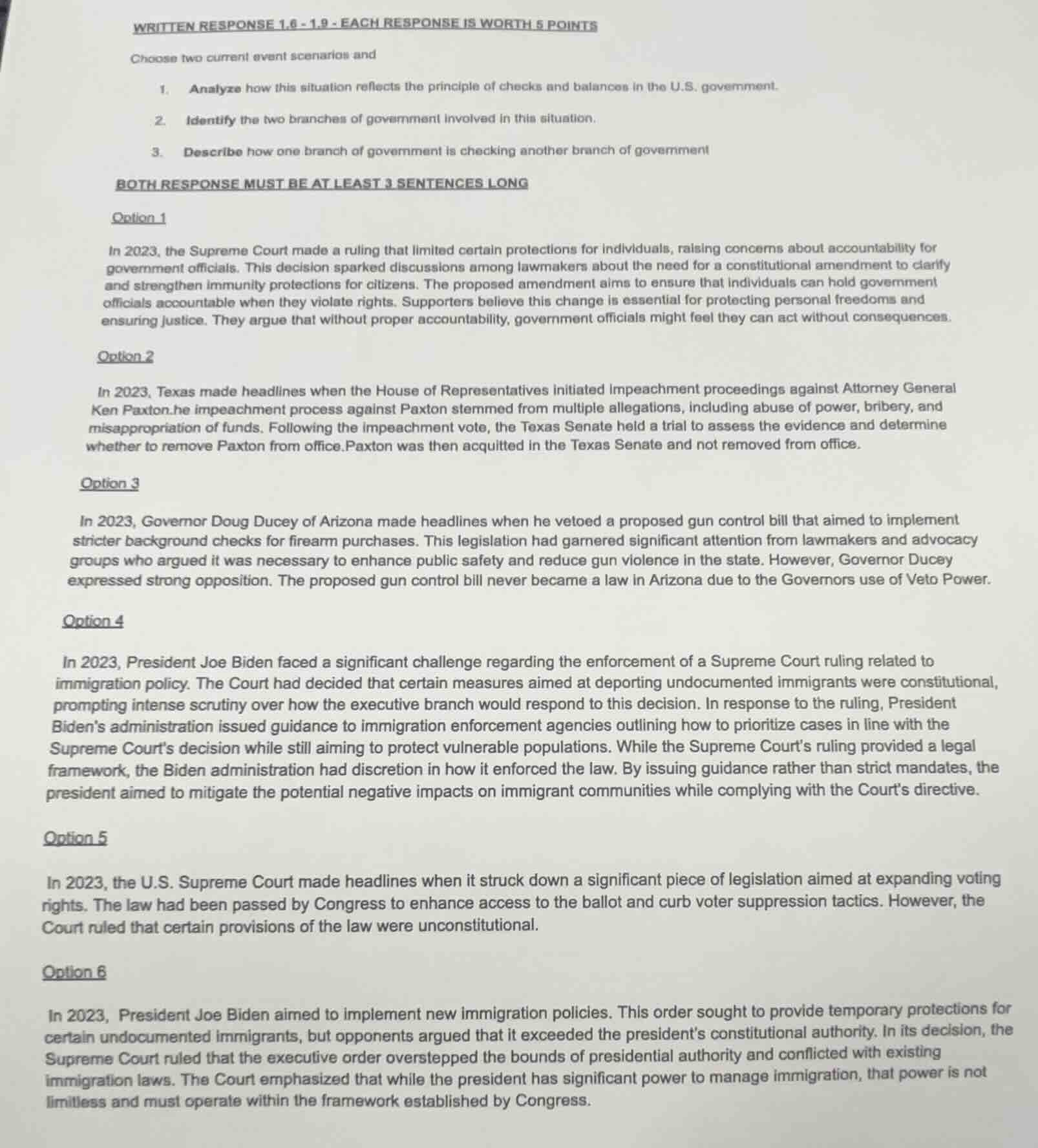
written response 1.6 - 1.9 - each response is worth 5 points
choose two current event scenarios and
- analyze how this situation reflects the principle of checks and balances in the u.s. government.
- identify the two branches of government involved in this situation.
- describe how one branch of government is checking another branch of government
both response must be at least 3 sentences long
option 1
in 2023, the supreme court made a ruling that limited certain protections for individuals, raising concerns about accountability for government officials. this decision sparked discussions among lawmakers about the need for a constitutional amendment to clarify and strengthen immunity protections for citizens. the proposed amendment aims to ensure that individuals can hold government officials accountable when they violate rights. supporters believe this change is essential for protecting personal freedoms and ensuring justice. they argue that without proper accountability, government officials might feel they can act without consequences.
option 2
in 2023, texas made headlines when the house of representatives initiated impeachment proceedings against attorney general ken paxton.he impeachment process against paxton stemmed from multiple allegations, including abuse of power, bribery, and misappropriation of funds. following the impeachment vote, the texas senate held a trial to assess the evidence and determine whether to remove paxton from office.paxton was then acquitted in the texas senate and not removed from office.
option 3
in 2023, governor doug ducey of arizona made headlines when he vetoed a proposed gun control bill that aimed to implement stricter background checks for firearm purchases. this legislation had garnered significant attention from lawmakers and advocacy groups who argued it was necessary to enhance public safety and reduce gun violence in the state. however, governor ducey expressed strong opposition. the proposed gun control bill never became a law in arizona due to the governors use of veto power.
option 4
in 2023, president joe biden faced a significant challenge regarding the enforcement of a supreme court ruling related to immigration policy. the court had decided that certain measures aimed at deporting undocumented immigrants were constitutional, prompting intense scrutiny over how the executive branch would respond to this decision. in response to the ruling, president bidens administration issued guidance to immigration enforcement agencies outlining how to prioritize cases in line with the supreme courts decision while still aiming to protect vulnerable populations. while the supreme courts ruling provided a legal framework, the biden administration had discretion in how it enforced the law. by issuing guidance rather than strict mandates, the president aimed to mitigate the potential negative impacts on immigrant communities while complying with the courts directive.
option 5
in 2023, the u.s. supreme court made headlines when it struck down a significant piece of legislation aimed at expanding voting rights. the law had been passed by congress to enhance access to the ballot and curb voter suppression tactics. however, the court ruled that certain provisions of the law were unconstitutional.
option 6
in 2023, president joe biden aimed to implement new immigration policies. this order sought to provide temporary protections for certain undocumented immigrants, but opponents argued that it exceeded the presidents constitutional authority. in its decision, the supreme court ruled that the executive order overstepped the bounds of presidential authority and conflicted with existing immigration laws. the court emphasized that while the president has significant power to manage immigration, that power is not limitless and must operate within the framework established by congress.
For Option 2 (Texas Paxton Impeachment):
- The situation shows checks and balances as it uses a constitutional process to hold a top executive branch official accountable, preventing unchecked power. The legislative branch exercises oversight over the executive to ensure officials act within legal bounds.
- The two branches involved are the legislative branch (Texas House of Representatives and Texas Senate) and the executive branch (Texas Attorney General Ken Paxton, part of the state executive).
- The Texas House of Representatives, part of the legislative branch, initiated impeachment proceedings against Attorney General Paxton, checking the executive branch by formally alleging misconduct and voting to impeach, which forced a Senate trial. This process allows the legislature to investigate and potentially remove executive officials who abuse their power, ensuring the executive branch acts responsibly.
For Option 5 (Supreme Court Voting Rights Ruling):
- This situation reflects checks and balances as the judicial branch reviews and limits the actions of the legislative branch, ensuring that congressional legislation aligns with the U.S. Constitution. This prevents the legislative branch from passing laws that overstep constitutional limits on its power.
- The two branches involved are the legislative branch (U.S. Congress, which passed the voting rights law) and the judicial branch (U.S. Supreme Court, which ruled on the law's constitutionality).
- The U.S. Supreme Court, the judicial branch, checked the legislative branch by striking down key provisions of the voting rights law. The Court reviewed the law to determine if it complied with the Constitution, and its ruling invalidated parts of the legislation, restricting Congress's ability to enforce that specific voting rights framework and ensuring legislative actions stay within constitutional boundaries.

Snap & solve any problem in the app
Get step-by-step solutions on Sovi AI
Photo-based solutions with guided steps
Explore more problems and detailed explanations
Response for Option 2:
- This situation embodies checks and balances by using a formal, constitutional process to hold an executive branch official accountable, ensuring no branch can act without oversight or consequence. Impeachment is a core checks and balances tool designed to prevent abuse of power by executive officials, as it lets the legislature investigate and potentially remove officials who violate public trust. This process ensures that even high-ranking executive members are not above accountability, a key tenet of the checks and balances system.
- The two branches of government involved are the Texas legislative branch (the Texas House of Representatives and Texas Senate) and the Texas executive branch (Texas Attorney General Ken Paxton).
- The Texas House of Representatives, part of the legislative branch, checked the executive branch by initiating impeachment proceedings against Attorney General Ken Paxton. After allegations of abuse of power, bribery, and misappropriation of funds emerged, the House voted to impeach Paxton, which forced a trial in the Texas Senate. This action allowed the legislative branch to investigate the executive official's conduct and determine if he should be removed from office, using its constitutional authority to oversee and constrain executive power.
Response for Option 5:
- This situation reflects the principle of checks and balances by demonstrating the judicial branch's power to review and limit legislative actions, ensuring that all federal laws align with the U.S. Constitution. Checks and balances require each branch to have the ability to restrict the others' power, and the Court's ruling prevents Congress from overstepping its constitutional authority by passing laws that violate constitutional protections or limits. This oversight ensures the legislative branch cannot enact laws that undermine the framework of the Constitution or individual rights as interpreted by the judiciary.
- The two branches of government involved are the U.S. legislative branch (Congress, which passed the voting rights legislation) and the U.S. judicial branch (the U.S. Supreme Court, which reviewed the law).
- The U.S. Supreme Court, the judicial branch, checked the legislative branch by striking down certain provisions of the voting rights law passed by Congress. The Court reviewed the law to assess its constitutionality, and determined that key parts of the legislation violated constitutional standards. By invalidating these provisions, the Court restricted Congress's ability to implement that specific voting rights framework, using its power of judicial review to ensure legislative actions stay within the bounds set by the Constitution.