QUESTION IMAGE
Question
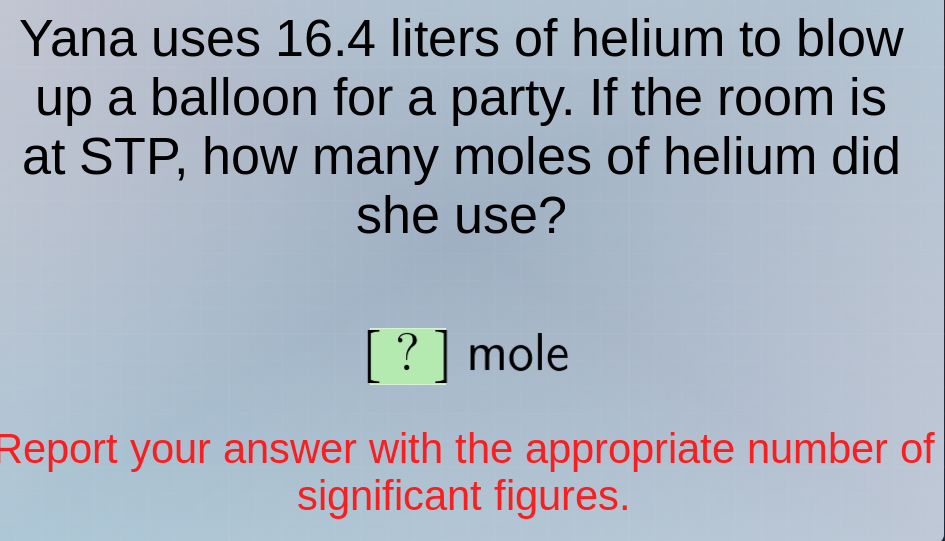
yana uses 16.4 liters of helium to blow up a balloon for a party. if the room is at stp, how many moles of helium did she use?? molereport your answer with the appropriate number of significant figures.
Step1: Recall STP molar volume
At STP (Standard Temperature and Pressure, 0°C and 1 atm), the molar volume of any ideal gas is \( 22.4 \, \text{L/mol} \). This means that 1 mole of an ideal gas occupies 22.4 liters at STP.
Step2: Calculate moles of helium
We know the volume of helium is \( 16.4 \, \text{L} \). To find the number of moles, we use the formula:
\[
\text{Moles} = \frac{\text{Volume}}{\text{Molar Volume at STP}}
\]
Substituting the values:
\[
\text{Moles} = \frac{16.4 \, \text{L}}{22.4 \, \text{L/mol}} \approx 0.732 \, \text{mol}
\]
Now, considering significant figures: the given volume (16.4 L) has three significant figures, and the molar volume (22.4 L/mol) also has three significant figures. When dividing, the result should have three significant figures. So, \( 0.732 \) mol (or we can check the calculation again: \( 16.4\div22.4 = 0.732142\cdots \), which rounds to \( 0.732 \) with three significant figures, or wait, actually, let's do the division more accurately. Wait, 16.4 divided by 22.4:
\( 16.4 \div 22.4 = \frac{164}{224} = \frac{41}{56} \approx 0.73214 \). So with three significant figures, it's \( 0.732 \) mol? Wait, no, wait: 16.4 has three, 22.4 has three, so the result should have three. So \( 0.732 \) mol. Wait, but let's check the problem again. Wait, maybe I made a mistake in the molar volume? Wait, no, at STP (0°C and 1 atm), the molar volume is 22.4 L/mol for ideal gases. So that's correct.
Wait, but let's recalculate: 16.4 divided by 22.4. Let's do this division:
22.4 goes into 16.4 zero times. Add a decimal point. 22.4 goes into 164 seven times (722.4=156.8). Subtract 156.8 from 164: 7.2. Bring down a zero: 72.0. 22.4 goes into 72.0 three times (322.4=67.2). Subtract 67.2 from 72.0: 4.8. Bring down a zero: 48.0. 22.4 goes into 48.0 two times (222.4=44.8). Subtract 44.8 from 48.0: 3.2. Bring down a zero: 32.0. 22.4 goes into 32.0 once (122.4=22.4). Subtract 22.4 from 32.0: 9.6. So putting it all together: 0.7321... So approximately 0.732 mol. So with three significant figures, that's 0.732 mol. Wait, but let's check the significant figures again. The volume is 16.4 (three sig figs), molar volume 22.4 (three sig figs). So the answer should have three sig figs. So 0.732 mol. Alternatively, maybe the problem expects using the molar volume as 22.4 L/mol (which is three sig figs), so the answer is 0.732 mol. Wait, but let's confirm:
Wait, the formula is moles = volume / molar volume. So volume is 16.4 L (three sig figs), molar volume 22.4 L/mol (three sig figs). So the result should have three sig figs. So 16.4 / 22.4 = 0.73214..., which rounds to 0.732 mol. So that's the answer.

Snap & solve any problem in the app
Get step-by-step solutions on Sovi AI
Photo-based solutions with guided steps
Explore more problems and detailed explanations
\( 0.732 \) (or if we consider that maybe the molar volume is taken as 22.4 L/mol exactly, then the calculation is as above. So the number of moles is approximately \( 0.732 \) moles. Wait, but let's check again: 16.4 divided by 22.4. Let's do this division:
16.4 ÷ 22.4 = 0.732142857... So with three significant figures, it's 0.732. So the answer is 0.732 moles.