QUESTION IMAGE
Question
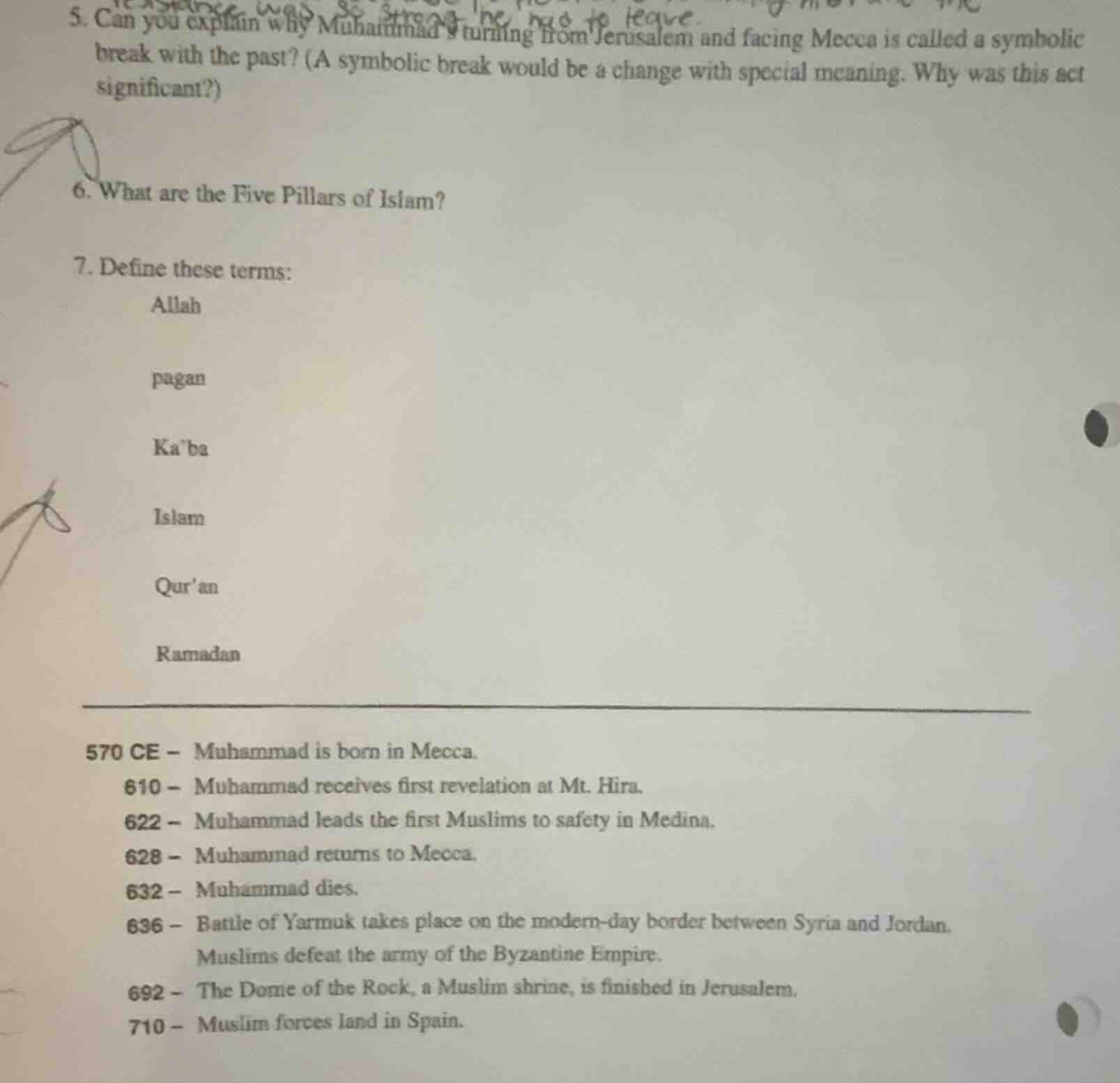
- can you explain why muhammads turning from jerusalem and facing mecca is called a symbolic break with the past? (a symbolic break would be a change with special meaning. why was this act significant?)
- what are the five pillars of islam?
- define these terms:
allah
pagan
ka’ba
islam
qur’an
ramadan
570 ce – muhammad is born in mecca.
610 – muhammad receives first revelation at mt. hira.
622 – muhammad leads the first muslims to safety in medina.
628 – muhammad returns to mecca.
632 – muhammad dies.
636 – battle of yarmuk takes place on the modern - day border between syria and jordan.
muslims defeat the army of the byzantine empire.
692 – the dome of the rock, a muslim shrine, is finished in jerusalem.
710 – muslim forces land in spain.
For Question 5:
Jerusalem was a sacred site for Judaism and Christianity, faiths early Muslims had ties to. Facing Mecca instead established a distinct, unique religious identity for Islam, separating it from the earlier Abrahamic traditions centered on Jerusalem and centering the faith on its own holy site in Mecca.
For Question 6:
These are the core religious obligations that guide Muslim life.
For Question 7:
Each term is a key concept in Islamic faith, history, or practice, defined by its religious and cultural context.

Snap & solve any problem in the app
Get step-by-step solutions on Sovi AI
Photo-based solutions with guided steps
Explore more problems and detailed explanations
- Question 5: This act was a symbolic break because it shifted the religious focus from Jerusalem (a holy city shared with Judaism and Christianity, faiths with which early Islam had connections) to Mecca, establishing Islam as a distinct, independent faith with its own central holy site, rather than aligning itself with the geographic religious center of older Abrahamic traditions.
- Question 6:
- Shahada: The declaration of faith, "There is no god but Allah, and Muhammad is his messenger."
- Salat: The requirement to perform 5 daily prayers facing Mecca.
- Zakat: The obligation to give a portion of one's wealth to the poor and needy.
- Sawm: Fasting during the holy month of Ramadan from sunrise to sunset.
- Hajj: The pilgrimage to the holy city of Mecca that every able-bodied Muslim must complete at least once in their lifetime if financially capable.
- Question 7:
- Allah: The Arabic word for the one, singular, all-powerful God in Islamic faith, the same deity worshipped in Judaism and Christianity.
- pagan: A person who worships multiple gods or nature-based deities; in the context of early Islam, it referred to the pre-Islamic inhabitants of Mecca who worshipped idols at the Ka'ba.
- Ka'ba: A cube-shaped sacred structure located in the Great Mosque of Mecca, considered the holiest site in Islam; Muslims face it during daily prayers.
- Islam: A monotheistic religion founded by the Prophet Muhammad, whose followers are called Muslims; its core tenet is submission to the will of Allah.
- Qur'an: The holy book of Islam, believed by Muslims to be the direct, literal word of Allah as revealed to the Prophet Muhammad.
- Ramadan: The ninth month of the Islamic lunar calendar, a holy month during which Muslims fast from sunrise to sunset, engage in extra prayer, and focus on spiritual reflection and charity.