QUESTION IMAGE
Question
you got the last problem right - keep it up!
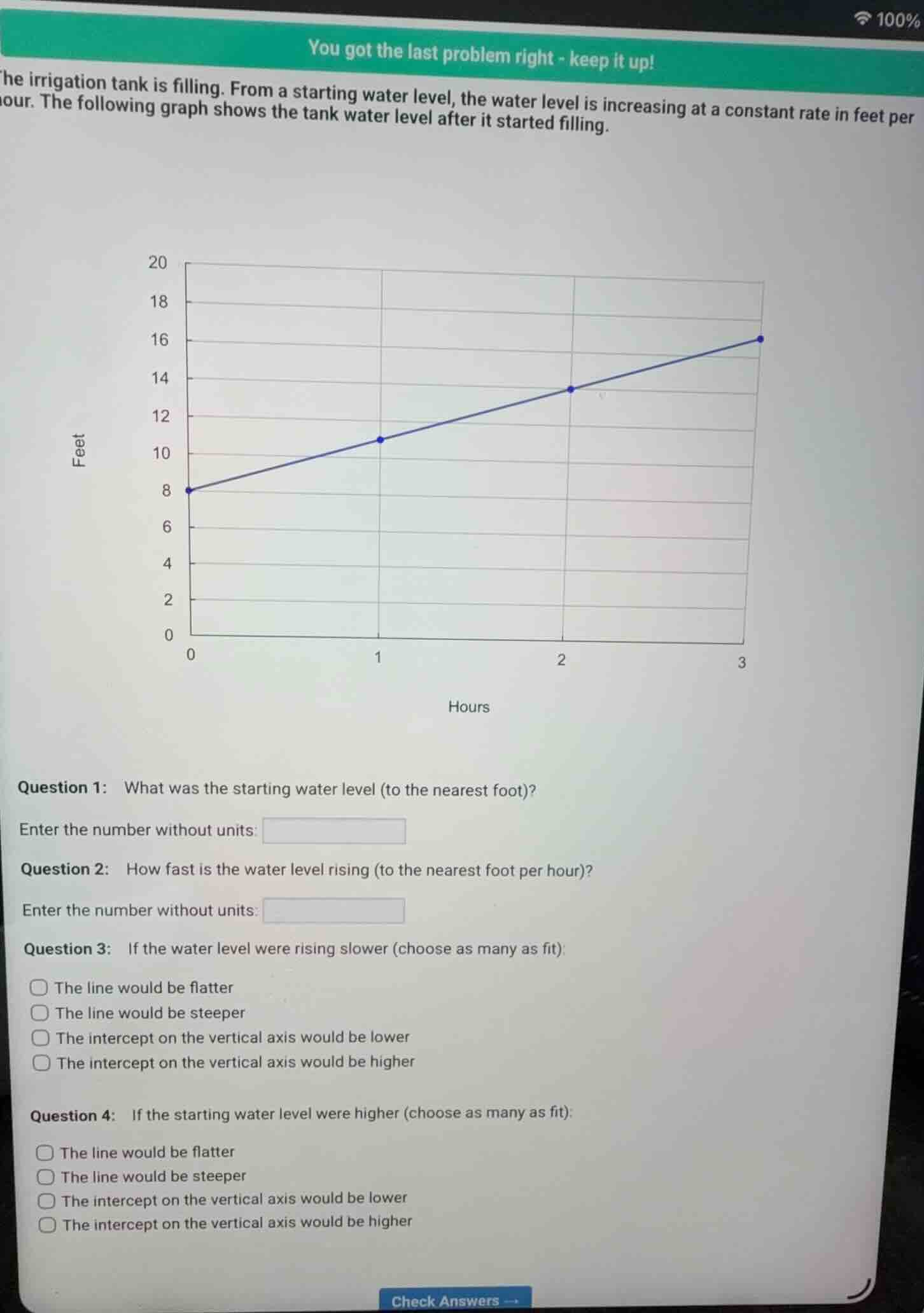
he irrigation tank is filling. from a starting water level, the water level is increasing at a constant rate in feet per
hour. the following graph shows the tank water level after it started filling.
question 1: what was the starting water level (to the nearest foot)?
enter the number without units:
question 2: how fast is the water level rising (to the nearest foot per hour)?
enter the number without units:
question 3: if the water level were rising slower (choose as many as fit):
the line would be flatter
the line would be steeper
the intercept on the vertical axis would be lower
the intercept on the vertical axis would be higher
question 4: if the starting water level were higher (choose as many as fit):
the line would be flatter
the line would be steeper
the intercept on the vertical axis would be lower
the intercept on the vertical axis would be higher
check answers
Step1: Find starting water level
The starting level is the y-intercept, at $x=0$: $y=8$.
Step2: Calculate rise rate (slope)
Slope formula: $\frac{y_2-y_1}{x_2-x_1}$. Use $(0,8)$ and $(1,11)$: $\frac{11-8}{1-0}=3$.
Step3: Analyze slower rise effect
Slope represents rise rate; slower = smaller slope = flatter line.
Step4: Analyze higher starting level effect
Starting level = y-intercept; higher start = higher intercept.

Snap & solve any problem in the app
Get step-by-step solutions on Sovi AI
Photo-based solutions with guided steps
Explore more problems and detailed explanations
- 8
- 3
- The line would be flatter
- The intercept on the vertical axis would be higher