QUESTION IMAGE
Question
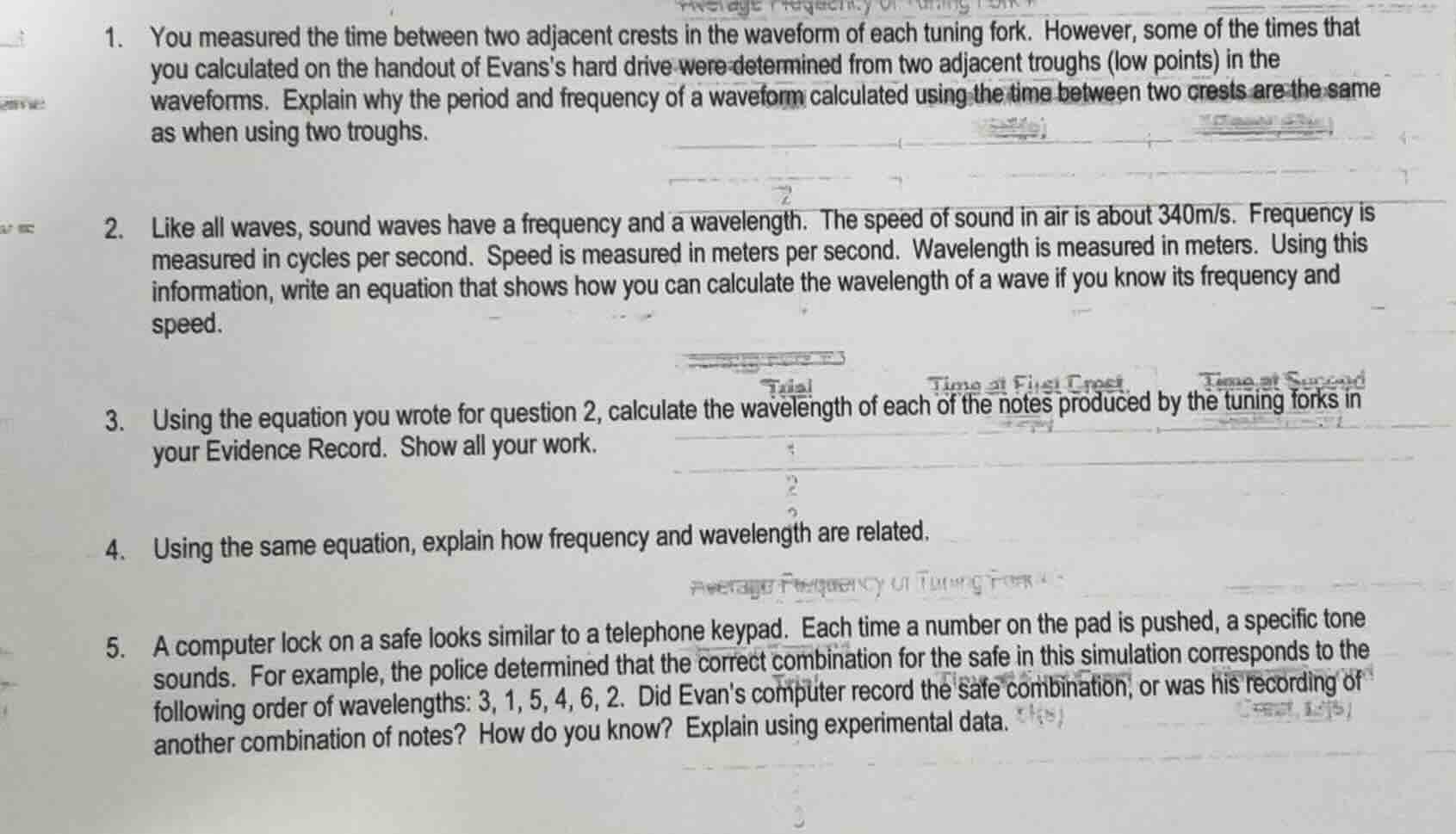
- you measured the time between two adjacent crests in the waveform of each tuning fork. however, some of the times that you calculated on the handout of evanss hard drive were determined from two adjacent troughs (low points) in the waveforms. explain why the period and frequency of a waveform calculated using the time between two crests are the same as when using two troughs.
- like all waves, sound waves have a frequency and a wavelength. the speed of sound in air is about 340m/s. frequency is measured in cycles per second. speed is measured in meters per second. wavelength is measured in meters. using this information, write an equation that shows how you can calculate the wavelength of a wave if you know its frequency and speed.
- using the equation you wrote for question 2, calculate the wavelength of each of the notes produced by the tuning forks in your evidence record. show all your work.
- using the same equation, explain how frequency and wavelength are related.
- a computer lock on a safe looks similar to a telephone keypad. each time a number on the pad is pushed, a specific tone sounds. for example, the police determined that the correct combination for the safe in this simulation corresponds to the following order of wavelengths: 3, 1, 5, 4, 6, 2. did evans computer record the safe combination, or was his recording of another combination of notes? how do you know? explain using experimental data.
Question 1
A wave's period is the time for one full cycle. A cycle includes moving from crest to crest (or trough to trough). The distance between two adjacent crests or two adjacent troughs is one full cycle. So the time between two crests (period) is the same as between two troughs because both represent one complete wave cycle. Frequency is the reciprocal of period (\(f = \frac{1}{T}\)), so if period is the same, frequency is also the same.
Step 1: Recall wave speed formula
The general formula for the speed (\( v \)) of a wave is the product of its frequency (\( f \)) and wavelength (\( \lambda \)), so \( v = f\lambda \).
Step 2: Rearrange for wavelength
To solve for wavelength (\( \lambda \)), we divide both sides of the equation \( v = f\lambda \) by frequency (\( f \)).
\( \lambda=\frac{v}{f} \)
Step 1: Identify known values
We know the speed of sound in air \( v = 340\,\text{m/s} \), and let the frequency of a tuning fork be \( f \) (e.g., if \( f = 440\,\text{Hz} \) for a standard A note).
Step 2: Apply the wavelength formula
Use the formula \( \lambda=\frac{v}{f} \). Substitute \( v = 340\,\text{m/s} \) and the value of \( f \). For example, if \( f = 440\,\text{Hz} \):
\( \lambda=\frac{340}{440}\approx0.773\,\text{m} \)
(Repeat this step for each tuning fork frequency from the Evidence Record.)

Snap & solve any problem in the app
Get step-by-step solutions on Sovi AI
Photo-based solutions with guided steps
Explore more problems and detailed explanations
The period is the time for one wave cycle. The distance between two adjacent crests or two adjacent troughs both represent one full wave cycle, so the time (period) between them is equal. Since frequency \( f=\frac{1}{T} \) (where \( T \) is period), equal periods mean equal frequencies.