QUESTION IMAGE
Question
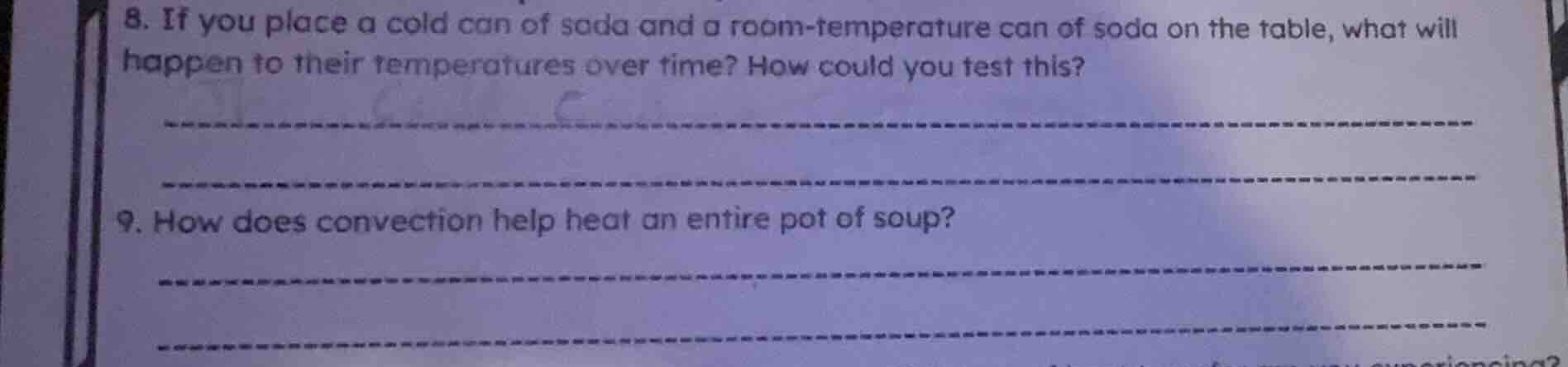
- if you place a cold can of soda and a room - temperature can of soda on the table, what will happen to their temperatures over time? how could you test this?
- how does convection help heat an entire pot of soup?
Response
Question 8
Brief Explanations
- Temperature Change: According to the principle of thermal equilibrium (heat transfer from higher - temperature objects to lower - temperature objects until they reach the same temperature as the surrounding environment), the cold can of soda will absorb heat from the surrounding air (which is at room temperature) and its temperature will increase. The room - temperature can of soda will release heat to the surrounding air if the surrounding air temperature is different from its initial temperature, but in a typical room - setting, if the room temperature is stable, the main change for the room - temperature can is that it will also tend to stay at the room temperature. More accurately, the cold soda can will warm up towards room temperature, and the room - temperature soda can will stay relatively stable (or if there are minor fluctuations in the room's micro - climate, it will adjust slightly) until both reach thermal equilibrium with the room's air.
- Testing Method:
- Materials Needed: Two thermometers, a cold can of soda, a room - temperature can of soda, and a table in a room with a relatively stable temperature.
- Procedure:
- Place the cold can and the room - temperature can on the table, spaced apart so that they do not affect each other's heat transfer significantly.
- Insert a thermometer into the opening of each can (if possible, or place the thermometer in contact with the surface of the can, ensuring good thermal contact).
- Record the initial temperatures of both cans.
- Then, record the temperatures of both cans at regular intervals (for example, every 5 minutes) over a period of time (such as 30 minutes to 1 hour).
- Analyze the temperature - time data. The cold can's temperature should show an increasing trend towards the room temperature, and the room - temperature can's temperature should show little change (or a very small change if the room temperature is not perfectly stable) over time.
Brief Explanations
Convection is the transfer of heat through the movement of a fluid (liquid or gas). In a pot of soup:
- When the soup at the bottom of the pot is heated (for example, by a stove burner), its temperature increases. As the temperature of the soup at the bottom increases, its density decreases (because for most liquids, including soup - like liquids, density decreases as temperature increases).
- The less - dense, warmer soup at the bottom rises towards the top of the pot.
- At the same time, the cooler, more - dense soup at the top of the pot sinks towards the bottom of the pot.
- Once the cooler soup reaches the bottom, it is heated, its density decreases, and it then rises. This continuous cycle of warm soup rising and cool soup sinking (convection current) transfers heat throughout the entire volume of the soup, causing the entire pot of soup to be heated.

Snap & solve any problem in the app
Get step-by-step solutions on Sovi AI
Photo-based solutions with guided steps
Explore more problems and detailed explanations
- Temperature Change: The cold can of soda will increase in temperature (warming up) towards the room temperature, and the room - temperature can of soda will remain relatively close to the room temperature (with minor fluctuations if the room's thermal environment changes slightly) as they both approach thermal equilibrium with the surrounding air.
- Testing Method: Use two thermometers to measure the temperatures of the cold and room - temperature soda cans at regular intervals (e.g., every 5 minutes) after placing them on a table in a room with a stable temperature. Record the initial and subsequent temperatures to observe the cold can's warming trend and the room - temperature can's relatively stable temperature over time.