QUESTION IMAGE
Question
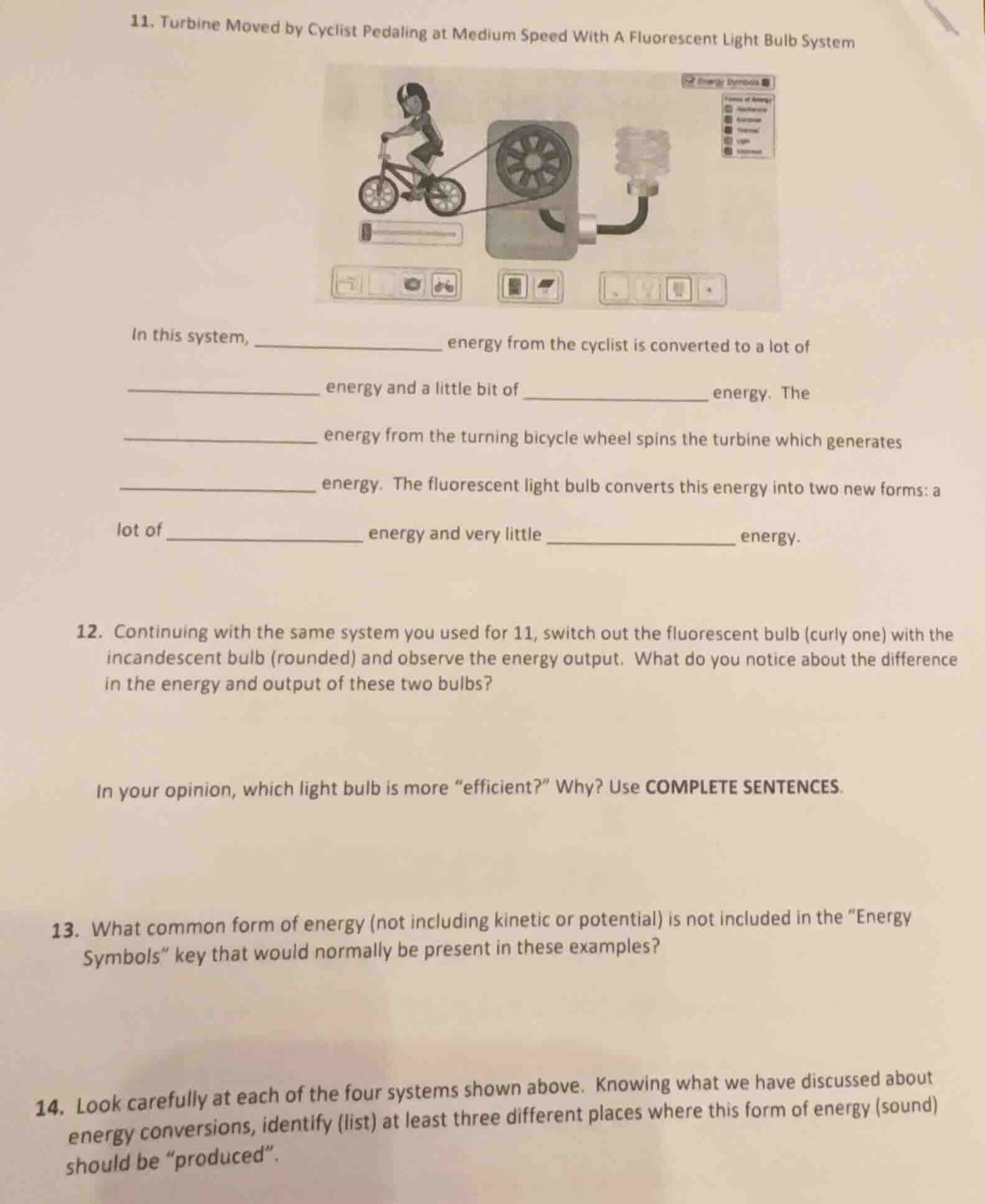
- turbine moved by cyclist pedaling at medium speed with a fluorescent light bulb system
in this system, ______________ energy from the cyclist is converted to a lot of
____________ energy and a little bit of ____________ energy. the
______________ energy from the turning bicycle wheel spins the turbine which generates
______________ energy. the fluorescent light bulb converts this energy into two new forms: a
lot of ____________ energy and very little ____________ energy.
- continuing with the same system you used for 11, switch out the fluorescent bulb (curly one) with the incandescent bulb (rounded) and observe the energy output. what do you notice about the difference in the energy and output of these two bulbs?
in your opinion, which light bulb is more \efficient?\ why? use complete sentences.
- what common form of energy (not including kinetic or potential) is not included in the \energy symbols\ key that would normally be present in these examples?
- look carefully at each of the four systems shown above. knowing what we have discussed about energy conversions, identify (list) at least three different places where this form of energy (sound) should be \produced\.
Question 11
Step 1: Analyze the cyclist's energy
The cyclist uses their body to pedal, so the initial energy from the cyclist is chemical energy (stored in the body from food).
Step 2: Energy from pedaling
When the cyclist pedals, they are moving, so the chemical energy is converted to kinetic (mechanical) energy, and some is lost as thermal (heat) energy due to friction in the body or bike.
Step 3: Energy from the turning wheel
The turning bicycle wheel has kinetic (mechanical) energy.
Step 4: Energy from the turbine
The turbine, when spun by the wheel, generates electrical energy (as it's a generator - like a dynamo).
Step 5: Energy from the fluorescent bulb
A fluorescent bulb converts electrical energy into light energy (a lot) and thermal (heat) energy (a little, since fluorescent bulbs are more efficient than incandescent but still produce some heat).
- Difference in energy output: The fluorescent bulb produces more light energy and less thermal energy compared to the incandescent bulb. The incandescent bulb produces more thermal energy (gets hot) and less light energy for the same input electrical energy.
- Efficiency: The fluorescent bulb is more efficient. Efficiency in energy conversion is about how much of the input energy is converted into the desired form (light, in this case). Since the fluorescent bulb converts a larger proportion of the electrical energy into light (and less into heat, which is wasted in terms of producing light), it is more efficient.
In energy conversion systems, especially those involving movement (like the bike, turbine, or electrical components), sound energy is often produced due to vibrations (e.g., the bike chain, the turbine spinning, the electrical components humming). The "Energy Symbols" key in the diagram (from what's typical in such diagrams) usually includes symbols for chemical, kinetic, thermal, electrical, light, etc., but sound energy (which is a form of mechanical energy from vibrations) is often missing.

Snap & solve any problem in the app
Get step-by-step solutions on Sovi AI
Photo-based solutions with guided steps
Explore more problems and detailed explanations
In this system, $\boldsymbol{\text{chemical}}$ energy from the cyclist is converted to a lot of $\boldsymbol{\text{kinetic (mechanical)}}$ energy and a little bit of $\boldsymbol{\text{thermal (heat)}}$ energy. The $\boldsymbol{\text{kinetic (mechanical)}}$ energy from the turning bicycle wheel spins the turbine which generates $\boldsymbol{\text{electrical}}$ energy. The fluorescent light bulb converts this energy into two new forms: a lot of $\boldsymbol{\text{light}}$ energy and very little $\boldsymbol{\text{thermal (heat)}}$ energy.