QUESTION IMAGE
Question
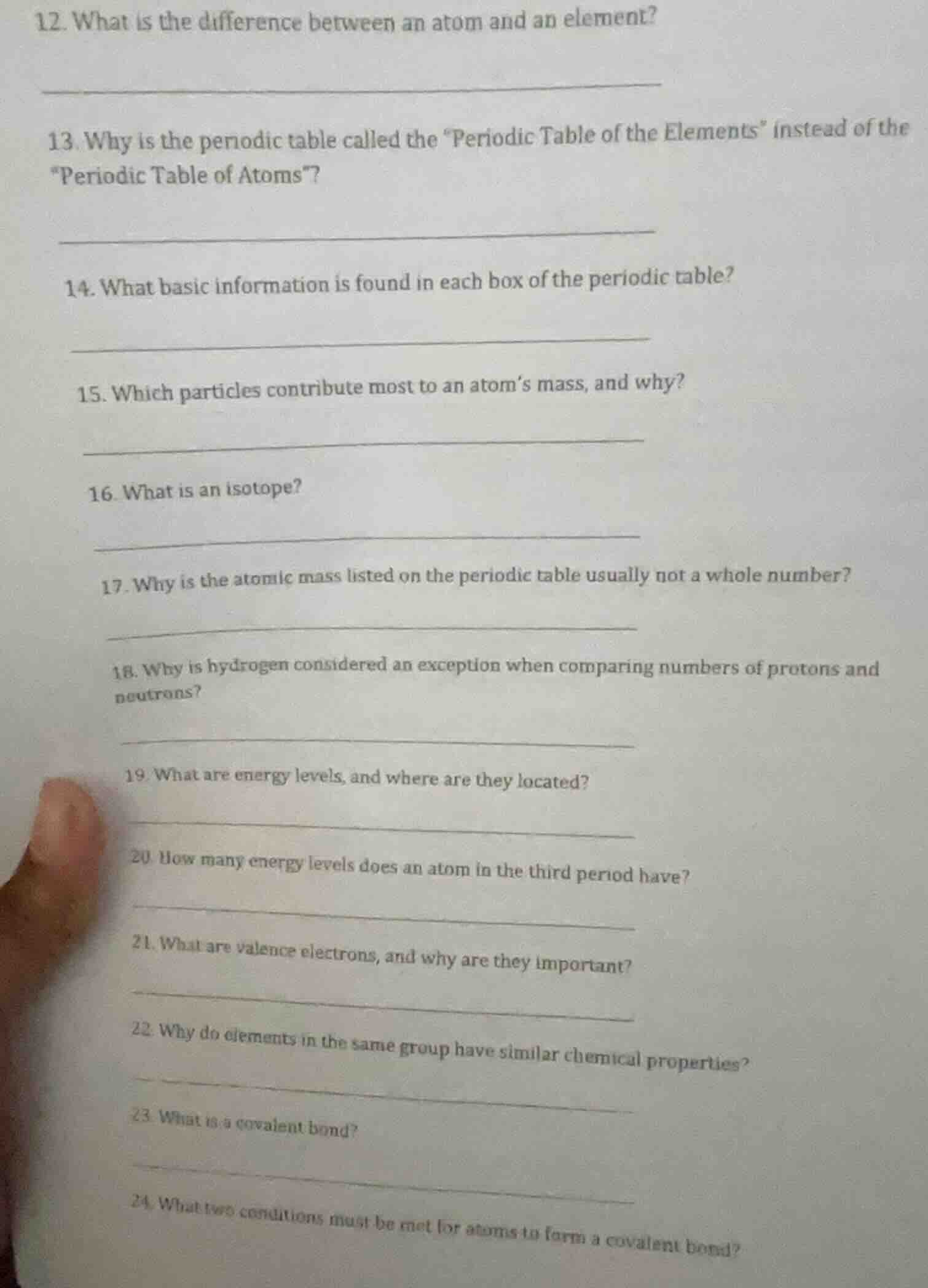
- what is the difference between an atom and an element?
- why is the periodic table called the \periodic table of the elements\ instead of the \periodic table of atoms\?
- what basic information is found in each box of the periodic table?
- which particles contribute most to an atom’s mass, and why?
- what is an isotope?
- why is the atomic mass listed on the periodic table usually not a whole number?
- why is hydrogen considered an exception when comparing numbers of protons and neutrons?
- what are energy levels, and where are they located?
- how many energy levels does an atom in the third period have?
- what are valence electrons, and why are they important?
- why do elements in the same group have similar chemical properties?
- what is a covalent bond?
- what two conditions must be met for atoms to form a covalent bond?
Question 12:
An atom is the smallest unit of matter with its element's properties. An element is a pure substance with unique atoms (same proton number). So an atom is a particle, an element is a substance made of same - type atoms.
The periodic table organizes elements. An element is a substance with unique atoms (same protons). Atoms of an element can have isotopes (different neutrons), so the table is about elements (based on proton number, defining the element) rather than atoms (which can vary in neutrons).
Each box in the periodic table has the element's symbol, atomic number (protons), atomic mass (average of isotopes' masses), and often the element's name. Some tables may also have electron configuration info.

Snap & solve any problem in the app
Get step-by-step solutions on Sovi AI
Photo-based solutions with guided steps
Explore more problems and detailed explanations
An atom is the smallest particle of matter that retains the chemical properties of an element. An element is a pure substance made up of only one type of atom (all atoms of an element have the same number of protons). For example, a single carbon atom is an atom, while the substance "carbon" (which can be made up of many carbon atoms) is an element.