QUESTION IMAGE
Question
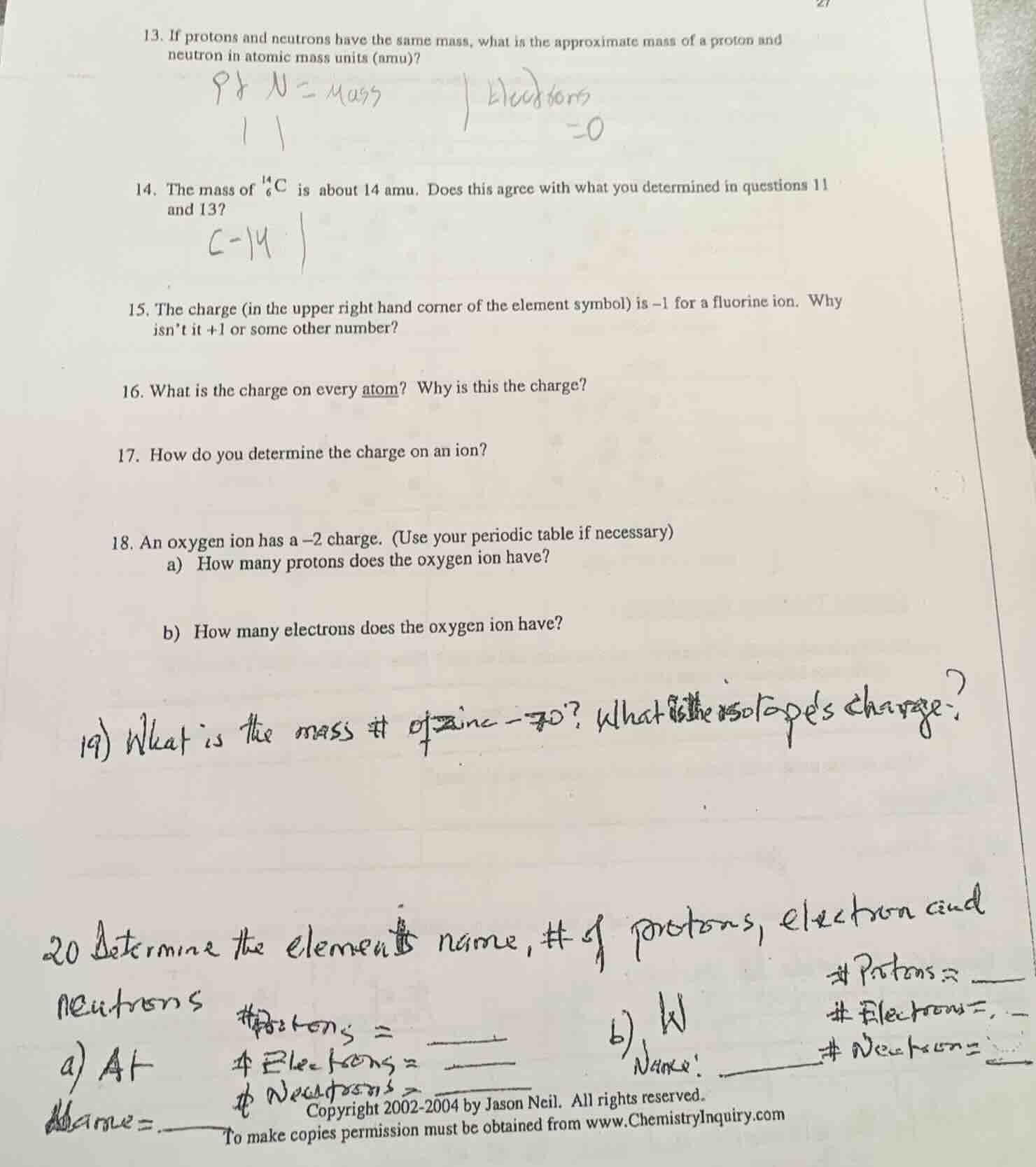
- if protons and neutrons have the same mass, what is the approximate mass of a proton and neutron in atomic mass units (amu)?
- the mass of (_6^{14}\text{c}) is about 14 amu. does this agree with what you determined in questions 11 and 13?
- the charge (in the upper right hand corner of the element symbol) is (-1) for a fluorine ion. why isn’t it (+1) or some other number?
- what is the charge on every atom? why is this the charge?
- how do you determine the charge on an ion?
- an oxygen ion has a (-2) charge. (use your periodic table if necessary)
a) how many protons does the oxygen ion have?
b) how many electrons does the oxygen ion have?
- what is the mass # of zinc - 70? what is the isotopes charge?
20 determine the elements name, # of protons, electron and neutrons
a) at
name=
#protons =
#electrons =
#neutrons =
b) w
name:
#protons =
#electrons =
#neutrons =
copyright 2002 - 2004 by jason neil. all rights reserved.
to make copies permission must be obtained from www.chemistryinquiry.com
Question 13
Step1: Recall atomic mass unit concept
Protons and neutrons have approximately the same mass, and 1 atomic mass unit (amu) is defined as approximately the mass of 1 proton or 1 neutron. So, the mass of a proton and a neutron is approximately 1 amu each.
Step1: Analyze carbon - 14 mass
Carbon - 14 ($_{6}^{14}\text{C}$) has 6 protons and 8 neutrons (since mass number = number of protons+number of neutrons, so number of neutrons = 14 - 6 = 8). From question 13, we know that protons and neutrons have a mass of approximately 1 amu each. So the total mass should be (number of protons×1 amu)+(number of neutrons×1 amu)=(6×1)+(8×1)=14 amu. So it agrees with the determination from questions 11 and 13.
Fluorine is in group 17 (halogens) of the periodic table. Halogens have 7 valence electrons. To achieve a stable octet (8 valence electrons), a fluorine atom gains 1 electron. When an atom gains an electron, it becomes an anion with a charge of - 1 (since electrons have a negative charge, gaining 1 electron gives a net charge of - 1). It can't be + 1 because fluorine has a high electronegativity and tends to gain electrons, not lose them (losing electrons would require a lot of energy as it is close to having a stable octet by gaining one electron).

Snap & solve any problem in the app
Get step-by-step solutions on Sovi AI
Photo-based solutions with guided steps
Explore more problems and detailed explanations
The approximate mass of a proton and a neutron is 1 amu.