QUESTION IMAGE
Question
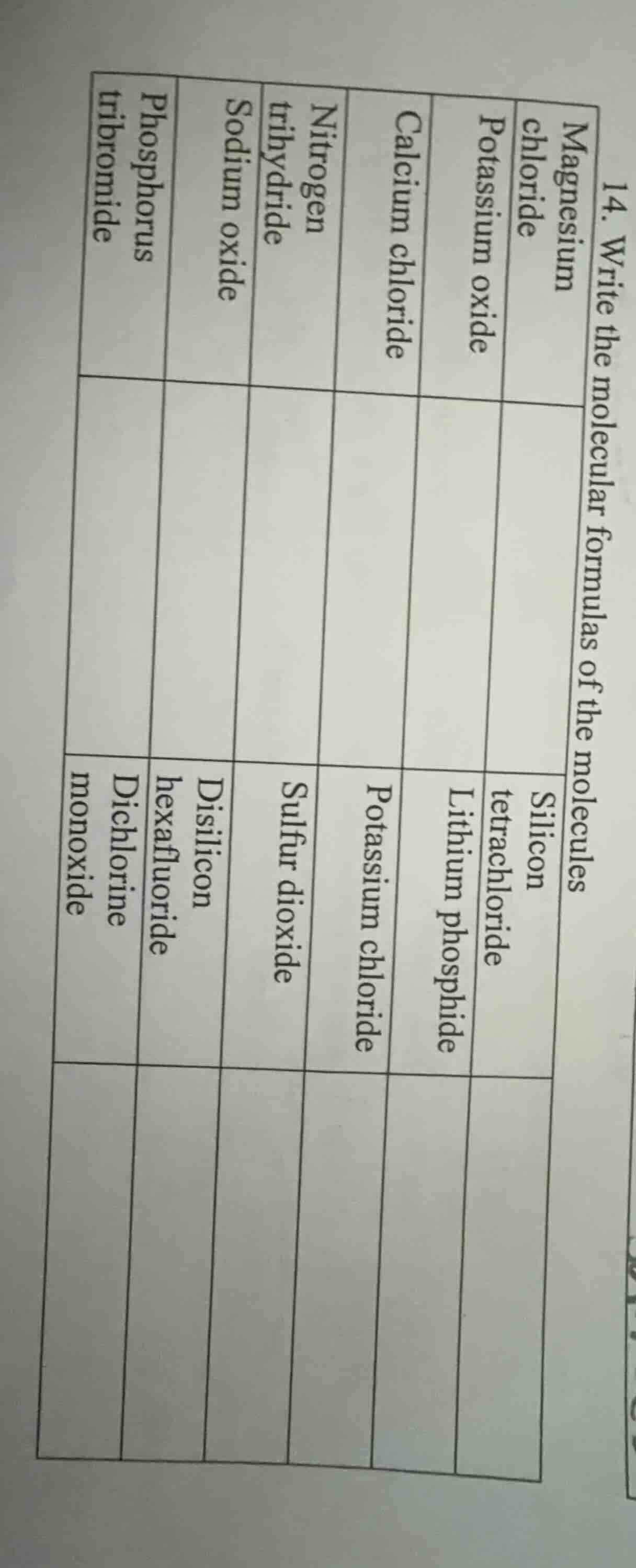
- write the molecular formulas of the molecules
magnesium chloride
potassium oxide
calcium chloride
nitrogen trihydride
sodium oxide
phosphorus tribromide
silicon tetrachloride
lithium phosphide
potassium chloride
sulfur dioxide
disilicon hexafluoride
dichlorine monoxide
To solve this, we determine the chemical formula for each compound by balancing the charges of ions (for ionic compounds) or using prefixes (for covalent compounds) to indicate the number of atoms.
1. Magnesium chloride
- Magnesium ion: \( \text{Mg}^{2+} \), Chloride ion: \( \text{Cl}^- \)
- Balance charges: \( 2 \times \text{Cl}^- \) balances \( \text{Mg}^{2+} \).
- Formula: \( \text{MgCl}_2 \)
2. Potassium oxide
- Potassium ion: \( \text{K}^+ \), Oxide ion: \( \text{O}^{2-} \)
- Balance charges: \( 2 \times \text{K}^+ \) balances \( \text{O}^{2-} \).
- Formula: \( \text{K}_2\text{O} \)
3. Calcium chloride
- Calcium ion: \( \text{Ca}^{2+} \), Chloride ion: \( \text{Cl}^- \)
- Balance charges: \( 2 \times \text{Cl}^- \) balances \( \text{Ca}^{2+} \).
- Formula: \( \text{CaCl}_2 \)
4. Nitrogen trihydride (Ammonia)
- Covalent compound: Prefixes indicate atoms. “Nitrogen” = 1 N, “trihydride” = 3 H.
- Formula: \( \text{NH}_3 \)
5. Sodium oxide
- Sodium ion: \( \text{Na}^+ \), Oxide ion: \( \text{O}^{2-} \)
- Balance charges: \( 2 \times \text{Na}^+ \) balances \( \text{O}^{2-} \).
- Formula: \( \text{Na}_2\text{O} \)
6. Phosphorus tribromide
- Covalent compound: “Phosphorus” = 1 P, “tribromide” = 3 Br.
- Formula: \( \text{PBr}_3 \)
7. Silicon tetrachloride
- Covalent compound: “Silicon” = 1 Si, “tetrachloride” = 4 Cl.
- Formula: \( \text{SiCl}_4 \)
8. Lithium phosphide
- Lithium ion: \( \text{Li}^+ \), Phosphide ion: \( \text{P}^{3-} \)
- Balance charges: \( 3 \times \text{Li}^+ \) balances \( \text{P}^{3-} \).
- Formula: \( \text{Li}_3\text{P} \)
9. Potassium chloride
- Potassium ion: \( \text{K}^+ \), Chloride ion: \( \text{Cl}^- \)
- Charges balance 1:1.
- Formula: \( \text{KCl} \)
10. Sulfur dioxide
- Covalent compound: “Sulfur” = 1 S, “dioxide” = 2 O.
- Formula: \( \text{SO}_2 \)
11. Disilicon hexafluoride
- Covalent compound: “Disilicon” = 2 Si, “hexafluoride” = 6 F.
- Formula: \( \text{Si}_2\text{F}_6 \)
12. Dichlorine monoxide
- Covalent compound: “Dichlorine” = 2 Cl, “monoxide” = 1 O.
- Formula: \( \text{Cl}_2\text{O} \)
Final Table (Formulas Filled):
| Compound | Formula | Compound | Formula |
|---|---|---|---|
| Potassium oxide | \( \text{K}_2\text{O} \) | Lithium phosphide | \( \text{Li}_3\text{P} \) |
| Calcium chloride | \( \text{CaCl}_2 \) | Potassium chloride | \( \text{KCl} \) |
| Nitrogen trihydride | \( \text{NH}_3 \) | Sulfur dioxide | \( \text{SO}_2 \) |
| Sodium oxide | \( \text{Na}_2\text{O} \) | Disilicon hexafluoride | \( \text{Si}_2\text{F}_6 \) |
| Phosphorus tribromide | \( \text{PBr}_3 \) | Dichlorine monoxide | \( \text{Cl}_2\text{O} \) |
(Note: For covalent compounds, prefixes (mono-, di-, tri-, tetra-, hexa-) indicate the number of atoms. For ionic compounds, charges of ions are balanced to form neutral compounds.)

Snap & solve any problem in the app
Get step-by-step solutions on Sovi AI
Photo-based solutions with guided steps
Explore more problems and detailed explanations
To solve this, we determine the chemical formula for each compound by balancing the charges of ions (for ionic compounds) or using prefixes (for covalent compounds) to indicate the number of atoms.
1. Magnesium chloride
- Magnesium ion: \( \text{Mg}^{2+} \), Chloride ion: \( \text{Cl}^- \)
- Balance charges: \( 2 \times \text{Cl}^- \) balances \( \text{Mg}^{2+} \).
- Formula: \( \text{MgCl}_2 \)
2. Potassium oxide
- Potassium ion: \( \text{K}^+ \), Oxide ion: \( \text{O}^{2-} \)
- Balance charges: \( 2 \times \text{K}^+ \) balances \( \text{O}^{2-} \).
- Formula: \( \text{K}_2\text{O} \)
3. Calcium chloride
- Calcium ion: \( \text{Ca}^{2+} \), Chloride ion: \( \text{Cl}^- \)
- Balance charges: \( 2 \times \text{Cl}^- \) balances \( \text{Ca}^{2+} \).
- Formula: \( \text{CaCl}_2 \)
4. Nitrogen trihydride (Ammonia)
- Covalent compound: Prefixes indicate atoms. “Nitrogen” = 1 N, “trihydride” = 3 H.
- Formula: \( \text{NH}_3 \)
5. Sodium oxide
- Sodium ion: \( \text{Na}^+ \), Oxide ion: \( \text{O}^{2-} \)
- Balance charges: \( 2 \times \text{Na}^+ \) balances \( \text{O}^{2-} \).
- Formula: \( \text{Na}_2\text{O} \)
6. Phosphorus tribromide
- Covalent compound: “Phosphorus” = 1 P, “tribromide” = 3 Br.
- Formula: \( \text{PBr}_3 \)
7. Silicon tetrachloride
- Covalent compound: “Silicon” = 1 Si, “tetrachloride” = 4 Cl.
- Formula: \( \text{SiCl}_4 \)
8. Lithium phosphide
- Lithium ion: \( \text{Li}^+ \), Phosphide ion: \( \text{P}^{3-} \)
- Balance charges: \( 3 \times \text{Li}^+ \) balances \( \text{P}^{3-} \).
- Formula: \( \text{Li}_3\text{P} \)
9. Potassium chloride
- Potassium ion: \( \text{K}^+ \), Chloride ion: \( \text{Cl}^- \)
- Charges balance 1:1.
- Formula: \( \text{KCl} \)
10. Sulfur dioxide
- Covalent compound: “Sulfur” = 1 S, “dioxide” = 2 O.
- Formula: \( \text{SO}_2 \)
11. Disilicon hexafluoride
- Covalent compound: “Disilicon” = 2 Si, “hexafluoride” = 6 F.
- Formula: \( \text{Si}_2\text{F}_6 \)
12. Dichlorine monoxide
- Covalent compound: “Dichlorine” = 2 Cl, “monoxide” = 1 O.
- Formula: \( \text{Cl}_2\text{O} \)
Final Table (Formulas Filled):
| Compound | Formula | Compound | Formula |
|---|---|---|---|
| Potassium oxide | \( \text{K}_2\text{O} \) | Lithium phosphide | \( \text{Li}_3\text{P} \) |
| Calcium chloride | \( \text{CaCl}_2 \) | Potassium chloride | \( \text{KCl} \) |
| Nitrogen trihydride | \( \text{NH}_3 \) | Sulfur dioxide | \( \text{SO}_2 \) |
| Sodium oxide | \( \text{Na}_2\text{O} \) | Disilicon hexafluoride | \( \text{Si}_2\text{F}_6 \) |
| Phosphorus tribromide | \( \text{PBr}_3 \) | Dichlorine monoxide | \( \text{Cl}_2\text{O} \) |
(Note: For covalent compounds, prefixes (mono-, di-, tri-, tetra-, hexa-) indicate the number of atoms. For ionic compounds, charges of ions are balanced to form neutral compounds.)