QUESTION IMAGE
Question
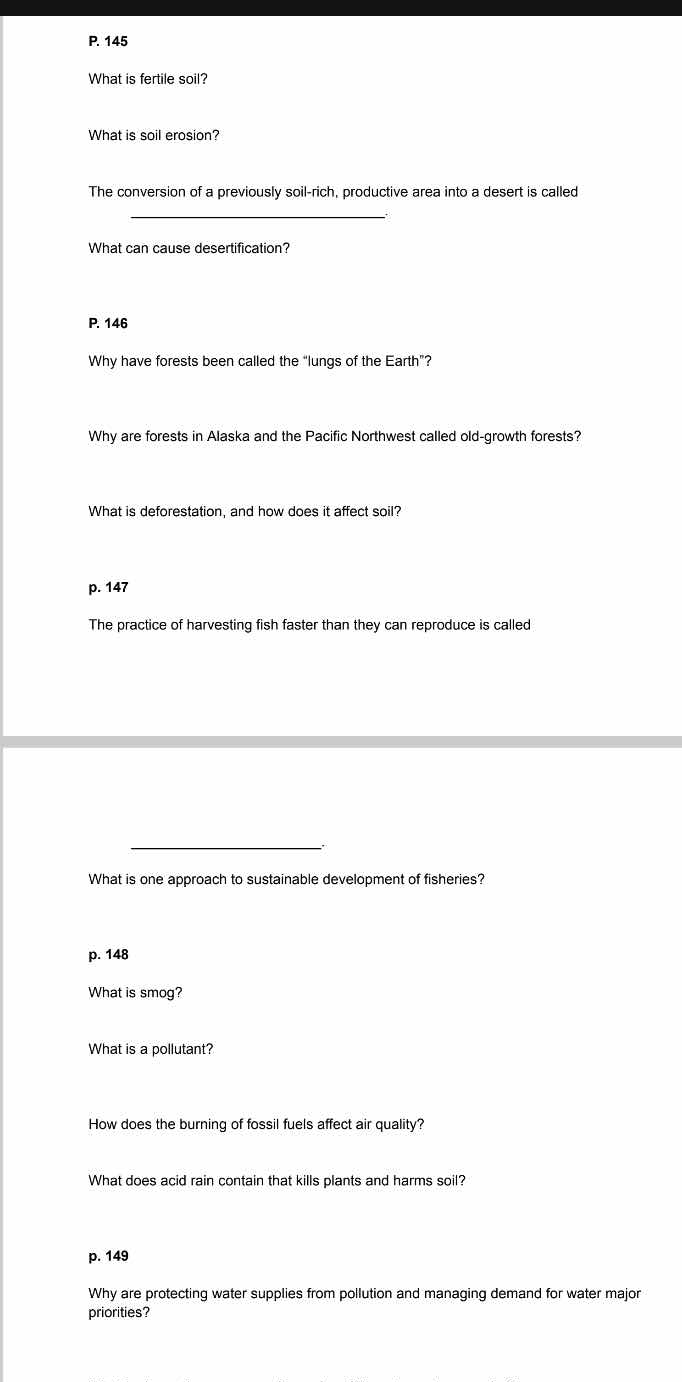
p. 145
what is fertile soil?
what is soil erosion?
the conversion of a previously soil - rich, productive area into a desert is called
what can cause desertification?
p. 146
why have forests been called the \lungs of the earth\?
why are forests in alaska and the pacific northwest called old - growth forests?
what is deforestation, and how does it affect soil?
p. 147
the practice of harvesting fish faster than they can reproduce is called
what is one approach to sustainable development of fisheries?
p. 148
what is smog?
what is a pollutant?
how does the burning of fossil fuels affect air quality?
what does acid rain contain that kills plants and harms soil?
p. 149
why are protecting water supplies from pollution and managing demand for water major priorities?
- Fertile soil: Soil with sufficient nutrients, organic matter, and structure to support healthy plant growth.
- Soil erosion: The natural or human-caused process of topsoil being worn away by wind, water, or other forces.
- Desertification term: The conversion described is desertification.
- Desertification causes: Drought, overgrazing, deforestation, and unsustainable farming practices.
- Forests as "lungs of the Earth": They absorb carbon dioxide and release oxygen via photosynthesis, similar to how lungs exchange gases.
- Old-growth forests (Alaska/Pacific NW): They are mature, undisturbed forests with old trees, complex ecosystems, and no major human harvesting history.
- Deforestation and soil impact: Deforestation is the clearing of forests; it removes tree roots that hold soil, increasing erosion, and reduces organic matter input to soil, lowering fertility.
- Overfishing term: Harvesting fish faster than they reproduce is overfishing.
- Sustainable fisheries approach: Implementing catch limits based on scientific population assessments to let fish stocks replenish.
- Smog: A type of air pollution, often a mixture of smoke, fog, and chemical pollutants (like ground-level ozone) that reduces visibility and harms health.
- Pollutant: A substance (solid, liquid, gas) that contaminates air, water, or soil, causing harm to living organisms or the environment.
- Fossil fuels and air quality: Burning releases pollutants like carbon monoxide, sulfur dioxide, nitrogen oxides, and particulate matter, which reduce air quality, cause smog, and harm respiratory health.
- Acid rain harmful component: It contains high levels of sulfuric acid ($H_2SO_4$) and nitric acid ($HNO_3$), which damage plants and alter soil chemistry.
- Water supply priorities: Clean water is essential for all life, and growing human demand plus pollution threaten access, so protecting supplies and managing demand ensure long-term availability.

Snap & solve any problem in the app
Get step-by-step solutions on Sovi AI
Photo-based solutions with guided steps
Explore more problems and detailed explanations
- Fertile soil is nutrient-rich, organically dense soil that supports robust plant growth.
- Soil erosion is the wearing away of topsoil by wind, water, or human activity.
- desertification
- Drought, overgrazing, deforestation, unsustainable agriculture.
- They absorb $CO_2$ and release $O_2$ via photosynthesis.
- They are mature, undisturbed forests with old trees and complex ecosystems.
- Deforestation is forest clearing; it increases soil erosion and reduces soil fertility.
- overfishing
- Enforce science-based catch limits to let stocks recover.
- Smog is a toxic mix of fog, smoke, and chemical air pollutants.
- A pollutant is a substance that contaminates environments and harms life.
- It releases harmful pollutants that reduce air quality and cause smog.
- Sulfuric acid ($H_2SO_4$) and nitric acid ($HNO_3$)
- Clean water is vital for life, and demand/pollution threaten global access.