QUESTION IMAGE
Question
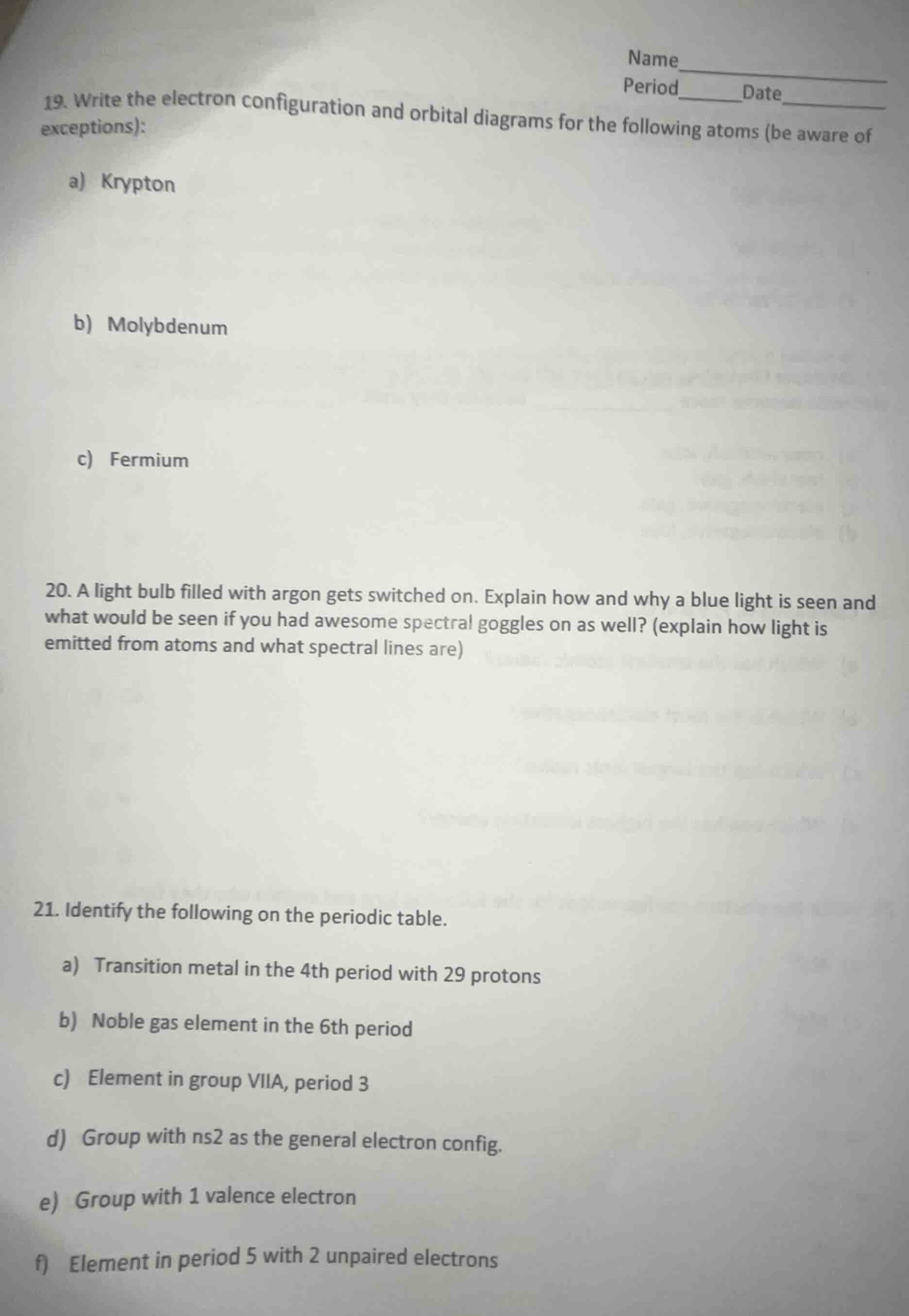
- write the electron configuration and orbital diagrams for the following atoms (be aware of exceptions):
a) krypton
b) molybdenum
c) fermium
- a light bulb filled with argon gets switched on. explain how and why a blue light is seen and what would be seen if you had awesome spectral goggles on as well? (explain how light is emitted from atoms and what spectral lines are)
- identify the following on the periodic table.
a) transition metal in the 4th period with 29 protons
b) noble gas element in the 6th period
c) element in group viia, period 3
d) group with ns2 as the general electron config.
e) group with 1 valence electron
f) element in period 5 with 2 unpaired electrons
---
Question 19
Step1: Find atomic number of Kr
Krypton (Kr) has atomic number 36.
Step2: Write full electron config
$1s^2 2s^2 2p^6 3s^2 3p^6 4s^2 3d^{10} 4p^6$
Step3: Orbital diagram for Kr
- $1s: \uparrow\downarrow$; $2s: \uparrow\downarrow$; $2p: \uparrow\downarrow\ \uparrow\downarrow\ \uparrow\downarrow$
- $3s: \uparrow\downarrow$; $3p: \uparrow\downarrow\ \uparrow\downarrow\ \uparrow\downarrow$; $4s: \uparrow\downarrow$
- $3d: \uparrow\downarrow\ \uparrow\downarrow\ \uparrow\downarrow\ \uparrow\downarrow\ \uparrow\downarrow$; $4p: \uparrow\downarrow\ \uparrow\downarrow\ \uparrow\downarrow$
Step1: Find atomic number of Mo
Molybdenum (Mo) has atomic number 42 (exception: half-filled $4d$ is stable).
Step2: Write electron config (exception)
$1s^2 2s^2 2p^6 3s^2 3p^6 4s^1 3d^{10} 4p^6 5s^1 4d^5$
Step3: Orbital diagram for Mo
- Core (Kr config): same as Kr above
- $5s: \uparrow$; $4d: \uparrow\ \uparrow\ \uparrow\ \uparrow\ \uparrow$
Step1: Find atomic number of Fm
Fermium (Fm) has atomic number 100.
Step2: Write electron config (uses actinide filling)
$1s^2 2s^2 2p^6 3s^2 3p^6 4s^2 3d^{10} 4p^6 5s^2 4d^{10} 5p^6 6s^2 4f^{14} 5d^{10} 6p^6 7s^2 5f^{12}$
Step3: Orbital diagram for Fm
- Core (Rn config): $1s$ to $6p$ filled (all $\uparrow\downarrow$)
- $7s: \uparrow\downarrow$; $5f$: 12 electrons $
ightarrow$ $\uparrow\downarrow\ \uparrow\downarrow\ \uparrow\downarrow\ \uparrow\downarrow\ \uparrow\downarrow\ \uparrow\ \uparrow$
- Blue Light Emission: When the bulb is switched on, electrical energy excites argon atoms' valence electrons, moving them to higher energy levels. These excited electrons are unstable and quickly drop back to their ground (lowest) energy level. The energy difference between the excited and ground levels is released as a photon of light. For argon, this energy corresponds to photons in the blue region of the visible spectrum, so we see blue light.
- Spectral Goggles Observation: Spectral lines are discrete, narrow bands of light corresponding to specific electron energy transitions (each transition emits a photon of a fixed wavelength). With spectral goggles, instead of seeing continuous blue light, you would see distinct, bright emission lines (specifically, argon's characteristic visible and ultraviolet spectral lines, including the blue line plus other non-visible lines the goggles can detect).
a) Number of protons = atomic number; atomic number 29 is copper, a 4th period transition metal.
b) 6th period noble gas is radon (Rn, atomic number 86).
c) Group VIIA (17), period 3 is chlorine (Cl, atomic number 17).
d) $ns^2$ corresponds to group 2 (alkaline earth metals), where all elements have 2 valence $s$-electrons.
e) Group 1 (alkali metals) has 1 valence electron in their outermost $s$-orbital.
f) In period 5, tin (Sn, atomic number 50) has electron configuration $[Kr] 5s^2 4d^{10} 5p^2$, with 2 unpaired $5p$ electrons.

Snap & solve any problem in the app
Get step-by-step solutions on Sovi AI
Photo-based solutions with guided steps
Explore more problems and detailed explanations
a) Krypton:
Electron Configuration: $1s^2 2s^2 2p^6 3s^2 3p^6 4s^2 3d^{10} 4p^6$
Orbital Diagram: All orbitals fully paired (each subshell has $\uparrow\downarrow$ in every orbital)
b) Molybdenum:
Electron Configuration: $1s^2 2s^2 2p^6 3s^2 3p^6 4s^1 3d^{10} 4p^6 5s^1 4d^5$
Orbital Diagram: Core orbitals fully paired; $5s$ has one unpaired electron, $4d$ has 5 unpaired electrons (half-filled subshell)
c) Fermium:
Electron Configuration: $1s^2 2s^2 2p^6 3s^2 3p^6 4s^2 3d^{10} 4p^6 5s^2 4d^{10} 5p^6 6s^2 4f^{14} 5d^{10} 6p^6 7s^2 5f^{12}$
Orbital Diagram: Core orbitals fully paired; $7s$ fully paired; $5f$ has 4 fully paired orbitals and 2 unpaired electrons
---