QUESTION IMAGE
Question
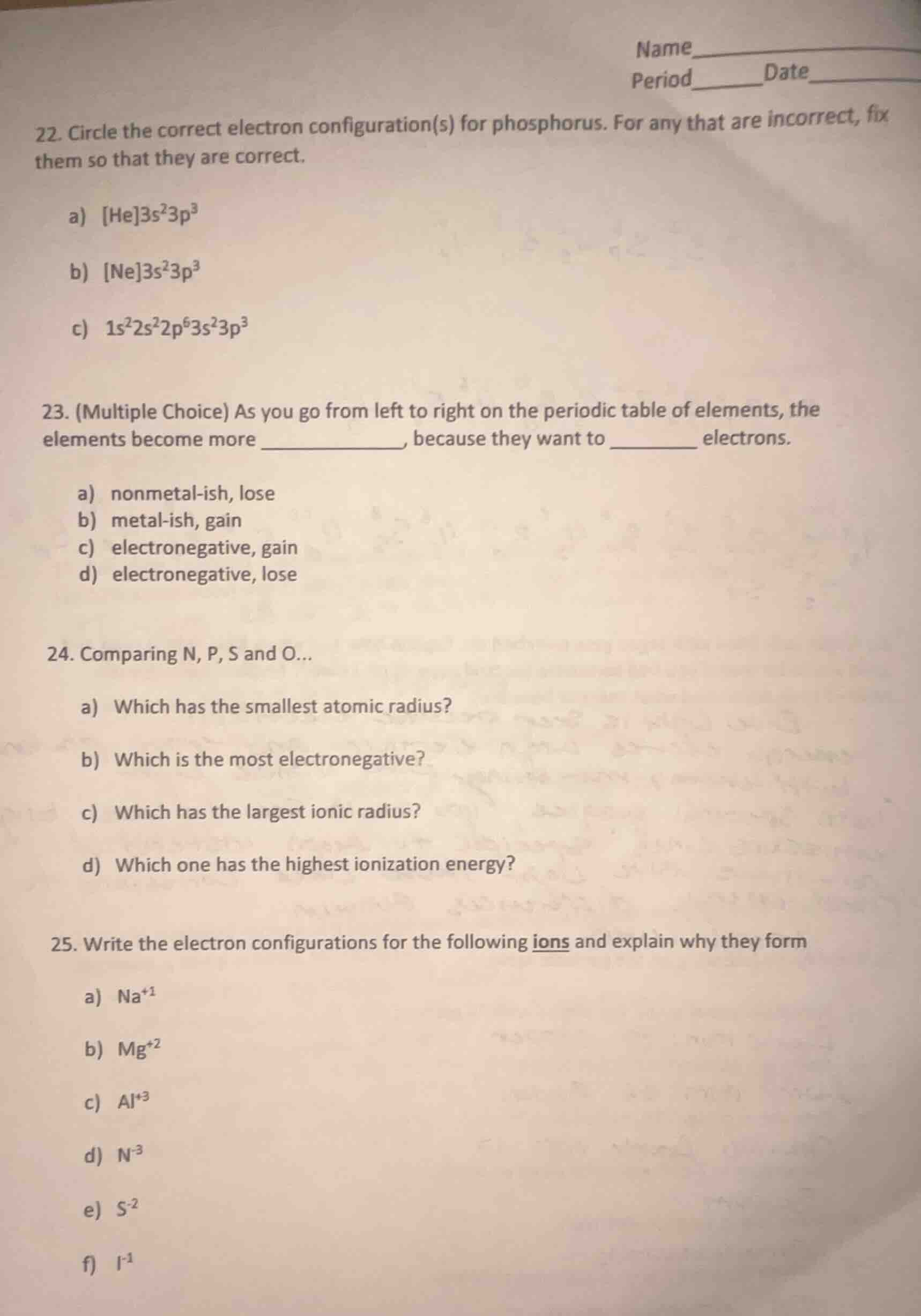
- (multiple choice) as you go from left to right on the periodic table of elements, the elements become more __________, because they want to ______ electrons.
a) nonmetal - ish, lose
b) metal - ish, gain
c) electronegative, gain
d) electronegative, lose
Step1: Analyze P's atomic number
Phosphorus (P) has an atomic number of 15, so it has 15 electrons.
Step2: Evaluate each configuration
a) $[He]3s^23p^3$: He has 2 electrons; total = $2+2+3=7$ (incorrect). Fix to $[Ne]3s^23p^3$ (Ne has 10 electrons, $10+2+3=15$).
b) $[Ne]3s^23p^3$: Ne has 10 electrons; total = $10+2+3=15$ (correct).
c) $1s^22s^22p^63s^23p^3$: Sum = $2+2+6+2+3=15$ (correct).
---
Step1: Recall periodic trend (left→right)
As you move left to right across a period, electronegativity increases, and nonmetals (right side) tend to gain electrons to fill valence shells.
Step2: Match to options
Option c matches this trend.
---
Step1: Recall atomic radius trends
Atomic radius decreases left→right across a period, and increases down a group. N and O are in period 2, P and S in period 3. O is further right than N in period 2.
Step2: Recall electronegativity trends
Electronegativity increases left→right across a period, decreases down a group. O is in period 2, rightmost of the four.
Step3: Recall ionic radius trends
For anions, radius increases down a group; for cations, radius decreases left→right. $P^{3-}$ (from P) has more electron shells than $N^{3-}$, and larger radius than $S^{2-}$.
Step4: Recall ionization energy trends
Ionization energy increases left→right across a period, decreases down a group. N has a slight exception due to half-filled p-orbitals, making its ionization energy higher than O.
---
Step1: Analyze each ion's electron count
For cations, subtract charge from atomic number; for anions, add charge to atomic number.
Step2: Write electron configurations
Use noble gas shorthand or full configuration, and explain stability via octet rule.
---

Snap & solve any problem in the app
Get step-by-step solutions on Sovi AI
Photo-based solutions with guided steps
Explore more problems and detailed explanations
Question 22
- a) Incorrect; corrected to $\boldsymbol{[Ne]3s^23p^3}$
- b) Correct: $\boldsymbol{[Ne]3s^23p^3}$
- c) Correct: $\boldsymbol{1s^22s^22p^63s^23p^3}$
Question 23
c) electronegative, gain
Question 24
a) O
b) O
c) P (as $P^{3-}$)
d) N
Question 25
a) $\boldsymbol{1s^22s^22p^6}$ or $\boldsymbol{[Ne]}$; Na (atomic #11) loses 1 electron to achieve a stable noble gas electron configuration (octet).
b) $\boldsymbol{1s^22s^22p^6}$ or $\boldsymbol{[Ne]}$; Mg (atomic #12) loses 2 electrons to achieve a stable noble gas electron configuration (octet).
c) $\boldsymbol{1s^22s^22p^6}$ or $\boldsymbol{[Ne]}$; Al (atomic #13) loses 3 electrons to achieve a stable noble gas electron configuration (octet).
d) $\boldsymbol{1s^22s^22p^6}$ or $\boldsymbol{[Ne]}$; N (atomic #7) gains 3 electrons to achieve a stable noble gas electron configuration (octet).
e) $\boldsymbol{1s^22s^22p^63s^23p^6}$ or $\boldsymbol{[Ar]}$; S (atomic #16) gains 2 electrons to achieve a stable noble gas electron configuration (octet).
f) $\boldsymbol{1s^22s^22p^63s^23p^63d^{10}4s^24p^6}$ or $\boldsymbol{[Xe]}$; I (atomic #53) gains 1 electron to achieve a stable noble gas electron configuration (octet).