QUESTION IMAGE
Question
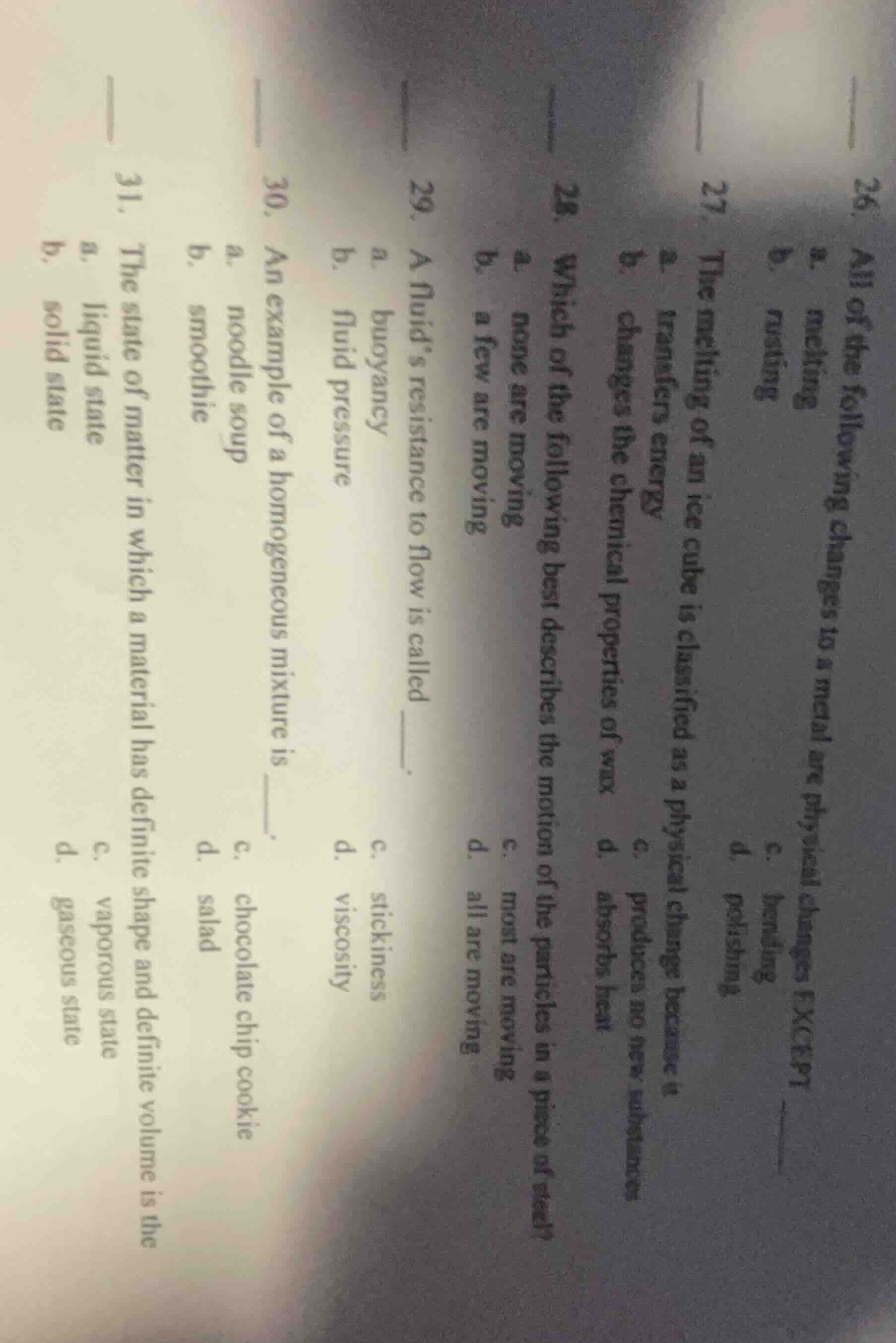
- all of the following changes to a metal are physical changes except——
a. melting
b. rusting
c. bending
d. polishing
- the melting of an ice cube is classified as a physical change because it——
a. transfers energy
b. changes the chemical properties of wax
c. produces no new substance
d. absorbs heat
- which of the following best describes the motion of the particles in a piece of steel?
a. none are moving
b. a few are moving
c. most are moving
d. all are moving
- a fluid’s resistance to flow is called——
a. buoyancy
b. fluid pressure
c. stickiness
d. viscosity
- an example of a homogeneous mixture is——
a. noodle soup
b. smoothie
c. chocolate chip cookie
d. salad
- the state of matter in which a material has definite shape and definite volume is the
a. liquid state
b. solid state
c. vaporous state
d. gaseous state
Question 26
Physical changes in metals don't alter their chemical composition. Melting (a), bending (c), and polishing (d) are physical. Rusting (b) is a chemical change (metal reacts with oxygen to form rust, new substance). So the non - physical change is rusting.
A physical change doesn't produce a new substance. Melting ice (solid to liquid water) transfers energy (a), changes wax's chemical properties would be chemical (b), absorbing heat is part of a change but not the classification reason (d). Since melting ice just changes state, no new substance, it's physical.
In any piece of steel (a solid), all particles (atoms) are in constant motion (kinetic theory of matter - particles in solids vibrate in place, still moving). So the best description is all are moving.

Snap & solve any problem in the app
Get step-by-step solutions on Sovi AI
Photo-based solutions with guided steps
Explore more problems and detailed explanations
b. rusting