QUESTION IMAGE
Question
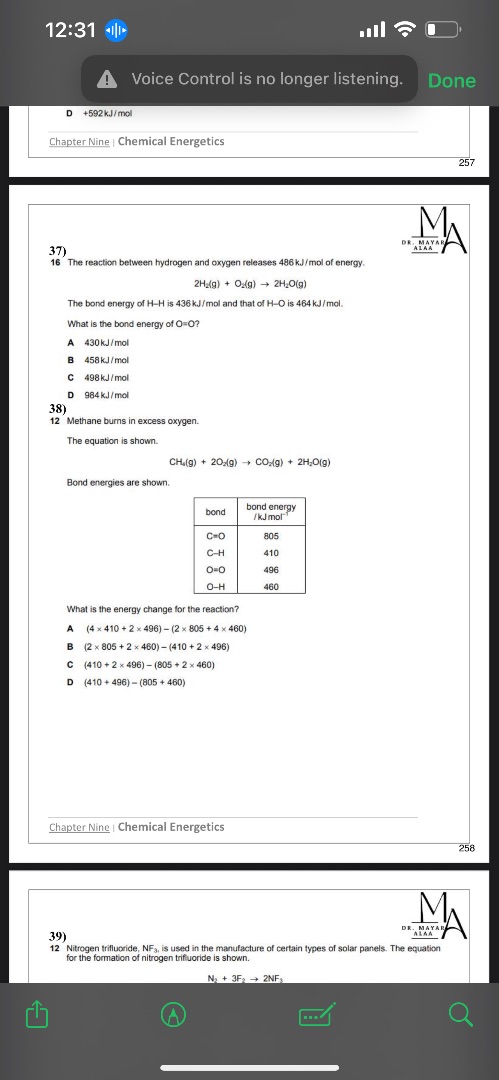
37)
16 the reaction between hydrogen and oxygen releases 486 kj/mol of energy.
2h₂(g) + o₂(g) → 2h₂o(g)
the bond energy of h-h is 436 kj/mol and that of h-o is 464 kj/mol.
what is the bond energy of o=o?
a 430 kj/mol
b 450 kj/mol
c 498 kj/mol
d 984 kj/mol
38)
12 methane burns in excess oxygen.
the equation is shown.
ch₄(g) + 2o₂(g) → co₂(g) + 2h₂o(g)
bond energies are shown.
| bond | bond energy /kj·mol⁻¹ |
|---|---|
| c-h | 410 |
| o=o | 498 |
| o-h | 460 |
what is the energy change for the reaction?
a (4×410 + 2×498) - (2×805 + 4×460)
b (2×805 + 2×460) - (410 + 2×498)
c (410 + 2×498) - (805 + 2×460)
d (410 + 498) - (805 + 460)
39)
12 nitrogen trifluoride, nf₃, is used in the manufacture of certain types of solar panels. the equation for the formation of nitrogen trifluoride is shown.
n₂ + 3f₂ → 2nf₃
\(2\) \(O - H\) bonds, and there are \(2\) \(H_2O\) molecules)
The reaction releases \(486\) kJ/mol, so \(\Delta H=- 486\) kJ/mol (negative because energy is released).
Using the formula \(\Delta H=\text{Sum of bond energies of reactants}-\text{Sum of bond energies of products}\)
\(-486=(2\times436 + x)-(4\times464)\)
Step2: Solve for \(x\)
First, calculate \(2\times436 = 872\) and \(4\times464 = 1856\)
So, \(-486=872 + x-1856\)
Simplify the right - hand side: \(872 + x-1856=x - 984\)
Then, \(x-984=-486\)
Add \(984\) to both sides: \(x=-486 + 984=498\) kJ/mol? Wait, no, wait. Wait, maybe I made a mistake in the sign. Wait, the formula is \(\Delta H=\sum E_{\text{reactants bonds broken}}-\sum E_{\text{products bonds formed}}\). If the reaction releases energy, \(\Delta H\) is negative.
Wait, let's re - do:
\(\Delta H=\) (bonds broken) - (bonds formed)
Bonds broken: \(2\) \(H_2\) (so \(2\) \(H - H\) bonds) and \(1\) \(O_2\) (1 \(O = O\) bond). So energy absorbed for breaking: \(2\times436+x\)
Bonds formed: \(4\) \(O - H\) bonds (in \(2\) \(H_2O\) molecules). Energy released for forming: \(4\times464\)
Since the reaction releases energy, the energy released (486) is equal to (energy released in forming) - (energy absorbed in breaking)
So \(486=(4\times464)-(2\times436 + x)\)
\(4\times464 = 1856\), \(2\times436 = 872\)
\(486=1856-(872 + x)\)
\(486=1856 - 872-x\)
\(486 = 984-x\)
Then, \(x=984 - 486=498\)? Wait, but let's check the options. Wait, maybe I messed up the number of bonds.
Wait, the reaction is \(2H_2(g)+O_2(g)
ightarrow2H_2O(g)\)
Number of \(H - H\) bonds broken: \(2\) (since \(2\) \(H_2\) molecules, each with 1 \(H - H\) bond)
Number of \(O = O\) bonds broken: \(1\)
Number of \(O - H\) bonds formed: \(4\) (since each \(H_2O\) has 2 \(O - H\) bonds, and 2 \(H_2O\) molecules)
So, \(\Delta H=(2\times E_{H - H}+E_{O = O})-(4\times E_{O - H})\)
We know \(\Delta H=- 486\) (because energy is released)
So, \(-486=(2\times436 + E_{O = O})-(4\times464)\)
\(2\times436=872\), \(4\times464 = 1856\)
\(-486=872+E_{O = O}-1856\)
\(-486=E_{O = O}-984\)
\(E_{O = O}=984 - 486 = 498\) kJ/mol? Wait, but the options have 498 as option C. Wait, maybe I made a mistake in the sign. Wait, if the reaction releases energy, the bonds formed release more energy than the bonds broken absorb. So \(\text{Energy released}=\text{Energy from forming bonds}-\text{Energy for breaking bonds}\)
So \(486=(4\times464)-(2\times436 + E_{O = O})\)
Which is the same as above. So \(E_{O = O}=4\times464-2\times436 - 486\)
\(4\times464 = 1856\), \(2\times436 = 872\)
\(E_{O = O}=1856-872 - 486=1856-(872 + 486)=1856 - 1358 = 498\) kJ/mol. So the bond energy of \(O = O\) is 498 kJ/mol, which is option C.
Step1: Recall the formula for energy change in a reaction
The energy change (\(\Delta H\)) of a reaction is given by the sum of the bond energies of the bonds broken (reactants) minus the sum of the bond energies of the bonds formed (products).
For the reaction \(CH_4(g)+2O_2(g)
ightarrow CO_2(g)+2H_2O(g)\)
Step 2: Identify bonds broken and bonds formed
- Bonds broken:
- In \(CH_4\): There are \(4\) \(C - H\) bonds, so energy for breaking \(C - H\) bonds: \(4\times E_{C - H}=4\times410\)
- In \(2O_2\): Wait, no, the reaction is \(CH_4 + 2O_2
ightarrow CO_2+2H_2O\). The \(O_2\) has \(O = O\) bonds. So number of \(O = O\) bonds broken: \(2\) (since 2 moles of \(O_2\)), and each \(O_2\) has 1 \(O = O\) bond? Wait, no, the bond in \(O_2\) is \(O = O\), but in the table, the bond energies are given as \(C = O\) (805), \(C - H\) (410), \(O = O\) (498), \(O - H\) (460). Wait, wait, the table: bond \(C = O\) (805), \(C - H\) (410), \(O = O\) (498), \(O - H\) (460).
So, bonds broken:
- \(CH_4\) has 4 \(C - H\) bonds: energy \(4\times410\)
- \(2O_2\) has 2 \(O = O\) bonds: energy \(2\times498\)
So total energy for bonds broken: \(4\times410+2\times498\)
- Bonds formed:
- \(CO_2\) has 2 \(C = O\) bonds (since \(CO_2\) is \(O = C = O\)), so energy for forming \(CO_2\) bonds: \(2\times805\)
- \(2H_2O\) has \(2\times2 = 4\) \(O - H\) bonds (each \(H_2O\) has 2 \(O - H\) bonds), so energy for forming \(O - H\) bonds: \(4\times460\)
So total energy for bonds formed: \(2\times805 + 4\times460\)
Then, \(\Delta H=\) (bonds broken) - (bonds formed) \(=(4\times410 + 2\times498)-(2\times805+4\times460)\)
Which matches option A: \((4\times410 + 2\times498)-(2\times805 + 4\times460)\)

Snap & solve any problem in the app
Get step-by-step solutions on Sovi AI
Photo-based solutions with guided steps
Explore more problems and detailed explanations
C 498 kJ/mol