QUESTION IMAGE
Question
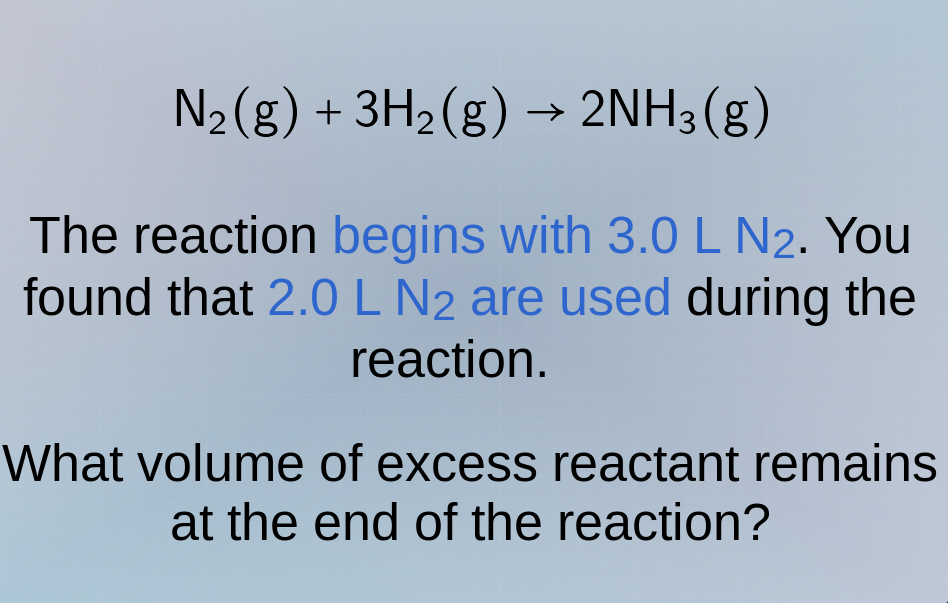
n₂(g) + 3h₂(g) → 2nh₃(g)
the reaction begins with 3.0 l n₂. you found that 2.0 l n₂ are used during the reaction.
what volume of excess reactant remains at the end of the reaction?
Step1: Determine the excess reactant and its initial volume
The initial volume of \(N_2\) is \(3.0\space L\), and the volume of \(N_2\) used is \(2.0\space L\). So, \(N_2\) is in excess? Wait, no, let's check the stoichiometry for \(H_2\). First, find the volume of \(H_2\) required to react with \(2.0\space L\) of \(N_2\). From the reaction \(N_2(g)+3H_2(g)
ightarrow2NH_3(g)\), the volume ratio of \(N_2\) to \(H_2\) is \(1:3\). So, volume of \(H_2\) required \(= 3\times\) volume of \(N_2\) used. Volume of \(N_2\) used is \(2.0\space L\), so volume of \(H_2\) required \(= 3\times2.0 = 6.0\space L\). But wait, we need to see if \(H_2\) is present? Wait, no, the problem is about excess reactant. Wait, initial \(N_2\) is \(3.0\space L\), used \(2.0\space L\), so remaining \(N_2\) would be \(3.0 - 2.0 = 1.0\space L\)? No, wait, maybe \(H_2\) is the other reactant. Wait, the problem says "excess reactant". Let's re - evaluate.
The reaction is \(N_2 + 3H_2
ightarrow2NH_3\). The volume ratio of \(N_2\) to \(H_2\) is \(1:3\). We have initial \(N_2 = 3.0\space L\), used \(N_2 = 2.0\space L\). So, moles (or volume, since at same T and P, volume is proportional to moles) of \(N_2\) used is \(2.0\space L\). Then, moles of \(H_2\) required is \(3\times2.0 = 6.0\space L\). But wait, we need to check if \(H_2\) is present. Wait, no, the problem is about excess reactant. Wait, maybe the initial amount of \(H_2\) is not given? Wait, no, maybe I misread. Wait, the reaction starts with \(3.0\space L\) of \(N_2\), and \(2.0\space L\) of \(N_2\) is used. So, the excess reactant is \(N_2\)? Wait, no, maybe \(H_2\) is the limiting? Wait, no, the problem is to find the volume of excess reactant. Wait, perhaps the initial \(H_2\) is not given, but that can't be. Wait, no, maybe the question is assuming that \(H_2\) is present in sufficient amount, but no, the excess reactant here is \(N_2\). Wait, initial \(N_2 = 3.0\space L\), used \(2.0\space L\), so remaining \(N_2 = 3.0 - 2.0 = 1.0\space L\)? No, that can't be. Wait, no, let's do it properly.
From the reaction, the mole ratio (and volume ratio, since same T and P) of \(N_2\) to \(H_2\) is \(1:3\). Let's assume that \(H_2\) is present in an amount such that \(N_2\) is in excess. Wait, the initial volume of \(N_2\) is \(3.0\space L\), volume of \(N_2\) used is \(2.0\space L\). So, the amount of \(H_2\) that reacts is \(3\times2.0 = 6.0\space L\) (from the volume ratio). But since we are only concerned with the excess reactant, which is \(N_2\) here. The volume of \(N_2\) remaining is initial volume minus used volume. Initial \(N_2 = 3.0\space L\), used \(N_2 = 2.0\space L\), so remaining \(N_2 = 3.0 - 2.0 = 1.0\space L\)? Wait, no, that seems too simple. Wait, maybe I made a mistake. Wait, the excess reactant is \(N_2\), so the volume of excess reactant ( \(N_2\)) remaining is \(3.0 - 2.0 = 1.0\space L\). But wait, what about \(H_2\)? Wait, the problem doesn't give initial \(H_2\) volume. Wait, maybe the question is that \(H_2\) is present in a large amount, and \(N_2\) is the one with initial volume \(3.0\space L\), used \(2.0\space L\), so excess \(N_2\) is \(1.0\space L\). Or maybe I got the reactants wrong. Wait, let's re - read the problem.
"The reaction begins with \(3.0\space L\space N_2\). You found that \(2.0\space L\space N_2\) are used during the reaction. What volume of excess reactant remains at the end of the reaction?"
Ah, so \(N_2\) is the excess reactant? Wait, no, if \(N_2\) is used, then the other reactant \(H_2\) must be the limiting? But we don't have initial \(H_2\) volume. Wait…

Snap & solve any problem in the app
Get step-by-step solutions on Sovi AI
Photo-based solutions with guided steps
Explore more problems and detailed explanations
\(1.0\space L\)