QUESTION IMAGE
Question
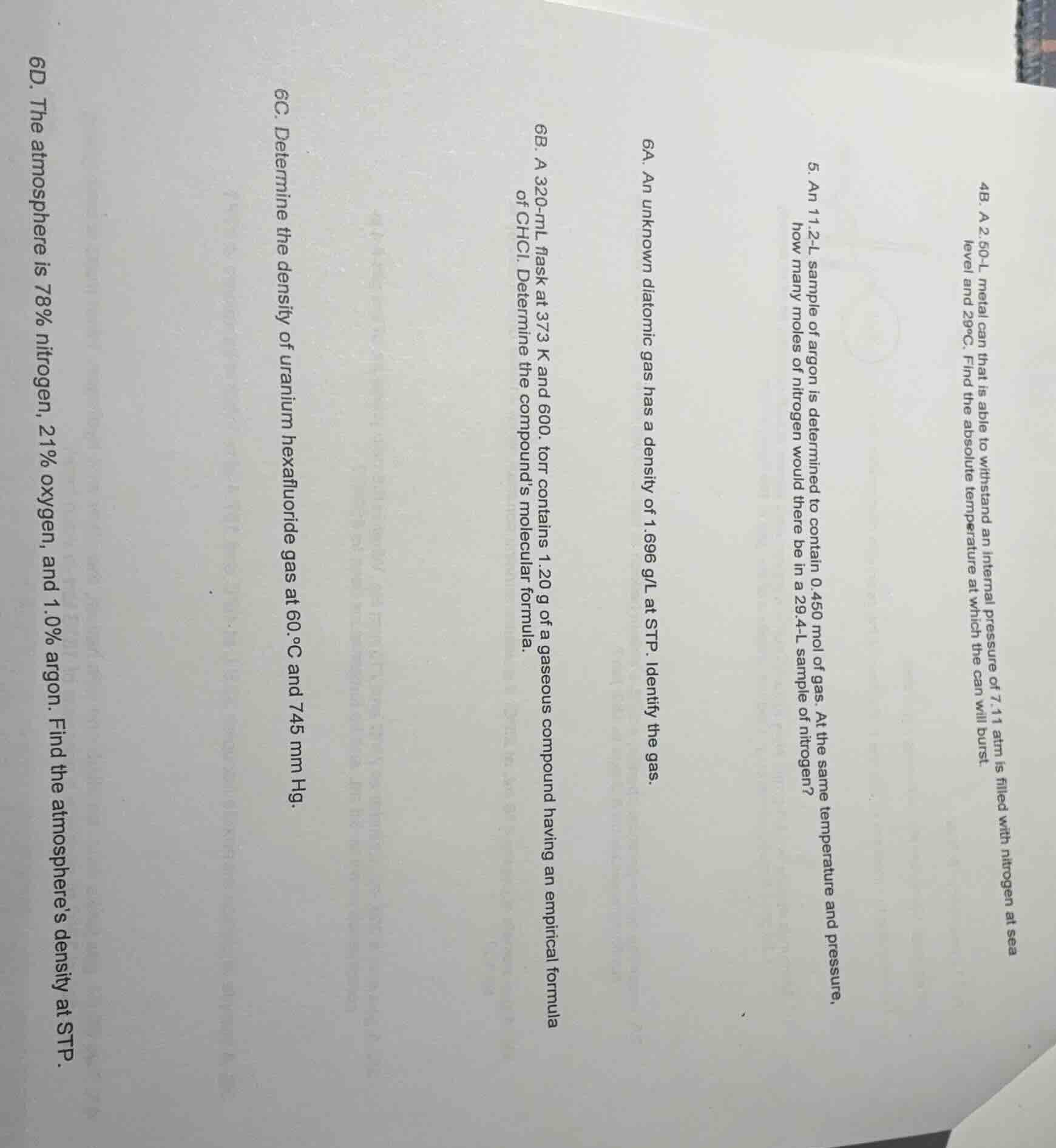
4b. a 2.50 - l metal can that is able to withstand an internal pressure of 7.11 atm is filled with nitrogen at sea level and 29°c. find the absolute temperature at which the can will burst.
- an 11.2 - l sample of argon is determined to contain 0.450 mol of gas. at the same temperature and pressure, how many moles of nitrogen would there be in a 29.4 - l sample of nitrogen?
6a. an unknown diatomic gas has a density of 1.696 g/l at stp. identify the gas.
6b. a 320 - ml flask at 373 k and 600. torr contains 1.20 g of a gaseous compound having an empirical formula of chcl. determine the compound’s molecular formula.
6c. determine the density of uranium hexafluoride gas at 60.°c and 745 mm hg.
6d. the atmosphere is 78% nitrogen, 21% oxygen, and 1.0% argon. find the atmosphere’s density at stp.
Let's solve problem 6D: Finding the atmosphere's density at STP.
Step 1: Recall the composition and molar masses
The atmosphere is 78% N₂, 21% O₂, and 1.0% Ar (by mole, since we're dealing with gases at the same conditions, mole fraction = volume fraction).
- Molar mass of N₂: \( M_{N_2} = 2 \times 14.01 = 28.02 \, \text{g/mol} \)
- Molar mass of O₂: \( M_{O_2} = 2 \times 16.00 = 32.00 \, \text{g/mol} \)
- Molar mass of Ar: \( M_{Ar} = 39.95 \, \text{g/mol} \)
Step 2: Calculate the average molar mass (\( \bar{M} \))
The average molar mass is the sum of the mole fraction (\( x \)) times the molar mass (\( M \)) of each component:
\[
\bar{M} = x_{N_2}M_{N_2} + x_{O_2}M_{O_2} + x_{Ar}M_{Ar}
\]
Substitute the mole fractions (78% = 0.78, 21% = 0.21, 1.0% = 0.01):
\[
\bar{M} = (0.78)(28.02) + (0.21)(32.00) + (0.01)(39.95)
\]
Step 3: Compute each term
- For N₂: \( 0.78 \times 28.02 = 21.8556 \, \text{g/mol} \)
- For O₂: \( 0.21 \times 32.00 = 6.72 \, \text{g/mol} \)
- For Ar: \( 0.01 \times 39.95 = 0.3995 \, \text{g/mol} \)
Step 4: Sum the terms
\[
\bar{M} = 21.8556 + 6.72 + 0.3995 = 28.9751 \, \text{g/mol} \approx 29.0 \, \text{g/mol}
\]
Step 5: Use density formula at STP
At STP (0°C, 1 atm), 1 mole of any ideal gas occupies 22.4 L. Density (\(
ho \)) is mass per volume:
\[
ho = \frac{\bar{M}}{V_m}
\]
where \( V_m = 22.4 \, \text{L/mol} \) (molar volume at STP).
Substitute \( \bar{M} = 29.0 \, \text{g/mol} \) and \( V_m = 22.4 \, \text{L/mol} \):
\[
ho = \frac{29.0 \, \text{g/mol}}{22.4 \, \text{L/mol}} \approx 1.29 \, \text{g/L}
\]

Snap & solve any problem in the app
Get step-by-step solutions on Sovi AI
Photo-based solutions with guided steps
Explore more problems and detailed explanations
The density of the atmosphere at STP is approximately \( \boldsymbol{1.29 \, \text{g/L}} \) (or more precisely, ~1.29 g/L when using the average molar mass we calculated).