QUESTION IMAGE
Question
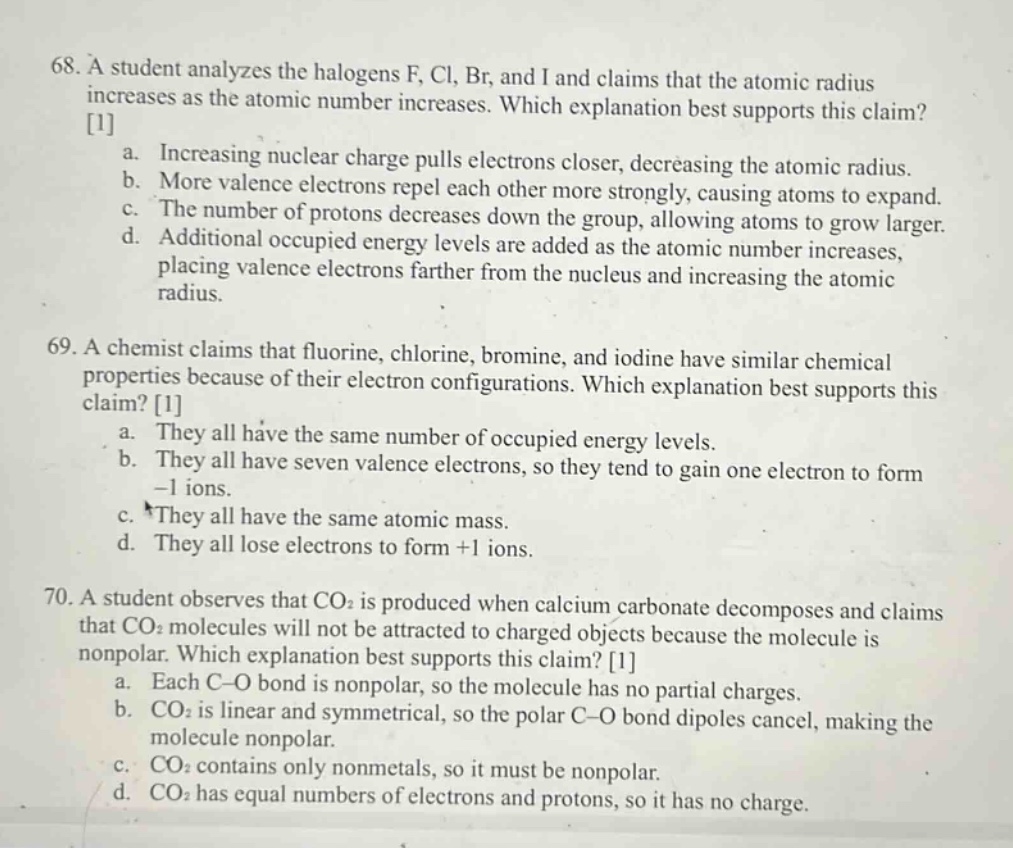
- a student analyzes the halogens f, cl, br, and i and claims that the atomic radius increases as the atomic number increases. which explanation best supports this claim? 1
a. increasing nuclear charge pulls electrons closer, decreasing the atomic radius.
b. more valence electrons repel each other more strongly, causing atoms to expand.
c. the number of protons decreases down the group, allowing atoms to grow larger.
d. additional occupied energy levels are added as the atomic number increases, placing valence electrons farther from the nucleus and increasing the atomic radius.
- a chemist claims that fluorine, chlorine, bromine, and iodine have similar chemical properties because of their electron configurations. which explanation best supports this claim? 1
a. they all have the same number of occupied energy levels.
b. they all have seven valence electrons, so they tend to gain one electron to form -1 ions.
c. they all have the same atomic mass.
d. they all lose electrons to form +1 ions.
- a student observes that co₂ is produced when calcium carbonate decomposes and claims that co₂ molecules will not be attracted to charged objects because the molecule is nonpolar. which explanation best supports this claim? 1
a. each c—o bond is nonpolar, so the molecule has no partial charges.
b. co₂ is linear and symmetrical, so the polar c—o bond dipoles cancel, making the molecule nonpolar.
c. co₂ contains only nonmetals, so it must be nonpolar.
d. co₂ has equal numbers of electrons and protons, so it has no charge.
Question 68
- Option a: Increasing nuclear charge would pull electrons closer, which would decrease atomic radius, but we need an explanation for increasing radius. So a is incorrect.
- Option b: Halogens have 7 valence electrons, and the number of valence electrons does not increase down the group. So b is incorrect.
- Option c: The number of protons (atomic number) increases down the group, not decreases. So c is incorrect.
- Option d: As atomic number increases down the halogen group (F, Cl, Br, I), each subsequent element has an additional occupied energy level. This places the valence electrons farther from the nucleus, increasing the atomic radius. This matches the claim.
- Option a: Down the halogen group, the number of occupied energy levels increases (F has 2, Cl has 3, etc.). So a is incorrect.
- Option b: Halogens (F, Cl, Br, I) all have 7 valence electrons. Having 7 valence electrons makes them tend to gain one electron to achieve a stable octet, forming - 1 ions. This similar electron configuration (7 valence electrons) leads to similar chemical properties.
- Option c: The atomic masses of F, Cl, Br, I are different. So c is incorrect.
- Option d: Halogens gain electrons, not lose them, to form - 1 ions, not + 1 ions. So d is incorrect.
- Option a: The C - O bond is polar because of the difference in electronegativity between C and O. So a is incorrect.
- Option b: \(CO_2\) has a linear structure (\(O = C = O\)). The polar C - O bond dipoles are equal in magnitude and opposite in direction, so they cancel each other out, making the molecule nonpolar. A nonpolar molecule is not attracted to charged objects. This explains why \(CO_2\) is nonpolar and not attracted to charged objects.
- Option c: Just because a molecule contains only nonmetals does not mean it is nonpolar (e.g., \(H_2O\) contains nonmetals but is polar). So c is incorrect.
- Option d: The fact that \(CO_2\) has equal numbers of electrons and protons (is neutral) is not related to its polarity. A neutral polar molecule (like \(H_2O\)) can be attracted to charged objects. So d is incorrect.

Snap & solve any problem in the app
Get step-by-step solutions on Sovi AI
Photo-based solutions with guided steps
Explore more problems and detailed explanations
d. Additional occupied energy levels are added as the atomic number increases, placing valence electrons farther from the nucleus and increasing the atomic radius.