QUESTION IMAGE
Question
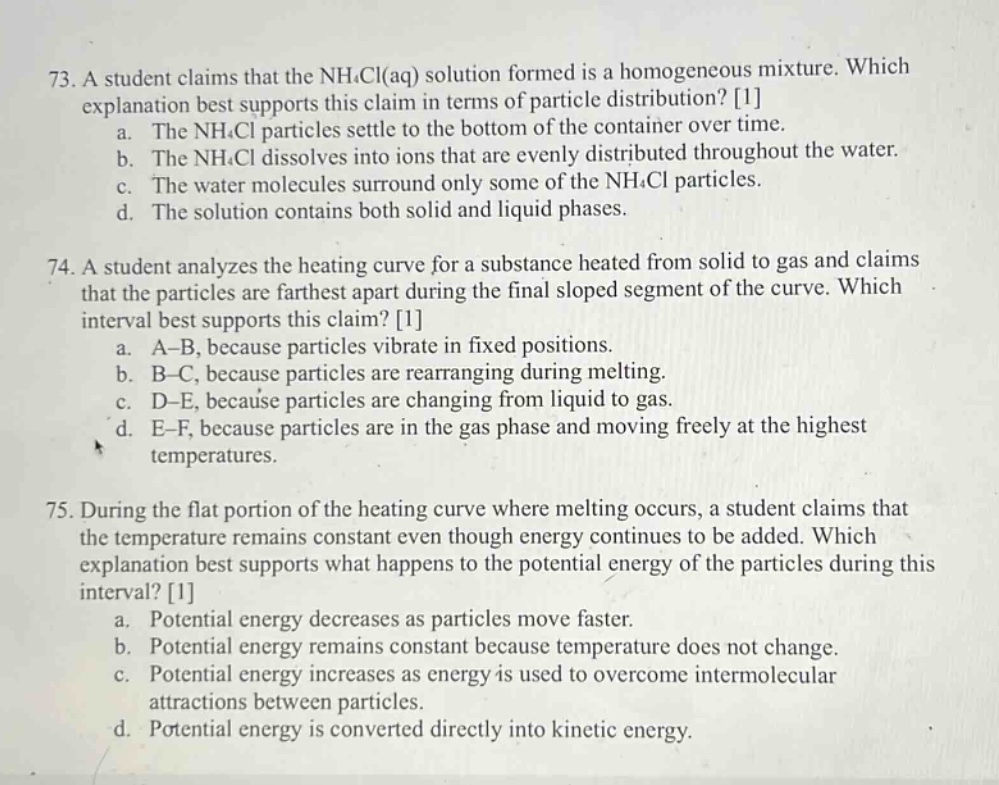
- a student claims that the nh₄cl(aq) solution formed is a homogeneous mixture. which explanation best supports this claim in terms of particle distribution? 1
a. the nh₄cl particles settle to the bottom of the container over time.
b. the nh₄cl dissolves into ions that are evenly distributed throughout the water.
c. the water molecules surround only some of the nh₄cl particles.
d. the solution contains both solid and liquid phases.
- a student analyzes the heating curve for a substance heated from solid to gas and claims that the particles are farthest apart during the final sloped segment of the curve. which interval best supports this claim? 1
a. a–b, because particles vibrate in fixed positions.
b. b–c, because particles are rearranging during melting.
c. d–e, because particles are changing from liquid to gas.
d. e–f, because particles are in the gas phase and moving freely at the highest temperatures.
- during the flat portion of the heating curve where melting occurs, a student claims that the temperature remains constant even though energy continues to be added. which explanation best supports what happens to the potential energy of the particles during this interval? 1
a. potential energy decreases as particles move faster.
b. potential energy remains constant because temperature does not change.
c. potential energy increases as energy is used to overcome intermolecular attractions between particles.
d. potential energy is converted directly into kinetic energy.
Question 73
To determine the best explanation for \( \text{NH}_4\text{Cl}(\text{aq}) \) being a homogeneous mixture, we analyze each option:
- Option a: If particles settled, it would be a heterogeneous mixture (like a suspension), so this is incorrect.
- Option b: When \( \text{NH}_4\text{Cl} \) dissolves, it dissociates into \( \text{NH}_4^+ \) and \( \text{Cl}^- \) ions that are evenly distributed in water, which is characteristic of a homogeneous solution.
- Option c: In a homogeneous solution, solute particles are uniformly surrounded by solvent molecules, so this is incorrect.
- Option d: A solution (aqueous \( \text{NH}_4\text{Cl} \)) is a single phase (liquid), so the claim of two phases is wrong.
To find the interval where particles are farthest apart, we analyze the heating curve segments:
- Option a: A - B is the solid phase (particles close, vibrating in fixed positions), so incorrect.
- Option b: B - C is melting (solid to liquid, particles closer than in gas), incorrect.
- Option c: D - E is liquid to gas (boiling), but the final sloped segment after boiling (E - F) is when the substance is fully gas. Wait, no—wait, the heating curve: A - B (solid, heating), B - C (melting, flat), C - D (liquid heating), D - E (boiling, flat), E - F (gas heating, sloped). In gas phase (E - F), particles are farthest apart (move freely at high temp). Option d says E - F: particles in gas phase, moving freely at highest temps. Option c: D - E is boiling (phase change, flat), so during E - F (gas heating), particles are farthest. So d is correct. Wait, let's recheck:
- A - B: solid (particles close)
- B - C: melting (solid→liquid, particles still close)
- C - D: liquid (particles closer than gas)
- D - E: boiling (liquid→gas, phase change, flat)
- E - F: gas (particles farthest apart, moving freely, temperature increasing as heat is added)
So the final sloped segment is E - F (gas phase), so option d is correct.
During melting (flat portion of heating curve), we analyze potential energy:
- Option a: Kinetic energy (not potential) increases with faster particle motion (temperature), but during melting, temperature (kinetic energy) is constant. Potential energy changes, so a is wrong.
- Option b: Potential energy changes during phase changes (melting) as intermolecular forces are overcome, so it's not constant. Wrong.
- Option c: When melting, energy is used to overcome intermolecular attractions (breaking bonds between particles in solid), which increases potential energy (since potential energy is related to position/attractions). Temperature (kinetic energy) remains constant, so this matches.
- Option d: During melting, energy goes into potential energy (overcoming attractions), not converting potential to kinetic (kinetic energy is constant as temp is constant). Wrong.

Snap & solve any problem in the app
Get step-by-step solutions on Sovi AI
Photo-based solutions with guided steps
Explore more problems and detailed explanations
b. The \( \text{NH}_4\text{Cl} \) dissolves into ions that are evenly distributed throughout the water.