QUESTION IMAGE
Question
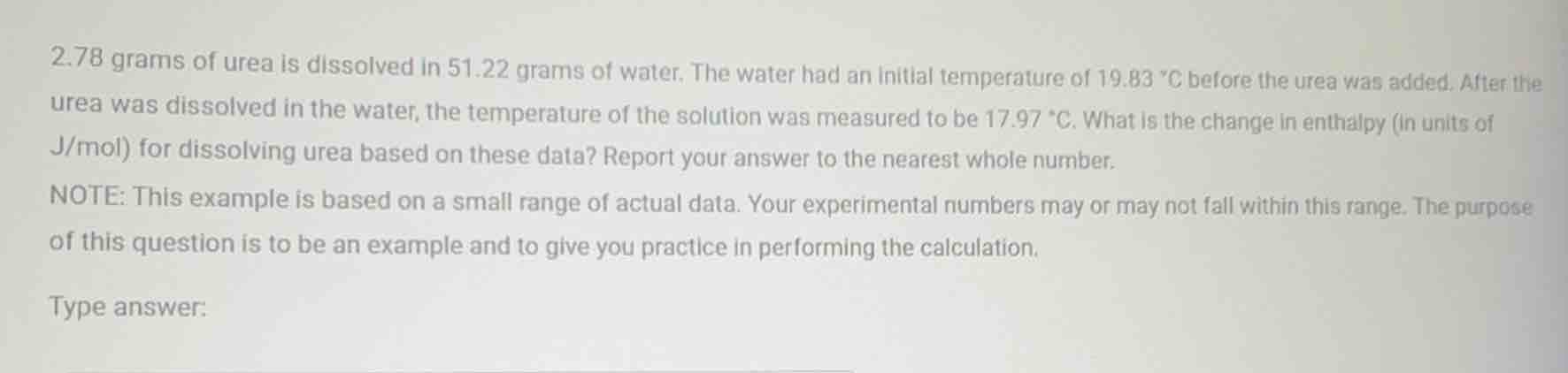
2.78 grams of urea is dissolved in 51.22 grams of water. the water had an initial temperature of 19.83 °c before the urea was added. after the urea was dissolved in the water, the temperature of the solution was measured to be 17.97 °c. what is the change in enthalpy (in units of j/mol) for dissolving urea based on these data? report your answer to the nearest whole number. note: this example is based on a small range of actual data. your experimental numbers may or may not fall within this range. the purpose of this question is to be an example and to give you practice in performing the calculation. type answer:
Step 1: Calculate the heat absorbed by the solution (q_solution)
The formula for heat is \( q = mc\Delta T \), where \( m \) is mass, \( c \) is specific heat capacity (for water, \( c = 4.184 \, \text{J/g}^\circ\text{C} \)), and \( \Delta T \) is the change in temperature. The total mass of the solution is the mass of urea plus the mass of water: \( m = 2.78 \, \text{g} + 51.22 \, \text{g} = 54.00 \, \text{g} \). The change in temperature \( \Delta T = 17.97^\circ\text{C} - 19.83^\circ\text{C} = -1.86^\circ\text{C} \) (but we'll take the absolute value for heat, then consider sign for enthalpy).
So, \( q_{\text{solution}} = mc\Delta T = 54.00 \, \text{g} \times 4.184 \, \text{J/g}^\circ\text{C} \times | -1.86^\circ\text{C} | \)
Calculating that: \( 54.00 \times 4.184 = 225.936 \); \( 225.936 \times 1.86 \approx 420.24 \, \text{J} \)
Step 2: Determine the heat of dissolution (q_dissolution)
Since the temperature of the solution decreased, the dissolution process is endothermic (heat is absorbed from the solution, so \( q_{\text{system (dissolution)}} = -q_{\text{solution}} \)? Wait, no: actually, the solution loses heat (temperature drops), so the dissolution process absorbs heat from the solution. So \( q_{\text{dissolution}} = -q_{\text{solution}} \)? Wait, let's clarify: the heat lost by the solution is gained by the dissolution process. So \( q_{\text{dissolution}} = -q_{\text{solution}} \) if we take \( q_{\text{solution}} \) as negative (since \( \Delta T \) is negative). Wait, maybe better: \( q_{\text{surroundings (solution)}} = mc\Delta T \), and \( q_{\text{system (dissolution)}} = -q_{\text{surroundings}} \).
So \( q_{\text{system}} = - (54.00 \times 4.184 \times (-1.86)) = 54.00 \times 4.184 \times 1.86 \approx 420.24 \, \text{J} \) (since the solution lost heat, the dissolution process gained heat, so positive for endothermic).
Step 3: Calculate moles of urea
Molar mass of urea (\( \text{CO(NH}_2\text{)}_2 \)): C=12.01, O=16.00, N=14.01, H=1.008. So molar mass \( M = 12.01 + 16.00 + 2 \times (14.01 + 2 \times 1.008) = 12.01 + 16.00 + 2 \times (14.01 + 2.016) = 12.01 + 16.00 + 2 \times 16.026 = 12.01 + 16.00 + 32.052 = 60.062 \, \text{g/mol} \)
Moles of urea, \( n = \frac{\text{mass}}{\text{molar mass}} = \frac{2.78 \, \text{g}}{60.062 \, \text{g/mol}} \approx 0.04628 \, \text{mol} \)
Step 4: Calculate enthalpy change (ΔH)
Enthalpy change for dissolution is \( \Delta H = \frac{q_{\text{system}}}{n} \). Since the process is endothermic, \( \Delta H \) is positive.
\( \Delta H = \frac{420.24 \, \text{J}}{0.04628 \, \text{mol}} \approx 9080 \, \text{J/mol} \)? Wait, wait, that can't be right. Wait, no, wait: wait, the temperature of the solution decreased, so the dissolution is endothermic, meaning the system (dissolution) absorbs heat, so \( q_{\text{system}} \) is positive, and \( \Delta H \) (which is \( q_{\text{system}} \) at constant pressure) is positive. But let's check the calculation again.
Wait, \( \Delta T = 17.97 - 19.83 = -1.86 \, ^\circ\text{C} \). So \( q_{\text{solution}} = mc\Delta T = 54.00 \times 4.184 \times (-1.86) = -54.00 \times 4.184 \times 1.86 \approx -420.24 \, \text{J} \). This means the solution lost 420.24 J of heat. Therefore, the dissolution process (system) gained 420.24 J of heat, so \( q_{\text{system}} = +420.24 \, \text{J} \).
Now, moles of urea: \( 2.78 \, \text{g} / 60.06 \, \text{g/mol} \approx 0.04628 \, \text{mol} \)
Then, \( \Delta H = q_{\text{system}} / n = 420.24 \, \text{J} / 0.04628 \, \text{mol} \approx 9080 \, \text{J/mol} \)? Wait, that seems high, bu…

Snap & solve any problem in the app
Get step-by-step solutions on Sovi AI
Photo-based solutions with guided steps
Explore more problems and detailed explanations
9080