QUESTION IMAGE
Question
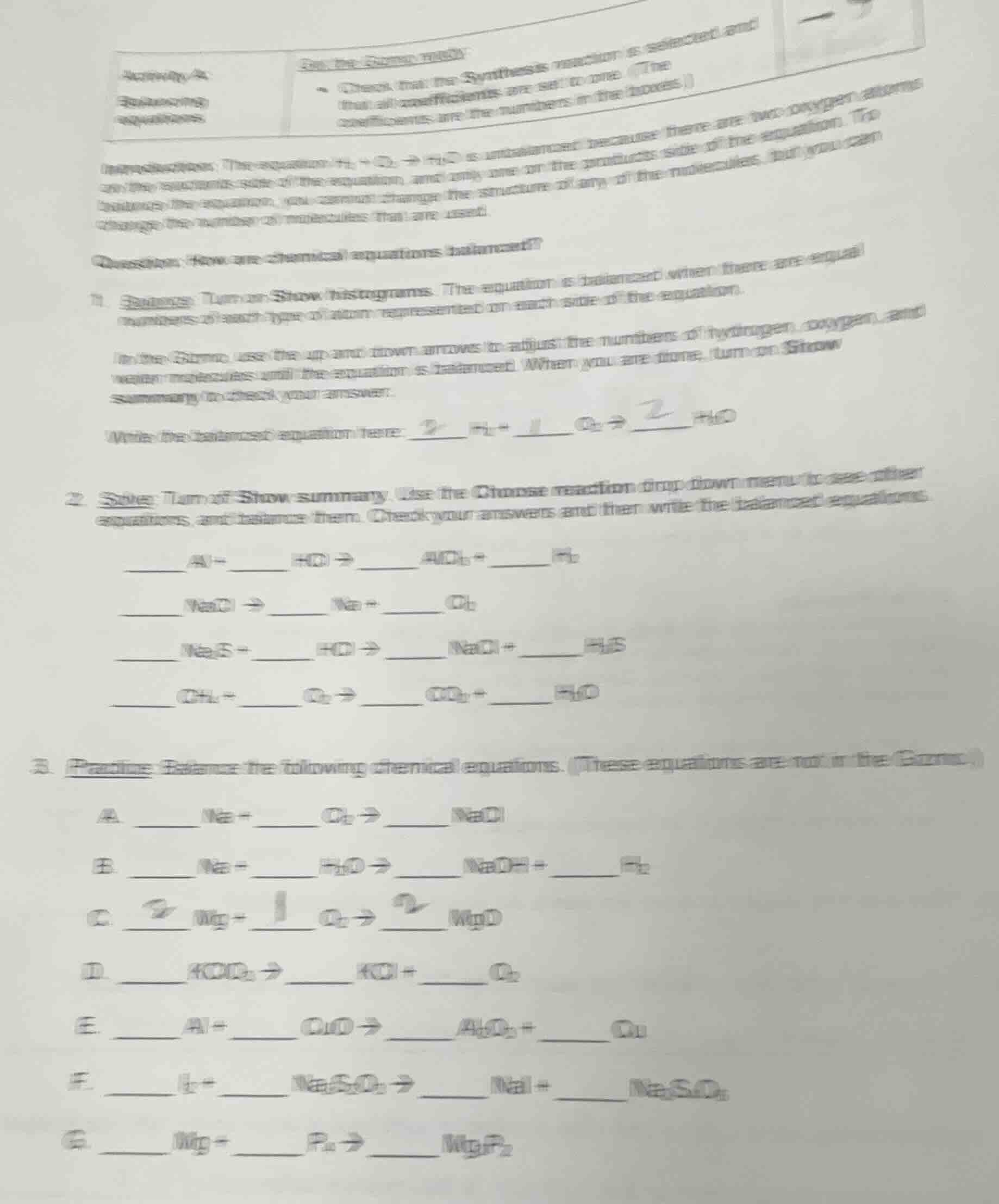
activity a: balancing equations\
run the gizmo: first\
- check that the synthesis reaction is selected, and that all coefficients are set to one. (the coefficients are the numbers in the process.)\
introduction: the equation h₂ + o₂ → h₂o is unbalanced because there are two oxygen atoms on the reactants side of the equation, and only one on the products side of the equation. to balance the equation, you cannot change the structure of any of the molecules, but you can change the number of molecules that are used.\
question: how are chemical equations balanced?\
- balance: turn on show histograms. the equation is balanced when there are equal numbers of each type of atom represented on each side of the equation.\
in the gizmo, use the up and down arrows to adjust the numbers of hydrogen, oxygen, and water molecules until the equation is balanced. when you are done, turn on show summary to check your answer.\
write the balanced equation here: \underline{\hspace{1cm}} h₂ + \underline{\hspace{1cm}} o₂ → \underline{\hspace{1cm}} h₂o\
- solve: turn off show summary. use the choose reaction drop - down menu to see other equations, and balance them. check your answers and then write the balanced equations.\
\underline{\hspace{1cm}} al + \underline{\hspace{1cm}} hcl → \underline{\hspace{1cm}} alcl₃ + \underline{\hspace{1cm}} h₂\
\underline{\hspace{1cm}} nacl → \underline{\hspace{1cm}} na + \underline{\hspace{1cm}} cl₂\
\underline{\hspace{1cm}} na₂s + \underline{\hspace{1cm}} hcl → \underline{\hspace{1cm}} nacl + \underline{\hspace{1cm}} h₂s\
\underline{\hspace{1cm}} c₂h₄ + \underline{\hspace{1cm}} o₂ → \underline{\hspace{1cm}} co₂ + \underline{\hspace{1cm}} h₂o\
- practice: balance the following chemical equations. (these equations are not in the gizmo.)\
a. \underline{\hspace{1cm}} na + \underline{\hspace{1cm}} cl₂ → \underline{\hspace{1cm}} nacl\
b. \underline{\hspace{1cm}} na + \underline{\hspace{1cm}} h₂o → \underline{\hspace{1cm}} naoh + \underline{\hspace{1cm}} h₂\
c. \underline{\hspace{1cm}} mg + \underline{\hspace{1cm}} o₂ → \underline{\hspace{1cm}} mgo\
d. \underline{\hspace{1cm}} kclo₃ → \underline{\hspace{1cm}} kcl + \underline{\hspace{1cm}} o₂\
e. \underline{\hspace{1cm}} al + \underline{\hspace{1cm}} cuo → \underline{\hspace{1cm}} al₂o₃ + \underline{\hspace{1cm}} cu\
f. \underline{\hspace{1cm}} i₂ + \underline{\hspace{1cm}} na₂s₂o₃ → \underline{\hspace{1cm}} nai + \underline{\hspace{1cm}} na₂s₄o₆\
g. \underline{\hspace{1cm}} mg + \underline{\hspace{1cm}} p₄ → \underline{\hspace{1cm}} mg₃p₂
1. Balancing $\boldsymbol{\ce{H2 + O2 -> H2O}}$
Step1: Analyze O atoms
On the left, $\ce{O2}$ has 2 O atoms. On the right, $\ce{H2O}$ has 1 O atom. To balance O, put a coefficient of 2 in front of $\ce{H2O}$: $\ce{H2 + O2 -> 2H2O}$.
Step2: Analyze H atoms
Now, right side has $2\times2 = 4$ H atoms. Left side $\ce{H2}$ has 2 H atoms. So put a coefficient of 2 in front of $\ce{H2}$: $\ce{2H2 + O2 -> 2H2O}$.
Step3: Check O atoms
Left side $\ce{O2}$ has 2 O atoms. Right side $2\times1 = 2$ O atoms. Balanced.
Step1: Analyze Cl atoms
Right side $\ce{AlCl3}$ has 3 Cl atoms. So put a coefficient of 3 in front of $\ce{HCl}$: $\ce{Al + 3HCl -> AlCl3 + H2}$.
Step2: Analyze H atoms
Left side has 3 H atoms (from 3 HCl), right side $\ce{H2}$ has 2 H atoms. Find LCM of 3 and 2, which is 6. So adjust HCl to 6 (coefficient 6) and $\ce{H2}$ to 3 (coefficient 3): $\ce{Al + 6HCl -> AlCl3 + 3H2}$.
Step3: Analyze Al atoms
Right side $\ce{AlCl3}$ has 1 Al atom. So put a coefficient of 2 in front of $\ce{Al}$ and 2 in front of $\ce{AlCl3}$ to balance Al: $\ce{2Al + 6HCl -> 2AlCl3 + 3H2}$.
Step4: Check all atoms
Al: 2 = 2; Cl: 6 = 6; H: 6 = 6. Balanced.
Step1: Analyze Cl atoms
Right side $\ce{Cl2}$ has 2 Cl atoms. So put a coefficient of 2 in front of $\ce{NaCl}$: $\ce{2NaCl -> Na + Cl2}$.
Step2: Analyze Na atoms
Left side has 2 Na atoms. So put a coefficient of 2 in front of $\ce{Na}$: $\ce{2NaCl -> 2Na + Cl2}$.
Step3: Check
Na: 2 = 2; Cl: 2 = 2. Balanced.

Snap & solve any problem in the app
Get step-by-step solutions on Sovi AI
Photo-based solutions with guided steps
Explore more problems and detailed explanations
$\boldsymbol{2}\ \ce{H2 + 1\ O2 -> 2\ H2O}$