QUESTION IMAGE
Question
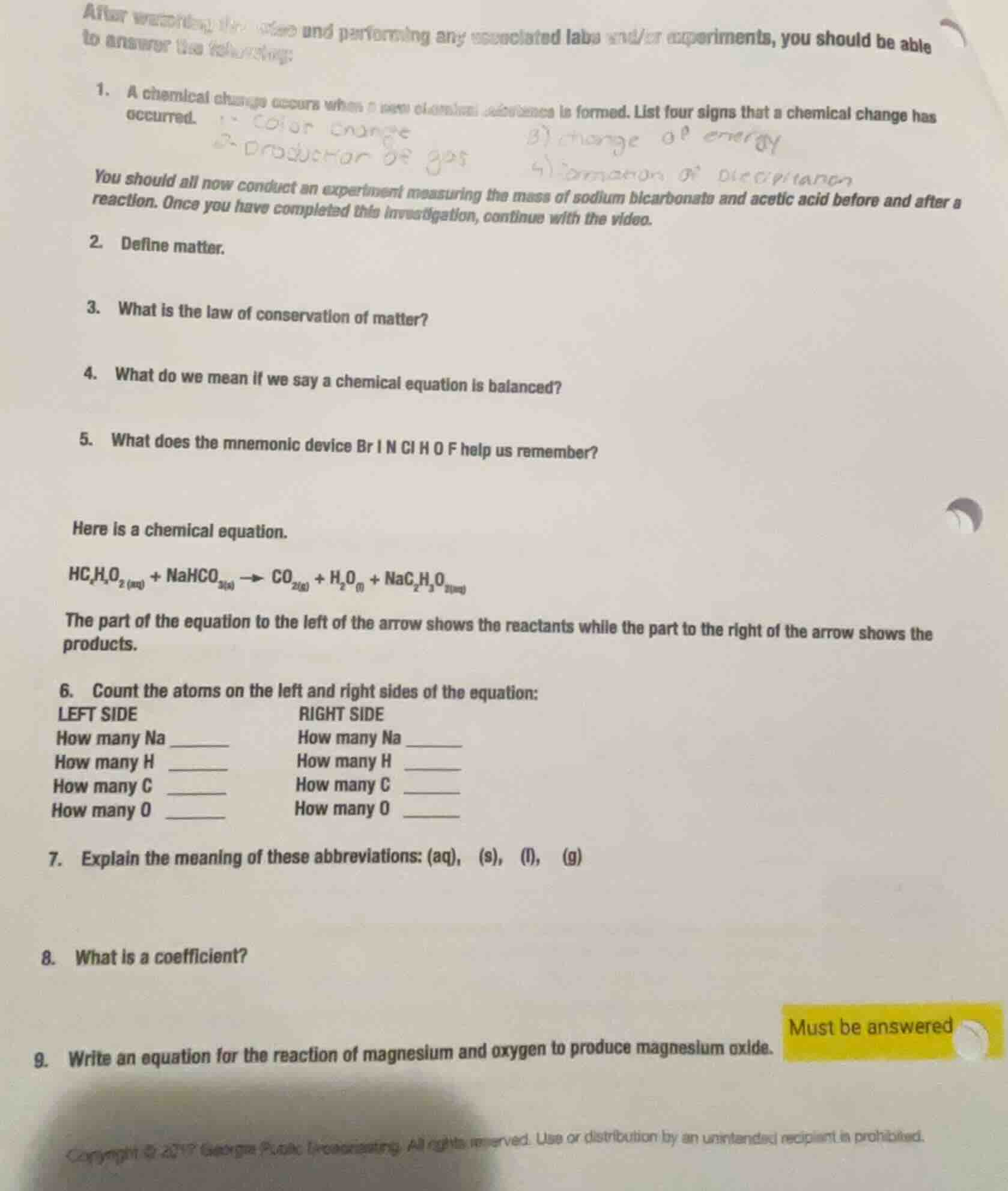
after watching the video and performing any associated labs and/or experiments, you should be able to answer the following: 1. a chemical change occurs when a new chemical substance is formed. list four signs that a chemical change has occurred. you should all now conduct an experiment measuring the mass of sodium bicarbonate and acetic acid before and after a reaction. once you have completed this investigation, continue with the video. 2. define matter. 3. what is the law of conservation of matter? 4. what do we mean if we say a chemical equation is balanced? 5. what does the mnemonic device br i n cl h o f help us remember? here is a chemical equation. \\(\ce{hc_{2}h_{3}o_{2(aq)} + nahco_{3(s)} -> co_{2(g)} + h_{2}o_{(l)} + nac_{2}h_{3}o_{2(aq)}}\\) the part of the equation to the left of the arrow shows the reactants while the part to the right of the arrow shows the products. 6. count the atoms on the left and right sides of the equation: left side right side how many na ____ how many na __ how many h __ how many h __ how many c __ how many c __ how many o __ how many o ____ 7. explain the meaning of these abbreviations: (aq), (s), (l), (g) 8. what is a coefficient? 9. write an equation for the reaction of magnesium and oxygen to produce magnesium oxide. copyright © 2017 george public innovating all rights reserved. use or distribution by an unintended recipient is prohibited.
- These are the four most common observable indicators that a new substance (chemical change) has formed.
- This is the fundamental definition of matter in chemistry, encompassing all physical substances.
- This is a core chemical principle that forms the basis for balancing chemical equations.
- Balancing ensures the law of conservation of matter is obeyed in the equation.
- Each letter in the mnemonic corresponds to the first letter of a diatomic element's name.
- Counted each atom type in reactants ($\text{HC}_2\text{H}_3\text{O}_{2(aq)} + \text{NaHCO}_{3(s)}$) and products ($\text{CO}_{2(g)} + \text{H}_2\text{O}_{(l)} + \text{NaC}_2\text{H}_3\text{O}_{2(aq)}$) individually to confirm equality.
- These are standard state symbols used in chemical equations to denote the physical form of each substance.
- Coefficients scale the amount of each substance without changing its chemical identity, unlike subscripts.
- Wrote the unbalanced equation first, then added coefficients to balance the number of Mg and O atoms on both sides, including state symbols for completeness.

Snap & solve any problem in the app
Get step-by-step solutions on Sovi AI
Photo-based solutions with guided steps
Explore more problems and detailed explanations
- 1) Color change; 2) Production of gas; 3) Change in energy (temperature change/light release); 4) Formation of a precipitate
- Matter is anything that has mass and occupies space.
- Matter cannot be created or destroyed in a chemical reaction; it only changes form.
- A balanced chemical equation has an equal number of each type of atom on both the reactant and product sides.
- It helps remember the diatomic elements: Bromine, Iodine, Nitrogen, Chlorine, Hydrogen, Oxygen, Fluorine (elements that exist as two-atom molecules in their standard state).
- LEFT SIDE: Na: 1, H: 5, C: 3, O: 5; RIGHT SIDE: Na: 1, H: 5, C: 3, O: 5
- (aq): Aqueous (dissolved in water); (s): Solid; (l): Liquid; (g): Gas
- A coefficient is a whole number placed in front of a chemical formula in an equation to balance the number of atoms.
- $\text{Mg}_{(s)} + \text{O}_{2(g)}
ightarrow \text{MgO}_{(s)}$ (balanced form: $2\text{Mg}_{(s)} + \text{O}_{2(g)}
ightarrow 2\text{MgO}_{(s)}$)