QUESTION IMAGE
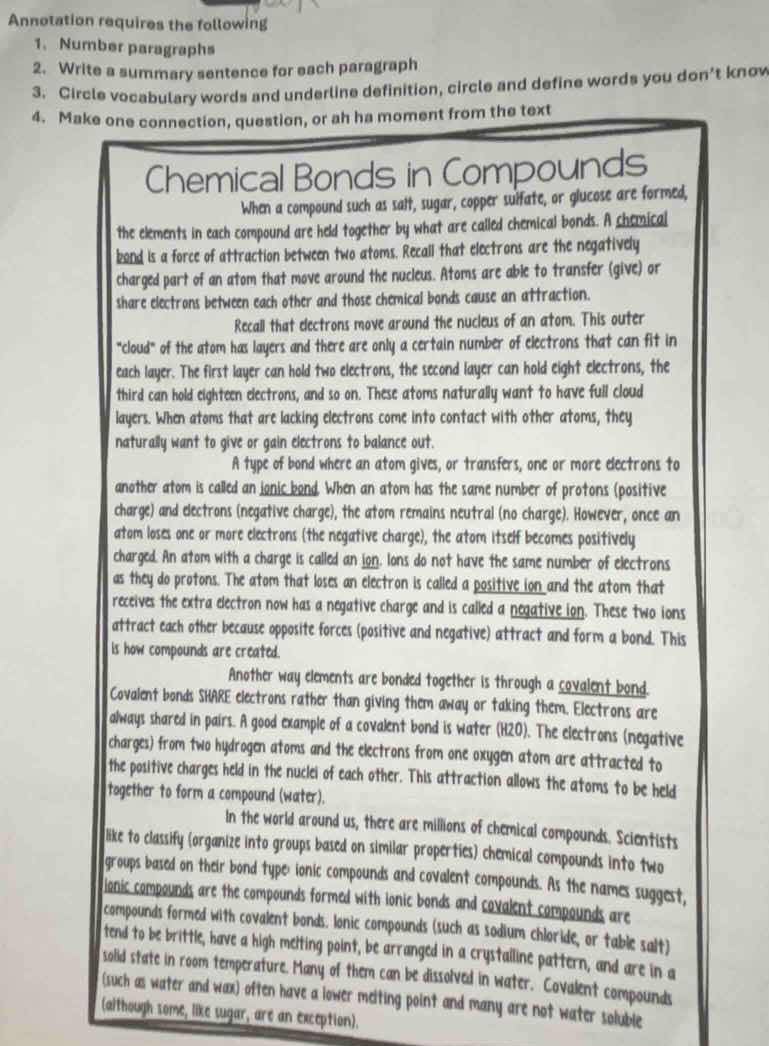
Question
annotation requires the following
- number paragraphs
- write a summary sentence for each paragraph
- circle vocabulary words and underline definition, circle and define words you dont know
- make one connection, question, or ah ha moment from the text
chemical bonds in compounds
when a compound such as salt, sugar, copper sulfate, or glucose are formed,
the elements in each compound are held together by what are called chemical bonds. a chemical
bond is a force of attraction between two atoms. recall that electrons are the negatively
charged part of an atom that move around the nucleus. atoms are able to transfer (give) or
share electrons between each other and those chemical bonds cause an attraction.
recall that electrons move around the nucleus of an atom. this outer
\cloud\ of the atom has layers and there are only a certain number of electrons that can fit in
each layer. the first layer can hold two electrons, the second layer can hold eight electrons, the
third can hold eighteen electrons, and so on. these atoms naturally want to have full cloud
layers. when atoms that are lacking electrons come into contact with other atoms, they
naturally want to give or gain electrons to balance out.
a type of bond where an atom gives, or transfers, one or more electrons to
another atom is called an ionic bond. when an atom has the same number of protons (positive
charge) and electrons (negative charge), the atom remains neutral (no charge). however, once an
atom loses one or more electrons (the negative charge), the atom itself becomes positively
charged. an atom with a charge is called an ion. ions do not have the same number of electrons
as they do protons. the atom that loses an electron is called a positive ion and the atom that
receives the extra electron now has a negative charge and is called a negative ion. these two ions
attract each other because opposite forces (positive and negative) attract and form a bond. this
is how compounds are created.
another way elements are bonded together is through a covalent bond.
covalent bonds share electrons rather than giving them away or taking them. electrons are
always shared in pairs. a good example of a covalent bond is water (h2o). the electrons (negative
charge) from two hydrogen atoms and the electrons from one oxygen atom are attracted to
the positive charge held in the nuclei of each other. this attraction allows the atoms to be held
together to form a compound (water).
in the world around us, there are millions of chemical compounds. scientists
like to classify (organize into groups based on similar properties) chemical compounds into two
groups based on their bond type: ionic compounds and covalent compounds. as the names suggest,
ionic compounds are the compounds formed with ionic bonds and covalent compounds are
compounds formed with covalent bonds. ionic compounds (such as sodium chloride, or table salt)
tend to be brittle, have a high melting point, be arranged in a crystalline pattern, and are in a
solid state in room temperature. many of them can be dissolved in water. covalent compounds
(such as water and wax) often have a lower melting point and many are not water soluble
(although some, like sugar, are an exception).

Snap & solve any problem in the app
Get step-by-step solutions on Sovi AI
Photo-based solutions with guided steps
Explore more problems and detailed explanations
- Paragraph 1: Chemical bonds are forces of attraction that hold atoms together in compounds by transferring or sharing electrons.
- Paragraph 2: Atoms seek stability by filling their electron layers through gaining or losing electrons when interacting with other atoms.
- Paragraph 3: Ionic bonds form when atoms transfer electrons, creating oppositely charged ions that attract each other to form compounds.
- Paragraph 4: Covalent bonds occur when atoms share electron pairs to form stable compounds, such as water.
- Paragraph 5: Compounds are classified as ionic or covalent based on their bond types and distinct physical properties like melting points and solubility.