QUESTION IMAGE
Question
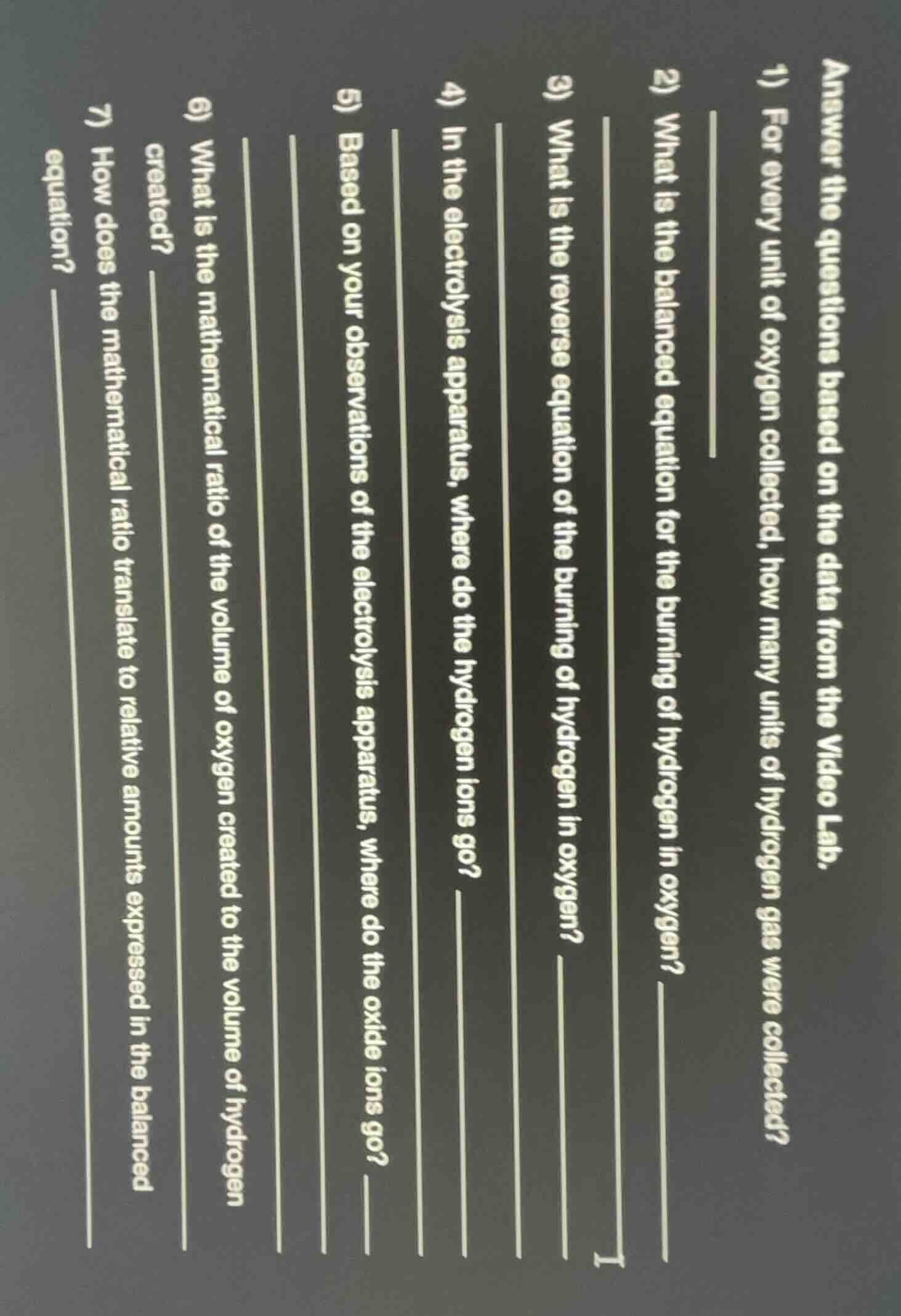
answer the questions based on the data from the video lab.
- for every unit of oxygen collected, how many units of hydrogen gas were collected?
- what is the balanced equation for the burning of hydrogen in oxygen?
- what is the reverse equation of the burning of hydrogen in oxygen?
- in the electrolysis apparatus, where do the hydrogen ions go?
- based on your observations of the electrolysis apparatus, where do the oxide ions go?
- what is the mathematical ratio of the volume of oxygen created to the volume of hydrogen created?
- how does the mathematical ratio translate to relative amounts expressed in the balanced equation?
Brief Explanations
- From the electrolysis of water (the basis of the video lab), the volume ratio of hydrogen to oxygen produced is 2:1.
- The burning of hydrogen in oxygen produces water; balance by adjusting coefficients to match atom counts.
- The reverse of hydrogen combustion is the decomposition of water, which occurs via electrolysis.
- In electrolysis of water, hydrogen ions ($H^+$) migrate to the negative cathode, gain electrons, and form hydrogen gas.
- In electrolysis of water, oxide ions (or hydroxide ions, $OH^-$) migrate to the positive anode, lose electrons, and form oxygen gas.
- Experimental observations from water electrolysis show 2 volumes of hydrogen are produced for every 1 volume of oxygen.
- The volume ratio directly corresponds to the mole ratio of reactants/products in the balanced chemical equation, as equal volumes of gases (at same T/P) have equal moles.

Snap & solve any problem in the app
Get step-by-step solutions on Sovi AI
Photo-based solutions with guided steps
Explore more problems and detailed explanations
- 2 units of hydrogen gas
- $2H_2(g) + O_2(g)
ightarrow 2H_2O(l)$
- $2H_2O(l)
ightarrow 2H_2(g) + O_2(g)$ (electrolysis of water)
- Hydrogen ions move to the cathode (negative electrode), where they are reduced to form hydrogen gas.
- Oxide/hydroxide ions move to the anode (positive electrode), where they are oxidized to form oxygen gas.
- 1:2 (oxygen volume to hydrogen volume)
- The 1:2 volume ratio translates to a 1:2 mole ratio of $O_2$ to $H_2$, which is reflected in the coefficients of the balanced equation for water formation/electrolysis.