QUESTION IMAGE
Question
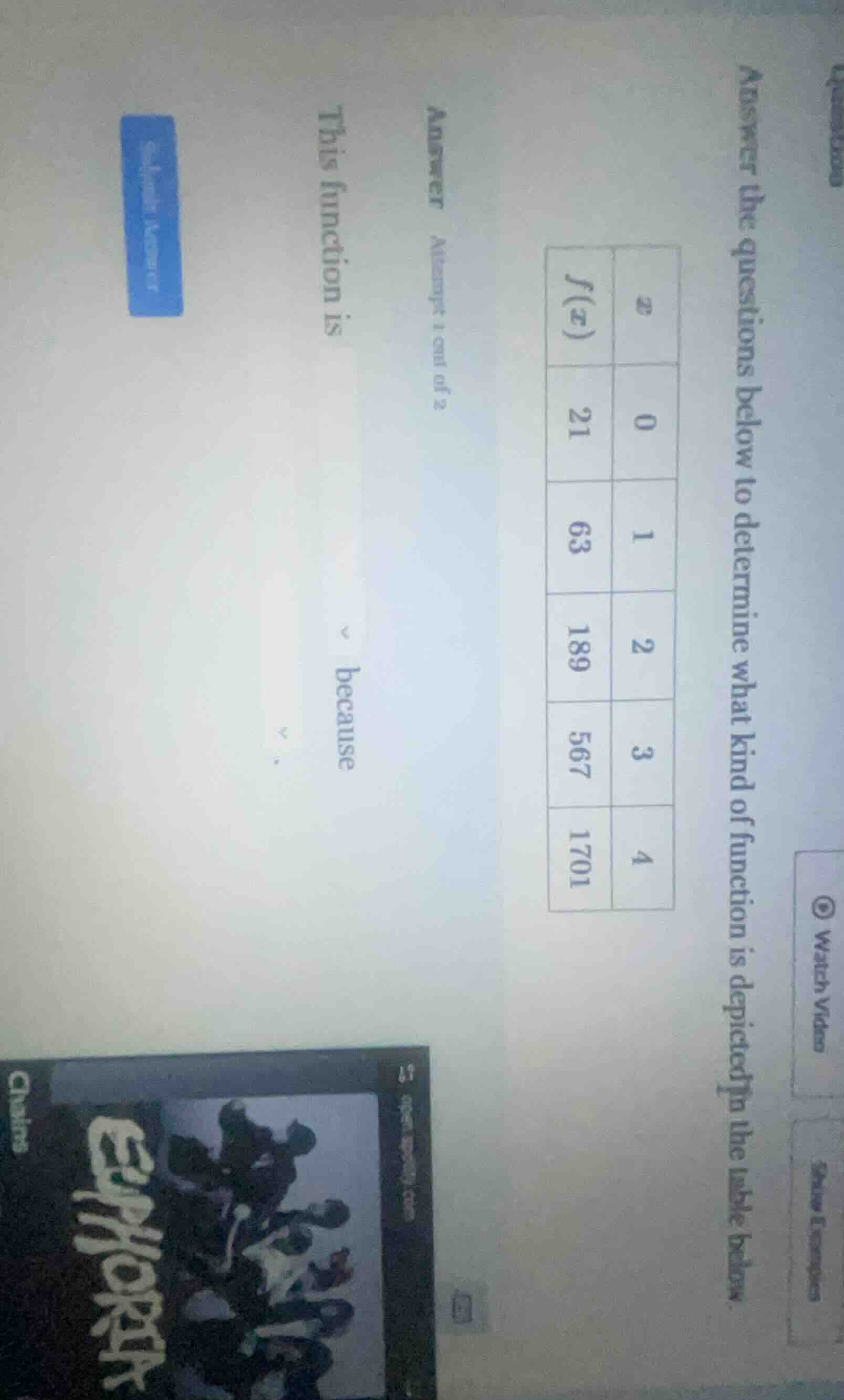
answer the questions below to determine what kind of function is depicted in the table below.
| x | f(x) |
|---|---|
| 1 | 63 |
| 2 | 189 |
| 3 | 567 |
| 4 | 1701 |
this function is
because
Step1: Check if it's linear (constant difference)
Calculate the differences between consecutive \( f(x) \) values:
\( 63 - 21 = 42 \), \( 189 - 63 = 126 \), \( 567 - 189 = 378 \), \( 1701 - 567 = 1134 \).
Differences are not constant, so not linear.
Step2: Check if it's exponential (constant ratio)
Calculate the ratios of consecutive \( f(x) \) values:
\( \frac{63}{21} = 3 \), \( \frac{189}{63} = 3 \), \( \frac{567}{189} = 3 \), \( \frac{1701}{567} = 3 \).
Ratios are constant (\( r = 3 \)), and when \( x = 0 \), \( f(0) = 21 \) (the initial value \( a = 21 \)). So the function follows \( f(x) = 21 \cdot 3^x \), which is exponential.

Snap & solve any problem in the app
Get step-by-step solutions on Sovi AI
Photo-based solutions with guided steps
Explore more problems and detailed explanations
This function is an exponential function because the ratio of consecutive \( f(x) \) values is constant (equal to 3), indicating exponential growth with an initial value of 21 and a common ratio of 3.