QUESTION IMAGE
Question
ap chemistry: 5 hw
directions: complete the following problems.
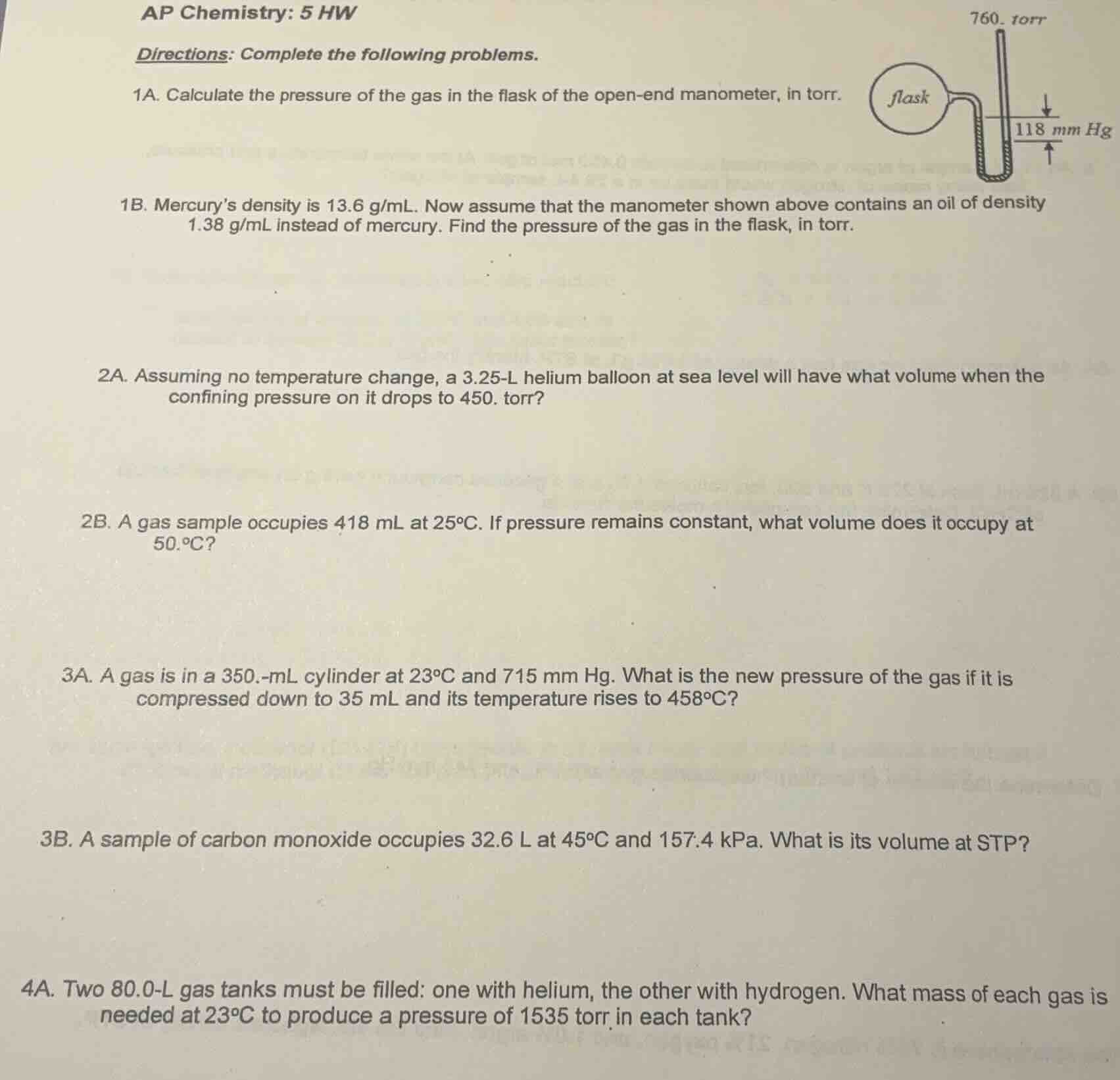
1a. calculate the pressure of the gas in the flask of the open - end manometer, in torr.
1b. mercury’s density is 13.6 g/ml. now assume that the manometer shown above contains an oil of density 1.38 g/ml instead of mercury. find the pressure of the gas in the flask, in torr.
2a. assuming no temperature change, a 3.25 - l helium balloon at sea level will have what volume when the confining pressure on it drops to 450. torr?
2b. a gas sample occupies 418 ml at 25°c. if pressure remains constant, what volume does it occupy at 50.°c?
3a. a gas is in a 350. - ml cylinder at 23°c and 715 mm hg. what is the new pressure of the gas if it is compressed down to 35 ml and its temperature rises to 458°c?
3b. a sample of carbon monoxide occupies 32.6 l at 45°c and 157.4 kpa. what is its volume at stp?
4a. two 80.0 - l gas tanks must be filled: one with helium, the other with hydrogen. what mass of each gas is needed at 23°c to produce a pressure of 1535 torr in each tank?
1A
Step1: Identify pressure relationship
In an open - end manometer, if the level of the fluid in the arm connected to the flask is lower than the other arm, the pressure of the gas ($P_{gas}$) is equal to the atmospheric pressure ($P_{atm}$) minus the pressure difference ($\Delta P$). Here, $P_{atm} = 760$ torr and $\Delta P=118$ torr (since 1 mm Hg = 1 torr). So the formula is $P_{gas}=P_{atm}-\Delta P$.
Step2: Calculate gas pressure
Substitute the values: $P_{gas}=760 - 118=642$ torr.
Step1: Relate pressure and density
The pressure difference $\Delta P$ is given by $\Delta P=
ho gh$. For the same height $h$, the pressure difference in terms of mercury and oil can be related. We know that $P_{mercury}=
ho_{mercury}gh$ and $P_{oil}=
ho_{oil}gh$. So, $P_{oil}=\frac{
ho_{oil}}{
ho_{mercury}}\times P_{mercury}$. First, find the pressure difference in torr (which is equal to mm Hg for mercury). The height $h = 118$ mm, so $P_{mercury - diff}=118$ torr. Then, $P_{oil - diff}=\frac{1.38}{13.6}\times118$ torr.
Step2: Calculate $P_{oil - diff}$
$\frac{1.38}{13.6}\times118=\frac{1.38\times118}{13.6}=\frac{162.84}{13.6}\approx11.97$ torr. Then, $P_{gas}=P_{atm}-P_{oil - diff}=760 - 11.97 = 748.03$ torr (approx).
Step1: Apply Boyle's Law
Boyle's Law states that $P_1V_1 = P_2V_2$ (at constant temperature). At sea level, $P_1 = 760$ torr, $V_1 = 3.25$ L, and $P_2 = 450$ torr. We need to find $V_2$. Rearranging the formula gives $V_2=\frac{P_1V_1}{P_2}$.
Step2: Calculate the new volume
Substitute the values: $V_2=\frac{760\times3.25}{450}=\frac{2470}{450}\approx5.49$ L.

Snap & solve any problem in the app
Get step-by-step solutions on Sovi AI
Photo-based solutions with guided steps
Explore more problems and detailed explanations
642 torr