QUESTION IMAGE
Question
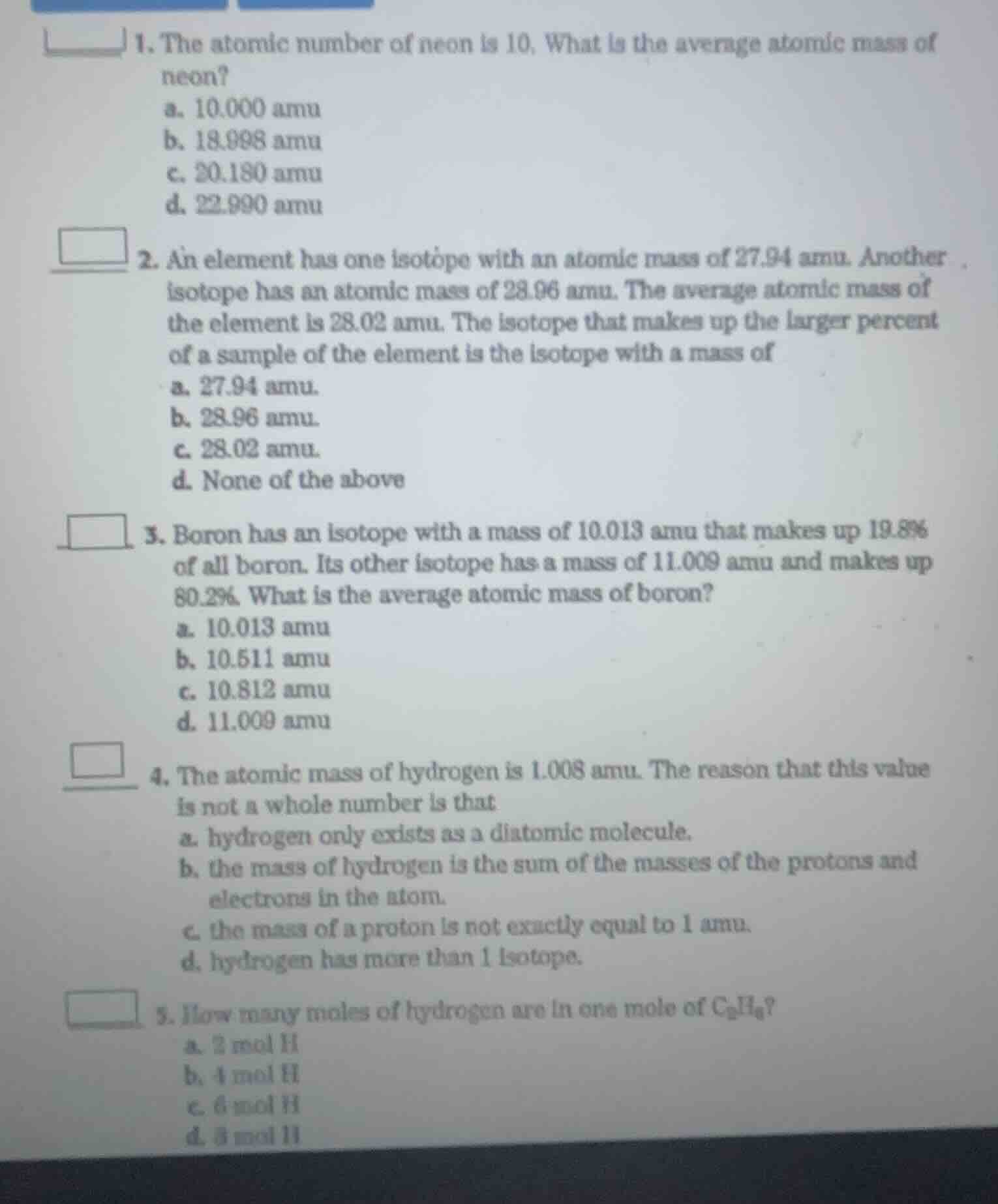
- the atomic number of neon is 10. what is the average atomic mass of neon?
a. 10.000 amu
b. 18.998 amu
c. 20.180 amu
d. 22.990 amu
- an element has one isotope with an atomic mass of 27.94 amu. another isotope has an atomic mass of 28.96 amu. the average atomic mass of the element is 28.02 amu. the isotope that makes up the larger percent of a sample of the element is the isotope with a mass of
a. 27.94 amu.
b. 28.96 amu.
c. 28.02 amu.
d. none of the above
- boron has an isotope with a mass of 10.013 amu that makes up 19.8% of all boron. its other isotope has a mass of 11.009 amu and makes up 80.2%. what is the average atomic mass of boron?
a. 10.013 amu
b. 10.511 amu
c. 10.812 amu
d. 11.009 amu
- the atomic mass of hydrogen is 1.008 amu. the reason that this value is not a whole number is that
a. hydrogen only exists as a diatomic molecule.
b. the mass of hydrogen is the sum of the masses of the protons and electrons in the atom.
c. the mass of a proton is not exactly equal to 1 amu.
d. hydrogen has more than 1 isotope.
- how many moles of hydrogen are in one mole of $c_2h_6$?
a. 2 mol h
b. 4 mol h
c. 6 mol h
d. 8 mol h
Step1: Recall neon's average atomic mass
The average atomic mass of neon is a known standard value from the periodic table, which is 20.180 amu.
Step2: Analyze isotope abundance trend
The average atomic mass is closer to the isotope with higher abundance. $28.02$ amu is closer to $27.94$ amu than $28.96$ amu, so the 27.94 amu isotope is more abundant.
Step3: Calculate boron's average atomic mass
Convert percentages to decimals, then multiply each isotope mass by its abundance and sum:
$\text{Average mass} = (10.013 \times 0.198) + (11.009 \times 0.802)$
$\text{Average mass} = 1.982574 + 8.829218 = 10.811792 \approx 10.812$ amu
Step4: Explain hydrogen's non-whole atomic mass
Hydrogen has isotopes (protium, deuterium, tritium), and the average atomic mass is a weighted average of these isotopes' masses, so it is not a whole number.
Step5: Extract hydrogen moles from formula
The formula $\text{C}_2\text{H}_6$ shows 6 hydrogen atoms per molecule, so 1 mole of $\text{C}_2\text{H}_6$ contains 6 moles of H.

Snap & solve any problem in the app
Get step-by-step solutions on Sovi AI
Photo-based solutions with guided steps
Explore more problems and detailed explanations
- c. 20.180 amu
- a. 27.94 amu
- c. 10.812 amu
- d. hydrogen has more than 1 isotope.
- c. 6 mol H