QUESTION IMAGE
Question
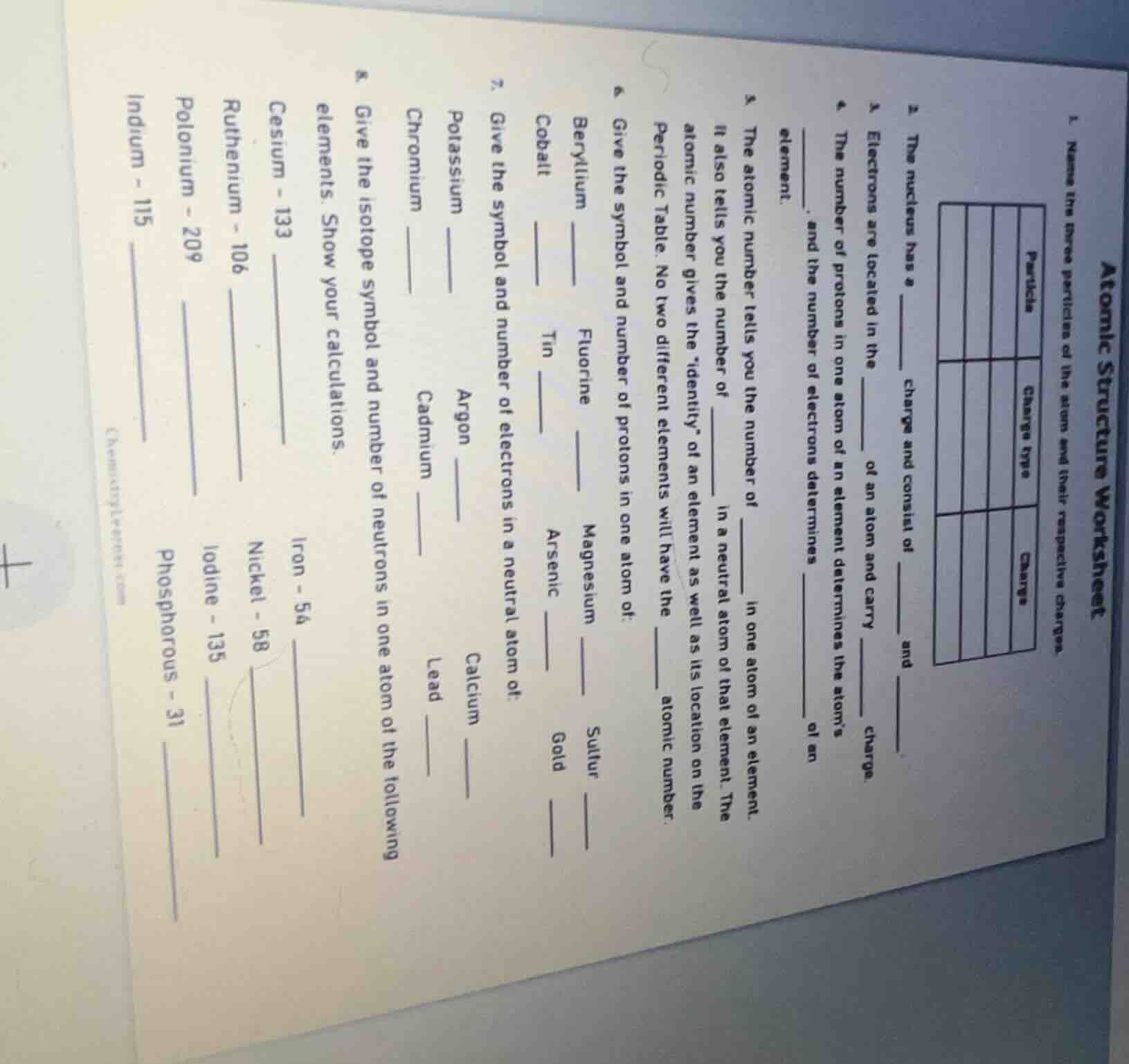
atomic structure worksheet
- name the three particles of the atom and their respective charges.
- the nucleus has a ____ charge and consist of __ and ____
a electrons are located in the ____ of an atom and carry ____ charge.
- the number of protons in one atom of an element determines the atom’s ____, and the number of electrons determines ____ of an element.
- the atomic number tells you the number of ______ in one atom of an element.
it also tells you the number of ______ in a neutral atom of that element. the
atomic number gives the “identity” of an element as well as its location on the
periodic table. no two different elements will have the ______ atomic number.
- give the symbol and number of protons in one atom of:
beryllium ______
fluorine ______
magnesium ______
sulfur ______
cobalt ______
tin ______
arsenic ______
gold ______
- give the symbol and number of electrons in a neutral atom of:
potassium ______
argon ______
calcium ______
chromium ______
cadmium ______
lead ______
- give the isotope symbol and number of neutrons in one atom of the following
elements. show your calculations.
cesium - 133 ______
iron - 54 ______
ruthenium - 106 ______
nickel - 58 ______
polonium - 209 ______
iodine - 135 ______
indium - 115 ______
phosphorous - 31 ______
chemistrylearner.com
Step1: Fill in atomic particle table
| Particle | Charge type | Charge |
|---|---|---|
| Neutron | Neutral | 0 |
| Electron | Negative | -1 |
Step2: Answer Q2 (nucleus properties)
The nucleus has a positive charge and consist of protons and neutrons.
Step3: Answer Q3 (electron location/charge)
Electrons are located in the electron cloud (or shells/orbitals) of an atom and carry a negative charge.
Step4: Answer Q4 (proton/electron roles)
The number of protons in one atom of an element determines the atom's atomic number, and the number of electrons determines electrical neutrality (or charge state) of an element.
Step5: Answer Q5 (atomic number definition)
The atomic number tells you the number of protons in one atom of an element. It also tells you the number of electrons in a neutral atom of that element. The atomic number gives the "identity" of an element as well as its location on the Periodic Table. No two different elements will have the same atomic number.
Step6: Answer Q6 (proton count from symbol)
Beryllium ($\text{Be}$): 4 protons
Fluorine ($\text{F}$): 9 protons
Magnesium ($\text{Mg}$): 12 protons
Sulfur ($\text{S}$): 16 protons
Cobalt ($\text{Co}$): 27 protons
Tin ($\text{Sn}$): 50 protons
Arsenic ($\text{As}$): 33 protons
Gold ($\text{Au}$): 79 protons
Step7: Answer Q7 (symbol + electron count)
Potassium ($\text{K}$): 19 electrons
Argon ($\text{Ar}$): 18 electrons
Calcium ($\text{Ca}$): 20 electrons
Chromium ($\text{Cr}$): 24 electrons
Cadmium ($\text{Cd}$): 48 electrons
Lead ($\text{Pb}$): 82 electrons
Step8: Calculate neutrons (mass - atomic #)
Cesium - 133: $133 - 55 = 78$ neutrons, symbol $\ce{^{133}_{55}Cs}$
Iron - 54: $54 - 26 = 28$ neutrons, symbol $\ce{^{54}_{26}Fe}$
Ruthenium - 106: $106 - 44 = 62$ neutrons, symbol $\ce{^{106}_{44}Ru}$
Nickel - 58: $58 - 28 = 30$ neutrons, symbol $\ce{^{58}_{28}Ni}$
Polonium - 209: $209 - 84 = 125$ neutrons, symbol $\ce{^{209}_{84}Po}$
Iodine - 135: $135 - 53 = 82$ neutrons, symbol $\ce{^{135}_{53}I}$
Indium - 115: $115 - 49 = 66$ neutrons, symbol $\ce{^{115}_{49}In}$
Phosphorous - 31: $31 - 15 = 16$ neutrons, symbol $\ce{^{31}_{15}P}$

Snap & solve any problem in the app
Get step-by-step solutions on Sovi AI
Photo-based solutions with guided steps
Explore more problems and detailed explanations
1.
| Particle | Charge type | Charge |
|---|---|---|
| Neutron | Neutral | 0 |
| Electron | Negative | -1 |
- positive; protons; neutrons
- electron cloud (shells/orbitals); negative
- atomic number; electrical neutrality (charge state)
- protons; electrons; same
- Beryllium: 4; Fluorine: 9; Magnesium: 12; Sulfur: 16; Cobalt: 27; Tin: 50; Arsenic: 33; Gold: 79
- Potassium ($\text{K}$): 19; Argon ($\text{Ar}$): 18; Calcium ($\text{Ca}$): 20; Chromium ($\text{Cr}$): 24; Cadmium ($\text{Cd}$): 48; Lead ($\text{Pb}$): 82
8.
- Cesium-133: $\ce{^{133}_{55}Cs}$, 78 neutrons
- Iron-54: $\ce{^{54}_{26}Fe}$, 28 neutrons
- Ruthenium-106: $\ce{^{106}_{44}Ru}$, 62 neutrons
- Nickel-58: $\ce{^{58}_{28}Ni}$, 30 neutrons
- Polonium-209: $\ce{^{209}_{84}Po}$, 125 neutrons
- Iodine-135: $\ce{^{135}_{53}I}$, 82 neutrons
- Indium-115: $\ce{^{115}_{49}In}$, 66 neutrons
- Phosphorous-31: $\ce{^{31}_{15}P}$, 16 neutrons