QUESTION IMAGE
Question
atoms, ions, & isotopes
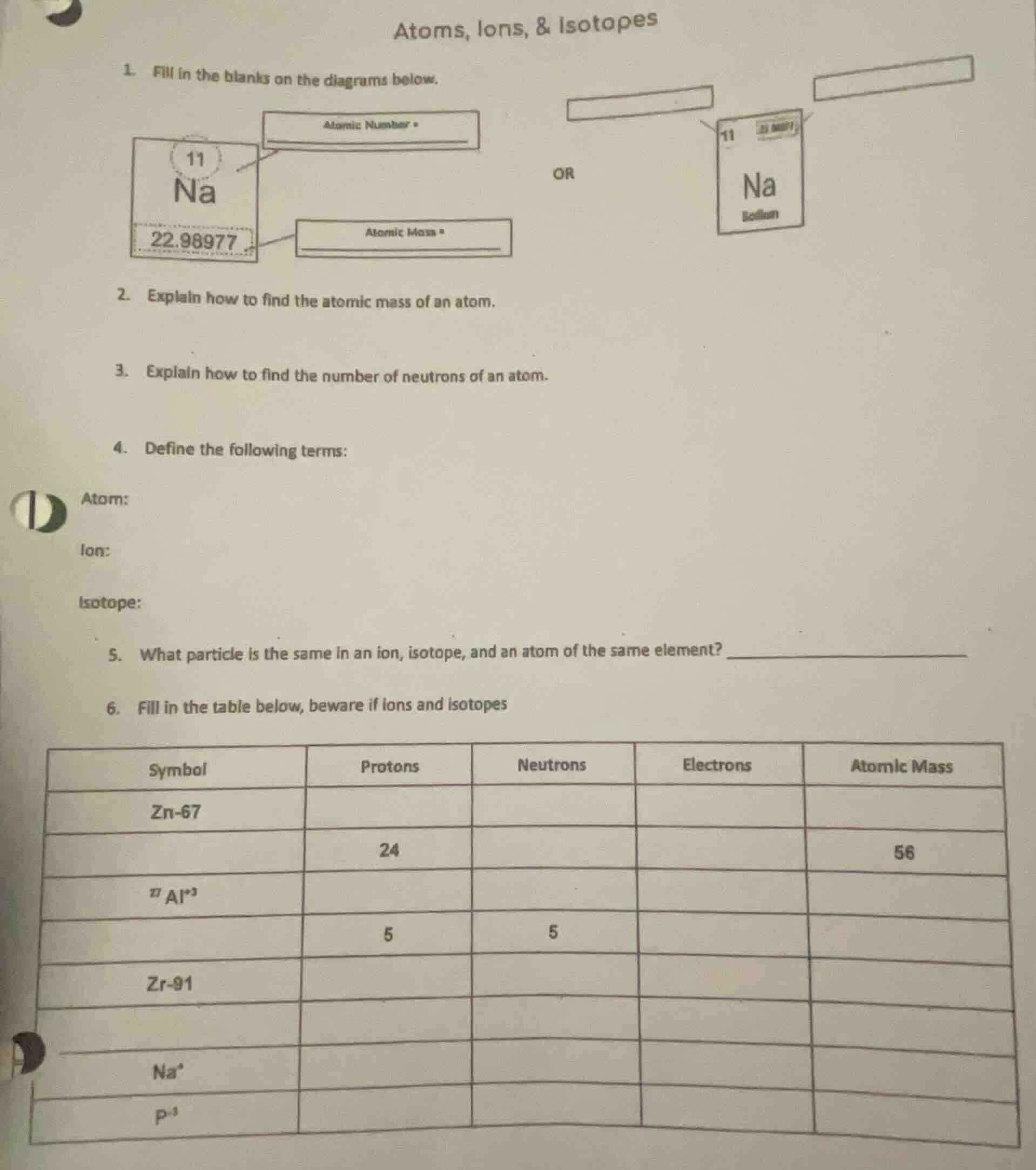
- fill in the blanks on the diagrams below.
- explain how to find the atomic mass of an atom.
- explain how to find the number of neutrons of an atom.
- define the following terms:
atom:
ion:
isotope:
- what particle is the same in an ion, isotope, and an atom of the same element?
- fill in the table below, beware if ions and isotopes
| symbol | protons | neutrons | electrons | atomic mass |
|---|---|---|---|---|
| 24 | 56 | |||
| $^{27}$al$^{+3}$ | ||||
| 5 | 5 | |||
| zr - 91 | ||||
| na$^+$ | ||||
| p$^{-3}$ |
Step1: Fill periodic table blanks
For left diagram:
Atomic Number = number of protons = $11$
Atomic Mass = weighted average mass = $22.98977$
For right diagram:
Top left box: Atomic Number = $11$
Top right box: Atomic Mass = $22.98977$
Step2: Explain atomic mass calculation
Atomic mass is the weighted average of the masses of all naturally occurring isotopes of an element. It is calculated by multiplying the mass of each isotope by its relative abundance (decimal form) and summing these products:
$$\text{Atomic Mass} = \sum (m_i \times a_i)$$
where $m_i$ = mass of isotope $i$, $a_i$ = abundance of isotope $i$
Step3: Explain neutron count calculation
Neutrons = Atomic Mass (rounded to nearest whole number, mass number) minus Atomic Number:
$$\text{Neutrons} = A - Z$$
where $A$ = mass number, $Z$ = atomic number
Step4: Define key terms
Atom: Neutral particle with equal protons/electrons.
Ion: Charged atom (gain/loss of electrons).
Isotope: Same protons, different neutrons.
Step5: Identify shared particle
Protons determine element identity, so they are the same in ion, isotope, atom of the same element.
Step6: Fill the table
Row 1 (Zn-67):
Zn atomic number $Z=30$, so protons=30. Neutrons = $67-30=37$. Neutral atom, electrons=30. Atomic mass=67.
Row 2 (24 protons, mass=56):
Element with $Z=24$ is Cr (chromium). Neutrons = $56-24=32$. Neutral atom, electrons=24. Symbol: Cr-56.
Row 3 ($^{27}\text{Al}^{+3}$):
Al atomic number $Z=13$, protons=13. Neutrons = $27-13=14$. +3 charge means 3 electrons lost: $13-3=10$ electrons. Atomic mass=27.
Row 4 (5 protons, 5 neutrons):
Element with $Z=5$ is B (boron). Mass number = $5+5=10$. Neutral atom, electrons=5. Symbol: B-10, atomic mass=10.
Row 5 (Zr-91):
Zr atomic number $Z=40$, protons=40. Neutrons = $91-40=51$. Neutral atom, electrons=40. Atomic mass=91.
Row 6 (Na⁺):
Na atomic number $Z=11$, protons=11. Mass number of most common isotope=23, neutrons=$23-11=12$. +1 charge means 1 electron lost: $11-1=10$ electrons. Atomic mass=23.
Row 7 (P⁻³):
P atomic number $Z=15$, protons=15. Mass number of most common isotope=31, neutrons=$31-15=16$. -3 charge means 3 electrons gained: $15+3=18$ electrons. Atomic mass=31.

Snap & solve any problem in the app
Get step-by-step solutions on Sovi AI
Photo-based solutions with guided steps
Explore more problems and detailed explanations
1.
Left diagram:
Atomic Number = $11$
Atomic Mass = $22.98977$
Right diagram:
Top left blank: $11$
Top right blank: $22.98977$
- Atomic mass is the weighted average of the masses of all naturally occurring isotopes of an element, calculated by summing the product of each isotope's mass and its relative abundance.
- The number of neutrons is found by subtracting the atomic number (number of protons) from the mass number (rounded atomic mass): $\text{Neutrons} = \text{Mass Number} - \text{Atomic Number}$
4.
Atom: The neutral basic unit of matter with equal numbers of protons and electrons.
Ion: A charged atom or molecule that has gained or lost one or more electrons.
Isotope: Atoms of the same element (same number of protons) that have different numbers of neutrons.
- Protons
6.
| Symbol | Protons | Neutrons | Electrons | Atomic Mass |
|---|---|---|---|---|
| Cr-56 | 24 | 32 | 24 | 56 |
| $^{27}\text{Al}^{+3}$ | 13 | 14 | 10 | 27 |
| B-10 | 5 | 5 | 5 | 10 |
| Zr-91 | 40 | 51 | 40 | 91 |
| Na⁺ | 11 | 12 | 10 | 23 |
| P⁻³ | 15 | 16 | 18 | 31 |